

Amazon KDP Problems
Find the right diagnostic path for a missing book, search mismatch, weak sales or disappearing reviews.
Start with the affected edition and an observed fact. A public symptom is not proof of an account restriction.
Start with the observed symptom
Availability, search matching, classification, sales reports, rank and review display are different systems. A book can be available but sell poorly; a missing review does not prove an account restriction.
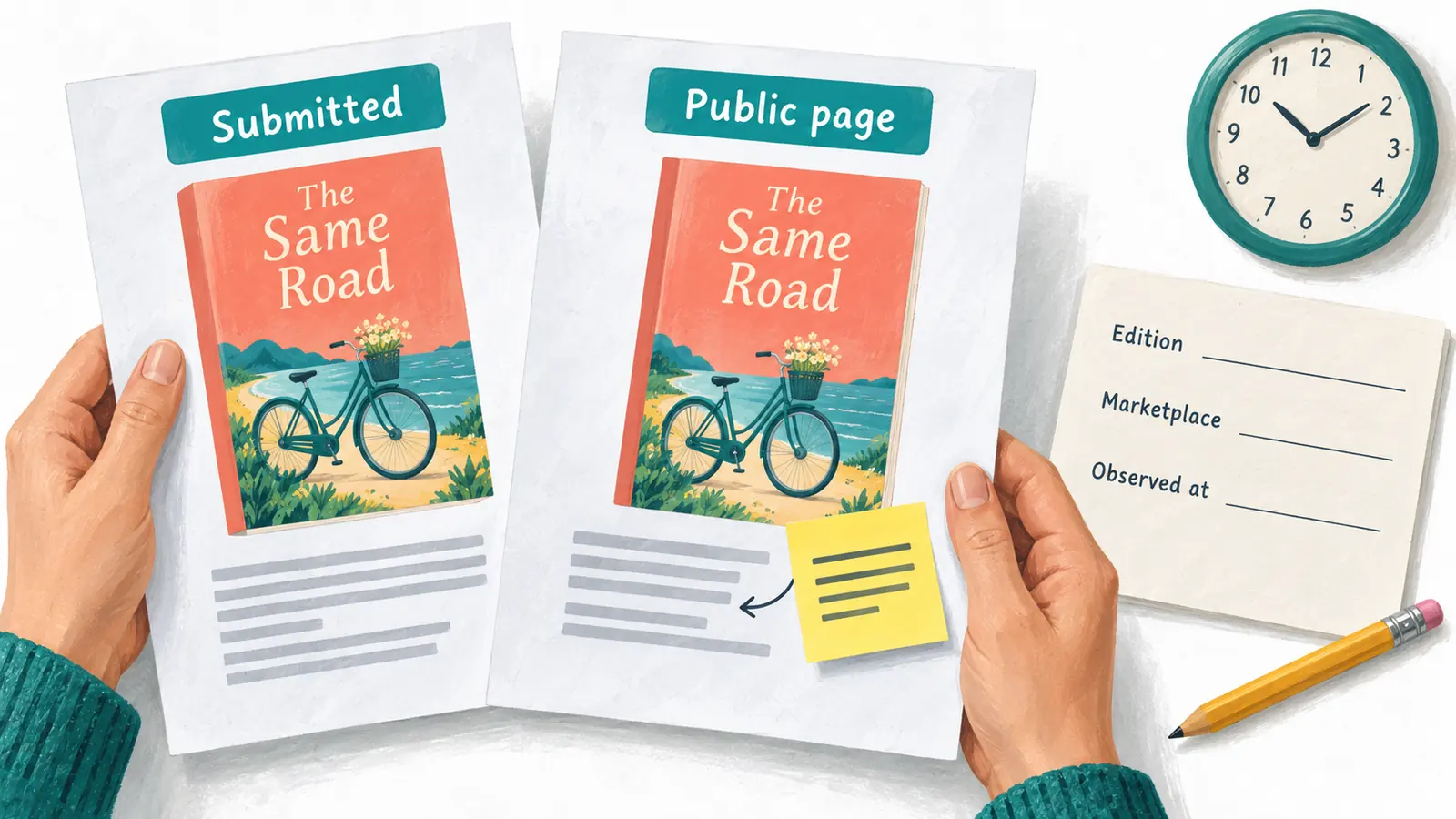
Describe what happened, where and to which edition. "The paperback page has no purchase option in this region" is a testable observation. An assumed enforcement reason is not.
Save the minimum useful evidence
Keep the edition identifier, format, marketplace, direct URL, actual result and timestamp with its time zone. Add the exact query, report filters, update history or review permalink when relevant.
Preserve both sides of a mismatch: submitted details and public page, or report filters and relevant order state. Label incomplete earlier records uncertain. Do not collect passwords, payment details or unrelated customer history.
Case note: affected edition; observed surface; expected and actual result; timestamp; last comparable record; submitted changes; unresolved question. Keep facts and hypotheses separate.
Choose the matching specialist guide
| Problem family | Guide | Decision it supports |
|---|---|---|
| Availability and search | Book not showing on Amazon | Identify the missing surface and correct destination |
| Availability and search | Previously available book disappeared | Preserve and investigate the before-and-after incident |
| Availability and search | Suspected indexing problem | Record scoped searches without private-index claims |
| Metadata and classification | Documented indexing repair | Correct an established mismatch and verify submission |
| Metadata and classification | Keywords not working | Audit descriptors against manuscript evidence |
| Metadata and classification | Category not showing | Separate selection, display and bestseller rank |
| Sales and measurement | No reported sales | Verify scope, timing, availability and actual exposure |
| Sales and measurement | Weak book sales | Prioritize a hypothesis from available evidence |
| Sales and measurement | Improve sales with a bounded plan | Connect one action with costs and a review point |
| Public signals and feedback | Book ranking dropped | Compare equivalent ranking observations |
| Public signals and feedback | Reviews disappeared | Check the record, context and appropriate contact route |
Investigate a broken destination before paying for promotion. Verify a zero report before judging demand. Compare equivalent rank records before rewriting metadata.
Use the clock for the actual operation
Saving, submitting, becoming Live and displaying an update are separate events. Use KDP Timelines for the operation and format, and the Orders Report reference for processing. Neither is a universal 72-hour rule.
Recheck a processing update at a recorded time; repair a broken outgoing link now; read an explicit notice immediately. Repeated speculative submissions make the original change harder to assess.
Protect the reader and the evidence
| Situation | Priority | Preserve before acting |
|---|---|---|
| Unavailable promoted destination | Contain new discretionary exposure and inspect the edition | URL, region, current message and last good observation |
| Misleading submitted promise | Make the permitted factual correction | Old wording, replacement and manuscript support |
| Explicit publishing or review notice | Read and follow its actual response process | Complete wording, identifiers and case history |
| Disappointing count without a verified defect | Clarify scope and select a bounded investigation | Comparable observations and missing evidence |
Do not repeatedly unpublish, create duplicate editions or coordinate transactions to investigate visibility. Make necessary factual corrections; label simultaneous changes as a combined intervention.
Respond to actual notices, not inferred restrictions
KDP's Book Status reference directs publishers with a Blocked title to its explanatory message. A blocked title is not synonymous with account termination, and rank or review changes establish neither.
For a concrete compliance question, use the policy audit, the rights inventory or the review-incentive audit. These inspect evidence; they do not reveal a private enforcement reason.
For account issues, distinguish a restriction, a termination notice and login or identity access. Use your trusted KDP route, retain correspondence and supply relevant truthful documents. Do not create another account or relabel a submission to bypass a restriction.
For review records, customer-review help identifies Amazon Community. Publishing support and review moderation are not interchangeable. This hub does not provide a reinstatement template or promise restoration.
Prepare a focused support case
State the affected record, expected and actual results, relevant dates, completed checks and remaining question. Ask about the concrete discrepancy, not a guaranteed position or disclosure of an algorithm.
Fictional summary: "These records concern the same paperback and marketplace. The submitted description differs from the public page after the documented update. Please clarify the remaining discrepancy." Remove unrelated personal information before sharing.
Do not impersonate a reader when investigating their review. Preserve the actual message rather than guessing a moderation reason.
Verify the affected surface and close the case
Recheck the original field, destination, report or review after the relevant event. Save the result and any support explanation. Availability in the checked region does not establish worldwide visibility or demand.
Leave an unresolved cause marked unknown. Once the edition is accurate and available, return to Discoverability or Book Marketing. For a wording-only task, use Keyword Research.
Sources and scope
Official KDP references checked: 15 October 2026. The case note and priorities are original teaching aids. No live account, listing or customer record was inspected; no restoration, ranking or sales outcome is guaranteed.
Frequently asked questions
Are all KDP problems indexing problems?
No. Availability, search matching, classification, reporting, rank and review display are different tasks. Begin with the actual affected surface.
What should I save before changing a listing?
Retain the identifier, format, marketplace, URL, current state and timestamp, plus the relevant query, report scope, update history or review record.
Does zero sales prove that something is broken?
No. Verify the report, timing, edition and actual exposure before diagnosing demand or a technical failure.
Is there one 72-hour rule for every KDP issue?
No. Publication, updates, report processing and review checks have different contexts. Use the current reference for the relevant operation and format.
Does a missing review or worse rank mean my account is terminated?
Not by itself. Preserve and follow an actual notice; a public symptom is not proof of an account-level decision.
When should I stop troubleshooting?
Verify the affected surface and record the bounded result or unresolved question. Return to the next publishing task instead of repeatedly changing unrelated fields.