

KDP Copyright Violation Risk: Check Rights Before Publishing
A rights request is not automatically a finding of infringement. Identify the material, edition and evidence actually involved.
Trace manuscript and artwork permissions, check format and territory boundaries, and prepare a focused response when documentation is requested.
Identify the rights question before assuming a copyright ban
A request to confirm publishing rights, a blocked edition and an account termination are not interchangeable. Start with the actual message and affected material. Record the book, format, territory, version and requested evidence. If you have only a missing retail page, investigate availability first rather than declaring that Amazon has found infringement.
KDP's Intellectual Property Rights FAQ requires the necessary publishing rights and describes possible book, account and royalty consequences when rights are absent. It does not make every documentation request a finding of infringement. The practical task is to establish what you may publish and provide the relevant evidence when requested.
Copyright ownership and publishing permission are different questions
Do not assume that every author must own every component outright. Identify the ownership or permission that actually covers each use. Conversely, a download receipt or a contractor invoice should not be treated as proof of unlimited publishing rights without examining the underlying terms. Where the agreement is unclear, obtain clarification or qualified advice before relying on it.
Inventory the materials in the final edition
Audit the exported book and cover, not only the manuscript folder. Include text, photographs, illustrations, maps, quotations, translations, fonts and any supplied exercises or templates. Identify where each material appears and whether it also appears in promotional images. A cover assembled by a contractor can contain several independently sourced elements.
| Material | Record to retain | Question to resolve |
|---|---|---|
| Original manuscript | Source versions and relevant agreements | Have any publishing rights been granted elsewhere? |
| Commissioned artwork | Agreement, delivered files and asset list | What uses and rights were actually granted? |
| Licensed image or font | Asset identifier and applicable license | Does the license cover the planned edition and use? |
| Quoted or translated material | Source and documented basis for use | Is the relevant permission or other basis established? |
Mark unknown provenance explicitly
If a designer cannot identify an image source, mark it unresolved. Do not invent an origin from visual similarity or assume that material from a search engine is available for commercial use. Ask for the actual asset identifier, source and license. Replace a disputed component only with material whose intended use you can support.
Keep the inventory compact enough to maintain. One row per meaningful asset, with a link to the relevant private document, is more useful than hundreds of unindexed screenshots. Do not publish full contracts or personal contact details as an attempt to demonstrate legitimacy.
A worked asset record
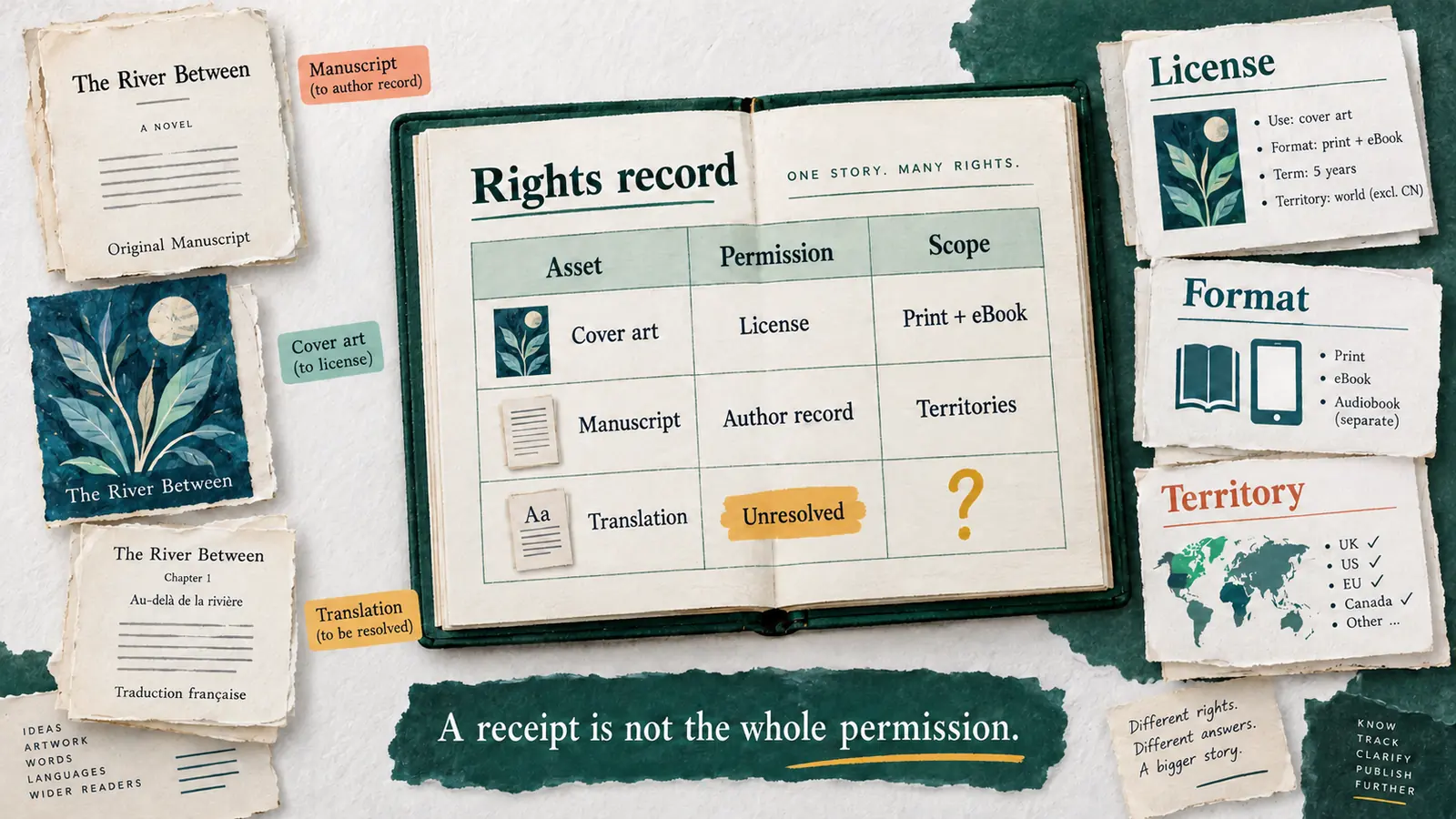
Fictional example: the cover image has a license covering print and eBook use, the manuscript has an author record, and a commissioned translation has no documented grant yet. Record these as three separate entries. An audiobook proposal needs its own scope check; the translation stays unresolved until its permission is established. Neither the cover invoice nor the manuscript record clears the other assets.
Read the scope instead of relying on the word commercial
For every permission, check the material, intended use, formats, language, territories, term and any restrictions that matter to the planned edition. Those are audit questions, not a universal list of rights every agreement grants. A license name such as "commercial" does not answer all of them.
Separate the book from its advertising assets
Check whether cover use, interior use and advertising use are treated the same way in the actual terms. A new format or translated edition may introduce a different question. Save the applicable license version and purchase record together so you can explain which terms you relied on, rather than linking only to a vendor page that may change.
For commissioned work, ask whether the creator used third-party components and what documentation accompanies them. Paying a fee does not tell you whether the deliverable is exclusive, transferable or usable in every medium. If the rights are ambiguous, resolve the agreement rather than asking KDP to interpret an incomplete commercial arrangement for you.
Make territory choices match the rights record
The eBook Distribution Rights guidance distinguishes worldwide from individual territory rights. Select the territories you actually hold. Do not choose worldwide merely because the publishing interface permits it or because your last unrelated book used that setting.
Check prior publication, reversion and format boundaries
A previously published book needs a clear account of the earlier arrangement. Locate the agreement and any relevant reversion, expiry or non-exclusive-rights record. Separate the format and territory you now intend to publish from those previously granted. Do not assume that an out-of-print retail page resolves a contract question.
The KDP rights FAQ gives examples of supporting documentation for prior publishers, formats and territories. It also says a copyright page alone is insufficient proof and that documents should be supplied when requested. Read the example matching your situation instead of sending every historical file preemptively.
A fictional boundary check
Fictional example: an author holds an agreement for one edition and wants to publish another. The audit identifies the planned format and territory, then locates the provisions covering them. If those provisions are unclear, the entry stays unresolved; the existence of a signed document is not treated as an answer by itself.
Keep correspondence explaining the actual rights situation with the agreement. Do not backdate a reversion letter or present an unsigned proposed contract as an executed permission. An accurate unresolved record is safer than a polished but unsupported claim.
Handle public-domain, quotation and generated-content questions separately
A work being old or available online does not settle whether your planned edition may use every component. KDP's Public Domain Content rules address eligibility, differentiation and proof. Public-domain status can vary by territory; assess the actual text, translation and added artwork rather than copying another publisher's label.
Do not turn attribution into a permission shortcut
A citation tells a reader where material came from; it does not, by itself, establish the right to reproduce it. There is no universal word count or percentage that this guide can declare safe for every quotation. The U.S. Copyright Office's fair-use explanation describes a case-specific assessment, not a fixed quotation allowance or a rule for every jurisdiction. Seek qualified legal advice when relying on an exception or responding to a contested claim.
Keep tool disclosure separate from rights analysis
AI disclosure does not establish permission to reproduce an existing work or guarantee copyright protection for an output. Retain the creation record and inspect the final asset. Use the general policy audit for KDP disclosure and metadata checks; this rights inventory does not resolve every question about generated material.
A modified image should not be marked cleared solely because it looks different. Record the actual source and basis for use. If you cannot support the planned use, resolve it before including the component in a new submission or campaign.
Respond to a rights-validation request with a focused packet
Read the notice for the named book, required evidence and response route. Preserve the original, case reference and dates. Match each submitted document to the question it answers. Explain the relevant asset, agreement or publication history without assuming that a file upload proves acceptance.
| Packet component | Purpose | Boundary |
|---|---|---|
| Notice reference | Identify the actual request and edition | Do not substitute another book's case |
| Short factual explanation | Connect the material to its rights basis | Do not invent permissions or admissions |
| Indexed supporting records | Locate the relevant provisions and files | Keep unrelated personal information private |
| Unresolved question | Ask about the specific remaining mismatch | Do not demand guaranteed approval |
Verify the stated outcome
Retain the reply and check the named edition or function. If a title is Blocked, follow the related email described in Book Status help. If the message concerns the whole account, use the termination response guide. A rights packet and an account appeal may overlap, but they are not automatically the same procedure.
Handle an actual infringement dispute without escalation by guesswork
If you receive a claim, preserve the message, affected identifiers and relevant source records. Get qualified advice about the actual allegation and your response obligations. Do not send threats, fabricate ownership evidence or make legal declarations you do not understand. Do not delete the original correspondence while replacing working files.
Report suspected copying through the appropriate channel
If you believe someone copied your work, the IP FAQ points to the reporting procedure for the relevant Amazon site. Identify the specific material and your basis for the report. A similar topic or an unfavorable review is not, by itself, a documented copying claim.
Keep review moderation separate: use the review-practices audit for campaign incentives. Neither a rights complaint nor a review report should be used as leverage to silence criticism. Record uncertain facts as uncertain and avoid public accusations that go beyond your evidence.
Maintain a rights record when the book changes
Recheck the inventory when adding artwork, translating, changing formats or using a new contractor. Keep final files connected to the permissions that apply to them. A clean audit of last year's cover does not clear the new cover's image or font automatically.
Close with a precise result
State which materials were checked, which uses were supported and which questions remain open. Do not label an account copyright-proof. Return to the KDP troubleshooting hub for separate availability or metadata problems once the rights task is resolved.
Use the KDP risks and account-safety guides to distinguish rights, review-policy and enforcement issues.
When distributing a permitted reader copy, keep the rights check separate from the reader's optional decision to review. Permission to share the file does not authorize a review incentive.
Sources and scope
Official references rechecked on 16 October 2026. The KDP rights FAQ was readable through the search index; its direct page returned an incomplete body. KDP Terms section 5.1.3 separately addresses requested rights documentation. The inventory and fictional records are organization aids, not legal advice. No private agreement was reviewed, and no infringement, payment or reinstatement outcome is predicted.
Frequently asked questions
Does a request for publishing-rights documents mean I have been banned?
Not by itself. Read the actual notice and distinguish a documentation request, a title restriction and an account decision.
Does a copyright page prove I hold publishing rights?
KDP's IP FAQ says a copyright page alone is insufficient proof. Provide the relevant supporting records when requested.
Must I own every image outright?
Identify the ownership or permission that actually covers the planned use. Do not assume a purchase receipt grants unlimited rights; seek clarification or legal advice where needed.
Is freely available online material automatically usable in my book?
No. Availability is not a documented basis for the intended use. Check the source, relevant rights and applicable KDP requirements.
Is there a universal safe word count for quotations?
This guide cannot declare a universal safe amount. Exceptions and permissions depend on the material and applicable law; get qualified advice for uncertain uses.
What should I send in a rights response?
Follow the actual request. Identify the book and material, explain the relevant facts and index supporting records without unrelated personal information or fabricated permissions.