

ARC Book Reviews on Amazon: From Reading Copy to Reader Choice
An advance copy creates an opportunity to read. It does not buy an opinion, reserve a rating or guarantee a public contribution.
Make the version and destination clear, support access and keep the decision to share independent of benefits and completion rules.
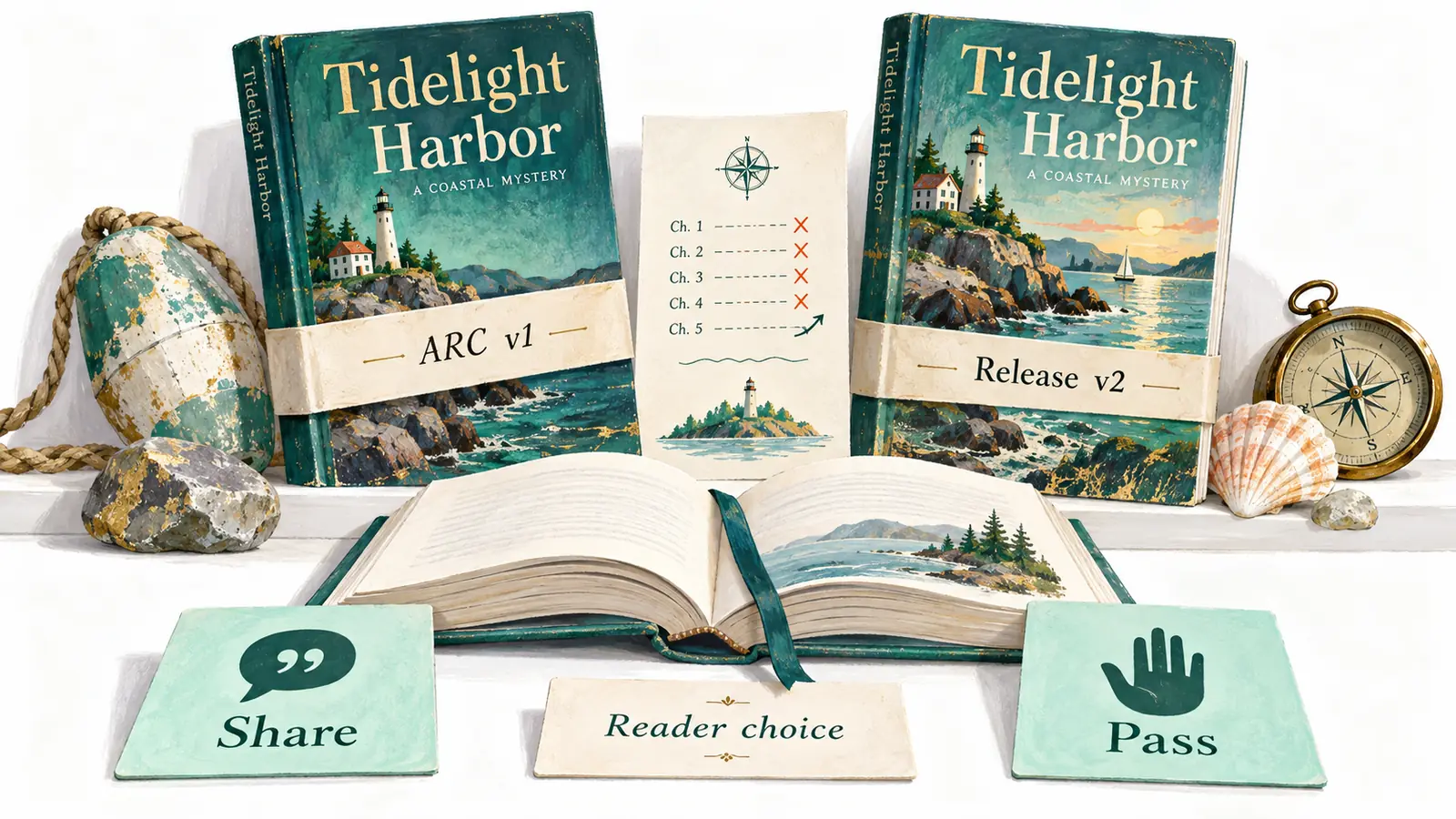
ARC book reviews on Amazon: the copy and the contribution are separate
An advance reader copy gives someone access to a book before or around release. It does not purchase their opinion, reserve a star rating or create a guaranteed Amazon contribution. This guide focuses on the handoff between receiving that copy and deciding independently whether to discuss the reading experience publicly.
KDP's customer-review guidance permits free or discounted book copies without requiring or influencing a review. Additional incentives invalidate reviews. That limited boundary is not blanket approval of every service called an ARC program.
Use the right guide for the job
For recruiting and administering a group, use the ARC team workflow. If the manuscript needs diagnosis before it is ready for ordinary readers, scope private beta feedback separately. Do not ask someone to perform unpaid editorial work and publish an endorsement as though those were one task.
Make it clear which version the person received
Give the copy a recognizable edition or version date in your delivery record. Explain material differences from the planned retail edition, such as missing illustrations, unfinished exercises or a changed chapter order. An early file with substantial gaps creates a different reading experience from a finished release copy.
Test the actual file on the formats you claim to support. Open navigation, inspect small text and check images rather than assuming a successful download means the book works. If the person requested a different supported format, address that access problem before sending any release announcement.
Do not hide the copy's limitations
A useful delivery note states the book, format, version and support route. It can explain that minor proofreading changes are expected without promising that every substantive issue will be fixed. Do not label an untested draft final merely to make a review invitation sound more credible.
Check where a response can actually appear
An Amazon product page, a reading platform, a private email and an editorial assessment are different destinations. Availability of the book file does not establish that each destination accepts a public contribution at that moment. Check the intended edition and store instead of assuming that an ebook preorder behaves like every other release format.
Use the prelaunch destination guide for release-format planning. If the retail page is unavailable, a factual availability update later is more useful than instructions to post on an unrelated product or use another account.
| Destination | Appropriate question | Do not assume |
|---|---|---|
| Amazon edition page | Is this the correct available edition and store? | A live page guarantees submission or display |
| Reading community | What do its current posting rules permit? | Permission there authorizes posting elsewhere |
| Private feedback | What separate question did the reader agree to answer? | A private answer may be republished automatically |
| Editorial coverage | What assessment and reuse rights were commissioned? | The assessment is an ordinary shopper review |
Remove obligations from the participant experience
Read the offer from the recipient's perspective. Can they stop reading, decline public posting or give an unfavorable opinion without losing a review-linked benefit? Inspect reminders, priority access, credits and completion screens together. A friendly invitation cannot cancel a contradictory rule elsewhere.
Watch for hidden completion gates
A required review URL or screenshot can turn an apparently optional activity into a posting task. So can an early benefit that is reclaimed when a public review does not appear. For an existing process with those dependencies, follow the replacement checklist before presenting the copy as unconditional.
Avoid sorting readers by promised praise. Genre fit and supported format are useful selection criteria; a commitment to five stars is not. Do not offer repeat access only to people whose opinions support the desired marketing message. Keep any separate private task's acceptance criteria about the work, not the sentiment.
Let a reader describe what they actually experienced
If someone independently chooses to write, their words and observations should be their own. Do not supply a finished review, a required opening sentence or a list of promotional claims to repeat. Explaining the correct book link is different from scripting an endorsement.
Scope matters more than polished praise
A reader might discuss pacing, clarity or whether an exercise was usable. They should not claim to have tested a method they never tried or finished material they did not read. Do not ask them to copy a private report into a public form merely to satisfy your dashboard.
For applicable disclosure questions, use the legal and platform checks guide. It distinguishes explaining a connection from obtaining permission for an otherwise prohibited arrangement. Do not promise that one standard sentence makes every campaign acceptable.
Fictional delivery wording: "This is the release-candidate EPUB dated 12 October. A short appendix is still being proofread. There is no public-review obligation. If you discuss the book, describe your own experience and the version you read where relevant. Contact us if the file does not open."
Handle version changes without requesting a revised verdict
If you replace a file, explain what changed and whether the reader needs a new download. A corrected navigation link differs from a rewritten ending. Keep both versions in your internal record so support can identify which file caused the problem.
Do not ask a reader to erase criticism because the retail book now differs. They can make their own decisions within the destination's rules. Your role is to state the factual change, not to turn an update into a request for a higher score.
A worked version-and-destination record
Fictional example: the reader received Tidelight Harbor as ARC v1. Release v2 repairs chapter navigation and includes the finished appendix. The organizer records those two changes, retests the EPUB and checks the intended Kindle edition's live store page. The release note identifies the optional replacement file and the edition link; it does not ask the reader to repeat their private feedback publicly.
If the destination has no usable review control, record that observation and stop. Do not promise that a preorder, an available paperback or a different marketplace guarantees the same review access. If the reader declines the new file or stops reading, close their delivery/contact task without inventing completion or withdrawing a review-linked benefit.
Unfinished reading is not necessarily a delivery failure
A reader may stop because of time, subject fit or their own preference. If they mention an actual file fault, investigate it. Otherwise, do not invent a defect or penalize them for declining. If you need systematic manuscript feedback, commission that separate output instead of treating every ARC recipient as an editor.
| Reader situation | Organizer action | Boundary |
|---|---|---|
| File will not open | Provide support for the promised format | No review proof required to receive help |
| Reader stops halfway | Respect the decision and contact preference | No invented claim of completion |
| Substantial edition change | Describe the version difference factually | No demand to improve a verdict |
| Public submission is restricted | Retain any voluntarily shared message | No alternate-account or replacement-review task |
Separate reading support from review publication
For an explanation of possible display changes and what they do not prove, see why reviews disappear. Use the review guide map when the task is outreach, conditions or service choice instead.
A successful delivery, a reported submission and a visible contribution are distinct observations. Use the timing guide when someone reports submitting but publication is unconfirmed. If a review was previously observed and later disappeared, use the missing-review workflow.
Do not convert uncertainty into an accusation
An absent contribution does not prove the recipient failed to read. A missing purchase badge does not prove their experience was fabricated; the badge explanation separates that question. Never request shopping-account credentials to investigate either symptom.
Support conversations can remain private and minimal. Keep the actual problem, edition and contact preference, not an unrelated order history. If the affected customer wants account-specific clarification, let them use the official route themselves rather than having the organizer impersonate them.
Close the handoff with an accurate description of the work
Record copies requested, working access provided, unresolved support issues and agreed communications completed. Those are useful operational outcomes even when no public review results. Do not describe a distribution invoice as payment for a certain number of endorsements.
Before uploading to a service, check your rights and any exclusivity or distribution commitments separately. A review-copy boundary is not a license to distribute every edition through every channel. The service comparison helps distinguish discovery, distribution and editorial assessment.
For the recruitment stage, use the no-paid-placement reader plan. If requests or responses are scarce, use the reader-path diagnostic to separate exposure, file access, reading and public display rather than treating them as one missing task.
Leave room for a real launch without a quota
Prepare a usable description and sample that do not depend on promised praise. Send only agreed factual updates, honor declines and preserve the version record. The aim of this handoff is an understandable book offer and genuine reader choice, not a guaranteed review date, rating or permanent display.
Sources and scope
KDP's official customer-review reference checked on 16 October 2026. Direct retrieval of its linked Community Guidelines returned a 503 response. The illustration, version record, destination matrix, exception cases and fictional wording are original practical aids, not an official Amazon workflow or approval of any named ARC service.
Frequently asked questions
Does receiving an ARC require an Amazon review?
Do not make a public review the price of a reading copy. Inspect the entire offer, including benefits, reminders and completion rules.
Is an ARC program automatically approved because it is voluntary?
No. A label does not establish the actual conditions, independence or destination requirements. Do not claim blanket approval.
Should an ARC be treated as beta reading?
Private manuscript diagnosis and access to a release copy are different tasks. Scope any private feedback separately.
What should happen when the retail book differs from the ARC?
Explain material version differences factually. Do not demand that the reader erase criticism or change a verdict.
Can an author provide a finished review for ARC readers to paste?
Do not script a shopper endorsement. Anyone choosing to contribute should describe their own actual experience.
What if an ARC reader cannot submit on Amazon?
Do not require another account or a replacement review. Keep access support separate from the customer's publication question.