

Amazon Fake Review Risk: Audit the Incentive, Not the Label
Reading the book and writing an honest opinion do not remove a reward condition attached to public reviewing.
Inspect the participant workflow, preserve reader independence and handle actual notices without guessing private moderation reasons.
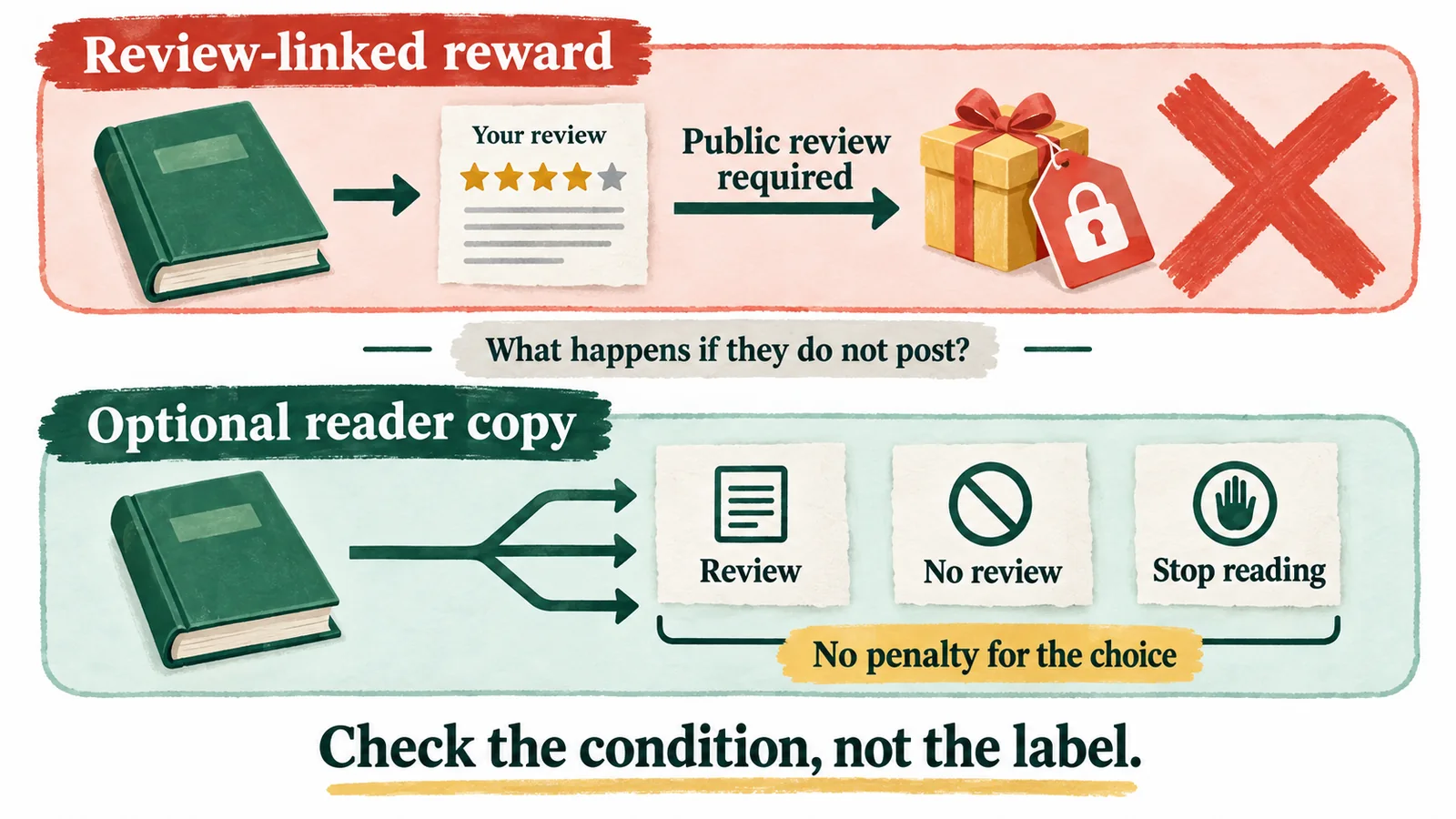
Audit the review mechanism, not a promise that it is honest
A reader can genuinely read a book and still participate in a problematic review arrangement. Start with the actual conditions: what the participant receives, what they must do and what happens if they decline to publish. The phrase "honest review" does not answer those questions. Nor does a campaign's claim that every participant bought the book.
This guide audits practices, not individual accounts. A missing review or a rejected submission does not prove a particular author purchased reviews. Separate the campaign terms you can inspect from a private moderation reason you cannot know. For missing-review evidence, use the review investigation guide; for broader publishing checks, use the KDP policy audit.
Begin with the no-review outcome
Ask a simple question: can a participant decline a public rating or review without losing a promised benefit? Trace that path in the actual rules and messages, not just the welcome page. If the answer changes after an assignment is accepted, the later conditions belong in the audit too.
Understand the published boundaries before designing a campaign
KDP's Customer Reviews help permits free or discounted book copies without a required or influenced review, and distinguishes additional compensation. Amazon's trusted-review explanation identifies financial-interest reviews, close personal relationships, monetary rewards and reciprocal positive reviews as prohibited examples.
| Arrangement | Decisive question | Practical boundary |
|---|---|---|
| Optional advance copy | Is public reviewing genuinely optional and uninfluenced? | Keep the copy separate from a review obligation |
| Reward released after a review link | Does public posting unlock the benefit? | Do not use a review as the payment condition |
| Author-to-author review swap | Is one review promised in return for another? | Do not organize reciprocal review obligations |
| Rating submitted to satisfy a campaign | Does the benefit depend on the public star rating? | A star-only task is still a review-system task |
A purchase badge is not a policy exemption
Amazon explains Verified Purchase as a purchase-related badge, not approval of every surrounding arrangement. Do not present reimbursement, a campaign reward or a reciprocal obligation as acceptable simply because the participant paid at checkout. Keep proof of a transaction separate from the conditions attached to a public contribution.
Trace money, points, credits and loss conditions
List every benefit in the workflow: money, a refund, service credits, access, discounts or future participation. Then identify the event that grants or preserves it. Do not stop at the moment of enrollment; inspect submission, validation, timeout, rejection and cancellation. A benefit awarded earlier but clawed back for not posting can still be contingent on posting.
Evaluate substance rather than renaming the reward
Practical application: calling compensation "points," "reader credit" or a "reading bonus" does not make a public-review condition independent. Ask what those units buy, when they can be retained and whether review proof controls the outcome. This is a workflow test, not a claim that Amazon has examined a specific points system.
Also inspect rating conditions. A campaign that says any opinion is welcome but rejects a low rating has conflicting rules. A screenshot requirement may be an operational record, but if it determines whether a review-linked benefit is kept, the incentive condition needs to be addressed. Removing the screenshot while retaining the obligation does not solve that problem.
Document the decline path
Walk through a participant who reads but chooses not to post. Record messages, eligibility changes and benefit changes. Compare the stated terms with what actually happens. Do not instruct readers to use another identity or device to make a prohibited arrangement harder to associate with the campaign.
Inspect a review service before purchasing or recommending it
Request the participant-facing instructions, not only a publisher-facing sales page. Ask how readers are recruited, what they receive, how reviews are checked and what happens when they do not post. Keep a dated copy of the actual terms. A seller's statement that it is compliant is not independent evidence of compliance.
| Question | Evidence to inspect | Decision implication |
|---|---|---|
| What happens without a public review? | Completion and cancellation rules | Look for benefit retention tied to posting |
| Can the reader choose any opinion? | Approval criteria and reminder messages | Reject rating control and scripted praise |
| What does the publisher buy? | Contract, invoice and delivery promise | Do not buy a guaranteed public-review count |
| Who writes or edits the contribution? | Participant workflow and examples | Preserve the reader's independent authorship |
Do not substitute technical concealment for a compliant process
Referrer stripping, different reviewer names or spacing out submissions do not remove a reward condition. A browser extension may assist with a technical task, but it cannot authorize a review arrangement. Reject claims that a service is safe because its activity is difficult to detect; that answers the wrong question.
If the provider will not show the actual rules, do not infer that missing evidence is favorable. Pause the purchase or recommendation while the mechanics remain unknown. This is especially important when a marketing package mixes reader discovery with review delivery under one fee.
Separate private reading feedback from public-review obligations
Private editorial feedback is a different deliverable from a public customer review. If you commission private reading notes, make that scope explicit and do not require a public rating as an extra step. Do not relabel the same review-linked reward as payment for reading while keeping the public contribution necessary in practice.
Make the alternative operational, not cosmetic
Define what the private assignment asks for, where it is submitted and how its completion is assessed without using a public-review URL or star rating. Do not funnel paid participants into public reviews as a hidden completion expectation. A separate private-feedback scope is not blanket permission for those participants to post Amazon reviews; applicable review rules still matter.
For an optional advance-reader program, use the ARC team workflow. Preserve the reader's decision whether to comment publicly and do not demand positive sentiment. For permissions involving manuscript material supplied to readers, use the rights inventory; review independence and permission to distribute are separate checks.
Review an existing campaign before sending another reminder
Preserve the current terms, reminders and reward rules privately. Stop review-contingent incentives and rating-control instructions rather than sending more participants through the same workflow. Identify scheduled messages and contractor instructions that still contain the old condition. Do not erase records needed to understand what occurred.
A fictional correction with a meaningful limit
Fictional case: a campaign calls its task reading feedback, but the benefit is removed unless a public-review link is submitted. The audit records that dependency and stops it. Changing the button label is not counted as a correction. Any genuinely private-feedback activity is separately defined without a public-review obligation.
Record the date, scope and verification of the change. Do not ask readers to rewrite old reviews to conceal the arrangement, offer rewards for removing criticism or claim that a new policy automatically cures earlier conduct. If an actual notice requires a response, describe the facts and completed changes truthfully.
Handle a missing review or notice without inventing the cause
The KDP review help directs review matters to Amazon Community. Record the contribution's identifier, relevant message and actual status. Do not impersonate the reader, demand account credentials or insist that a real purchase guarantees review eligibility.
Match the response to the affected system
A reviewer posting restriction, a removed contribution and a KDP account decision are different outcomes. Follow the genuine message for each. Use account-restriction triage when the publishing account is affected, not as a substitute for a reader's own support contact.
Keep the response tied to the stated concern
For an actual notice, retain its wording and case reference, identify the campaign terms in force at the time, and list verified changes with dates. Separate what the message states from what you infer. Use its response instructions; do not submit a generic confession or claim that ending one condition guarantees restoration. An absent review without a notice is not an account appeal.
When reporting suspected abuse, identify the specific observed behavior through the appropriate reporting channel. An unfavorable opinion or a burst of genuine reader interest is not proof of paid manipulation. Do not promise removal, disclosure of private investigation findings or restoration within a fixed number of days.
Build a release safeguard around reader independence
For the next campaign, use the rule-family reference and optional outreach workflow rather than treating the incentive audit as an invitation template. The KDP risks guide map connects these with rights and account-response tasks.
Before the next campaign, assign someone to inspect the invitation, participant terms, no-review path and provider contract together. Recheck them when a reward rule, subscription plan or validation step changes. A compliant-looking email can coexist with conflicting completion rules elsewhere in the product.
Measure delivery without purchasing an opinion
Track permissioned reader reach, copies delivered and genuinely private feedback where applicable. Do not make a public-review count or target star rating the promised deliverable. Close the audit with the mechanics checked and unresolved questions, not a claim that the account is immune to moderation.
Return to the KDP troubleshooting hub for independent listing or sales questions. A slow launch does not justify introducing a review obligation, and a campaign audit does not reveal Amazon's private reason for every missing review.
Sources and scope
Official KDP and Amazon references rechecked on 16 October 2026. Direct Community Guidelines retrieval was unavailable; KDP Customer Reviews and Amazon's accessible trusted-review explanation support the stated boundaries. Tables and examples are original practical applications, not a finding about a private account or service. No moderation outcome or ban probability is predicted.
Frequently asked questions
Does a Verified Purchase badge make a rewarded review acceptable?
No. A purchase-related badge does not authorize the conditions surrounding a review. Audit any incentive or reciprocal obligation separately.
Are points different from money when they depend on a public review?
Assess what the points provide and when they are retained. Renaming a review-linked benefit does not remove its dependency on posting.
What if a reward is granted before the review but removed without proof?
The benefit can still depend on public posting. Inspect the completion, timeout and cancellation rules, not only the initial grant.
Can an advance copy be offered without a required review?
KDP distinguishes a free or discounted book copy with no required or influenced review from compensation arrangements. Preserve the reader's genuine choice.
Can I rename a public-review task as private reading feedback?
A new label is not a new workflow. Private feedback must be genuinely separate, without a public-review completion condition; applicable review rules still matter.
Does a missing review prove paid manipulation?
No. Record the actual status and message, and use the appropriate support route. Do not infer a private moderation reason from a missing contribution alone.