

Amazon KDP Account Suspended: Identify the Restriction
A failed login, a blocked book and an account restriction require different responses. Start with the actual message.
Use a practical triage process to document scope, gather relevant evidence and verify the result without bypassing restrictions.
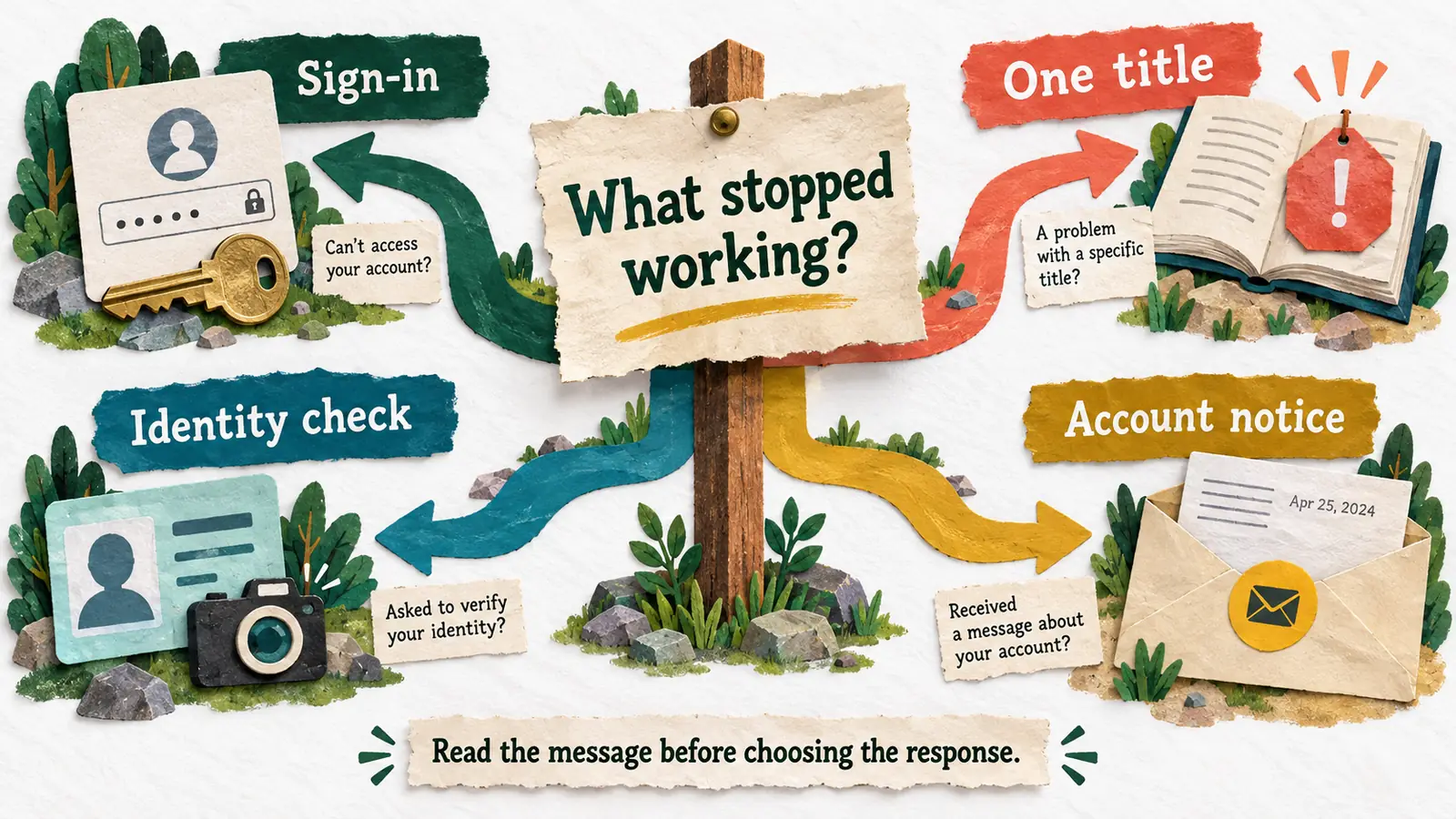
Identify the actual state before calling it a suspended KDP account
"My KDP account is suspended" can describe several different experiences: a failed sign-in, an unavailable publishing function, a blocked book or an explicit account notice. Start with the exact wording Amazon shows you. A generic browser error or missing retail page is not enough to establish account enforcement, and the word suspension does not establish a temporary duration or automatic recovery.
Write one sentence describing the observable problem without guessing its cause. For example, record whether you can reach Bookshelf, open Your Account, edit an affected edition or submit a publishing change. Keep that observation separate from the explanation in any email. If the notice expressly says termination, use the KDP termination response guide rather than treating it as an ordinary login fault.
Choose the procedure that matches the message
| Observed symptom | First check | Appropriate next path |
|---|---|---|
| Password rejected or security code unavailable | Correct publishing login and exact error | Sign-in or two-step recovery |
| Identity verification requested | Banner and due date in the correct account | Official verification workflow |
| One title marked Blocked | Affected edition and related email | Title-specific support correspondence |
| Account-level restriction or termination notice | Full notice, scope and requested action | Response or appeal route stated there |
Preserve the complete notice and verify the channel
Save the original email, its date, subject and case reference, plus a screenshot of any account banner. A cropped sentence may omit an affected title, requested document or deadline. Keep the full original privately; make a redacted copy for an adviser if needed. Public posts should not expose identity documents, addresses, access codes, private correspondence or payment details.
Open KDP through a trusted bookmark or by entering its address yourself. The official account security and scam guidance explains how to verify doubtful messages and contact support. A familiar logo or urgent subject line does not authenticate an email. Do not send credentials to a person claiming they can unlock the account.
Keep the required action visible
Extract three items into a private task note: what Amazon says is affected, what it asks you to do and when it asks you to do it. If any item is absent, mark it unknown. Do not replace missing instructions with a forum deadline or a consultant's generic script.
Map the restriction without inventing an account-wide cause
KDP's Book Status reference treats Blocked as a title status and directs you to the related email. That is a different observation from an account termination notice. Likewise, a retail link that stops opening needs an edition-availability investigation; the link alone cannot explain account health.
Requested identity verification can restrict publishing features until completed. Check the correct account for the banner and follow its due date. The presence of that request is not, by itself, evidence that a particular manuscript violated a content rule.
If an email requests identity verification but the banner is absent, first check that you opened the correct publishing account. Do not upload documents to an unsolicited message or treat a missing banner as a successful verification result. Keep the requested identity task separate from any book-specific notice.
Record only the checks you can safely perform
List accessible surfaces and affected identifiers once. Do not repeatedly attempt blocked actions, create duplicate editions or change unrelated metadata to see whether the restriction disappears. If access is unavailable, say so. A clean record of an unavailable check is more useful than an invented conclusion about everything behind the login.
Gather evidence that answers the stated concern
If the message identifies a publishing-rule concern, use the policy audit to choose the relevant evidence. A rights inventory and a review-incentive audit answer different questions; neither is a shortcut to predicting the account decision.
Build a small evidence index rather than sending your entire publishing archive. Match each attachment to a question raised in the notice. For a rights question, identify the particular manuscript, cover element or license involved; for an account-detail mismatch, identify the field and genuine correction route. These are organization examples, not a claim that every restriction has either cause.
| Record | What it establishes | Limit to acknowledge |
|---|---|---|
| Original notice and case history | Stated concern, scope and instructions | Does not reveal every internal check |
| Dated source file or relevant agreement | Version or permission being discussed | Must cover the actual material and use |
| Correction record | What changed and when | A correction is not proof of acceptance |
| Reproduction note or screenshot | Observed function and error | Only proves the recorded context |
Preserve originals and identify versions
Use meaningful attachment names and retain unedited originals. Explain whether a file is the submitted version, an earlier draft or a proposed revision. Do not backdate permissions, alter a notice or describe a purchased asset as your own original work. Where evidence is incomplete, state the missing piece and ask a focused clarification question.
Write a response that separates facts, corrections and questions
Follow the genuine notice's response instructions. Refer to its case identifier, summarize the affected record, address the stated concern and point to relevant evidence. Keep the main message readable without opening every attachment. If you made a necessary correction, explain the precise change; if you dispute an apparent mismatch, explain the factual basis without inventing an admission.
Use a case-specific structure
- Identify the notice and the affected account function or book.
- State the relevant facts you can document.
- Explain completed corrections, if any, and their dates.
- Index only the evidence needed for those facts.
- Ask the unresolved question or request the review described in the notice.
Do not claim that wording alone guarantees reinstatement. A long apology disconnected from the issue is not evidence; neither is a threat or a claim that other publishers do the same thing. For practical access steps, use the recovery workflow. It distinguishes authentication from an enforcement response.
Limit avoidable disruption while the case is unresolved
Review scheduled promotions and reader-facing links against the destinations you can actually verify. Pause spending that points to an unavailable offer when appropriate. Tell collaborators which files or campaigns should remain unchanged, and keep dated copies of current work. These are business-continuity precautions, not a prediction that Amazon will remove every edition.
Do not attempt a replacement-account workaround
The KDP Terms, section 4.2, prohibit a new account after termination. Do not buy an account, borrow another publisher's login or change identity to bypass enforcement. If the scope of a restriction is unclear, seek clarification rather than testing a workaround.
Track submissions and replies in one chronology. Avoid sending multiple conflicting versions through unrelated channels. Follow any stated response window; where no window is given, do not publish a made-up 24-hour or seven-day reinstatement promise. Record outstanding questions and new evidence so a follow-up adds information.
Use a fictional triage example to choose the next task
An author sees that a publishing action is unavailable and assumes the account has been banned. The private check finds an identity-verification banner but no termination notice. The next task is therefore the requested verification in the correct account, not a manuscript appeal or a new publisher registration. The author records the due date and submission result without calling an upload receipt approval.
Fictional case note: "The recorded account shows an identity request. Publishing submission is unavailable. No termination message was found in the checked correspondence. Next action: complete the requested official process and retain its result."
If the next genuine message instead announces termination, reclassify the case and follow that message. Triage is a method for selecting the current action, not a permanent diagnosis. A different notice can change the workflow without proving the earlier observation was dishonest.
Verify the particular outcome before resuming normal activity
When a response arrives, retain it and recheck the function originally affected. Can you access the correct Bookshelf? Has the requested verification state changed? Is the named edition editable or available? Keep those outcomes distinct. A working login does not prove a publishing restriction is lifted, and a live retail page does not prove every account action is enabled.
Close with a bounded result
Write what is resolved and what remains open, then restore only the activity supported by that result. If the answer is still unclear, ask about the specific remaining mismatch with the case reference. Return to the KDP troubleshooting hub for separate listing, metadata, sales or review symptoms rather than treating every later fluctuation as another suspension.
Sources and scope
Official KDP references rechecked on 16 October 2026. The triage method, evidence index and example are original teaching aids. No private account or enforcement notice was inspected. This is operational guidance, not legal advice or a guarantee of access restoration; current notices and applicable terms govern the actual case.
Frequently asked questions
Does a failed KDP login mean my account is suspended?
Not by itself. Record the exact sign-in error and check the correct publishing login before assuming an account-level decision.
Is a Blocked book the same as a terminated account?
No. Blocked is a title status. Use the associated book email and distinguish it from any separate account-level notice.
Is every KDP suspension temporary?
Do not assume a duration or automatic recovery. The actual notice, requested action and subsequent decision determine the next steps.
What should I retain before responding?
Keep the original notice, case reference, dates, affected identifiers and relevant evidence. Separate facts, completed corrections and unresolved questions.
Should I create a replacement publishing account?
No. Do not use a replacement account or another person's identity to bypass enforcement. Resolve the original case through its genuine channel.
What proves a restriction is resolved?
Check the originally affected function and any named editions. A successful login alone does not prove that publishing permission has been restored.