

Amazon Book Reviews Disappeared: Check What Changed
A missing written review, changed rating count and submission restriction need different checks.
Preserve the record, use the appropriate contact route and keep review-copy communication independent.
Name the review surface that changed
When an Amazon book review disappears, begin with the exact item or display you can no longer find. A missing written review, a changed rating count, a different displayed average and a review-submission restriction are not the same symptom. Each needs a different comparison. Do not start from the assumption that the author, the reader or the publishing account has been penalized.
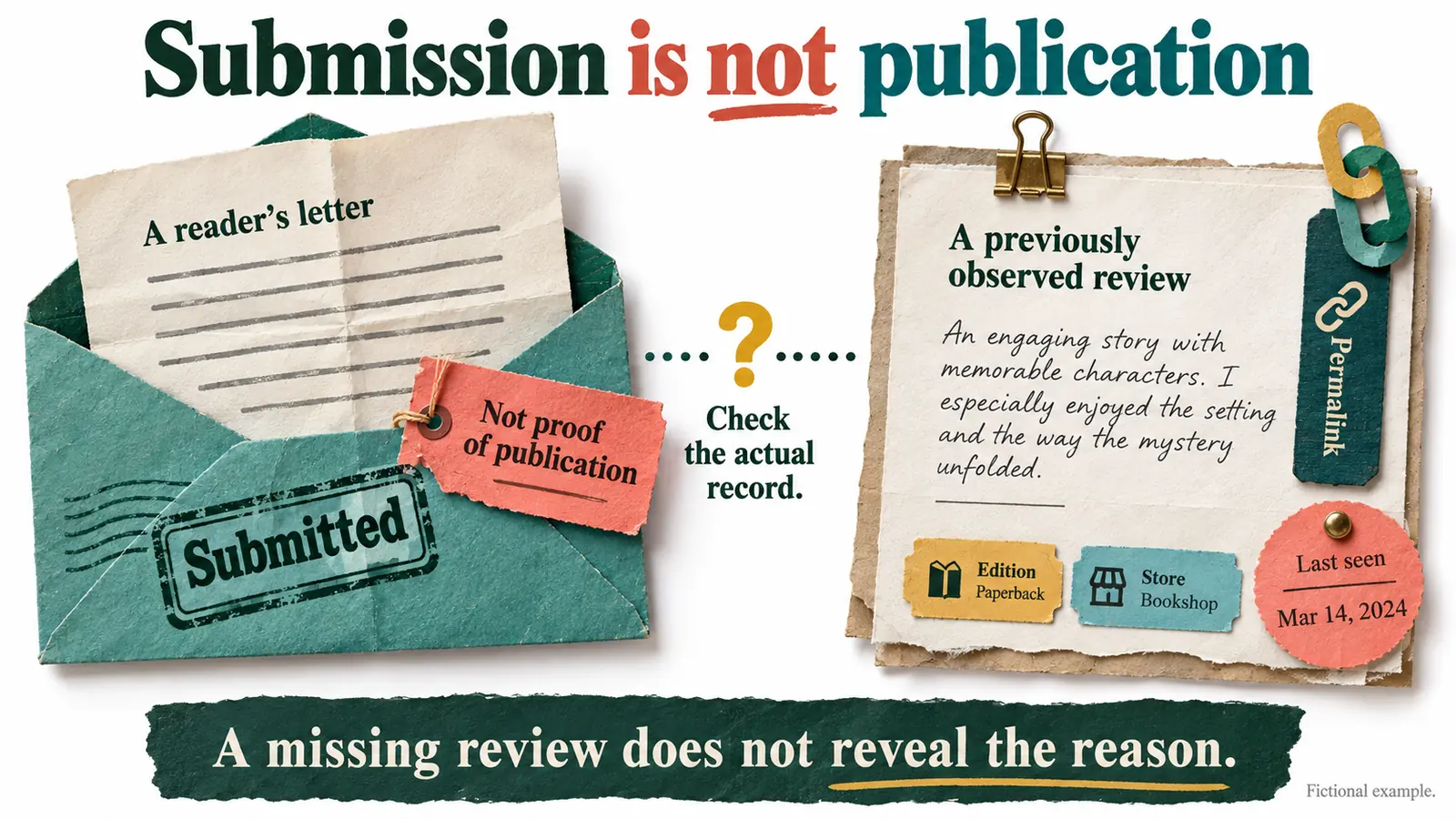
Distinguish a newly submitted review that has never been visible from one previously observed on a specific page. An email from a reader saying "submitted" is not proof of publication. Retain the wording of any actual rejection or restriction message rather than reducing all outcomes to "Amazon deleted it."
Keep rating and review evidence separate
A displayed star count is not a list of written review records. It cannot identify which text is missing. KDP's customer-review reference also explains that the displayed star rating is not a simple arithmetic average. Do not reverse-engineer a supposed deletion from a rounded average alone.
Preserve the original destination and observation
Save the book identifier, format, marketplace, product URL and review permalink if available. Record when the review was last seen and when it was first not observed. A dated screenshot can establish a previous display; it cannot reveal a private moderation reason. Keep an approximate timestamp explicitly approximate.
| Observation | Record to keep | Limit |
|---|---|---|
| Written review previously visible | Permalink, edition and dated screenshot | Does not explain why the later display changed |
| Reader reports submitting a review | Submission timing and actual message, with permission | Does not prove it was published |
| Rating count changed | Same surface and context at both times | Does not identify a specific written review |
| Submission restricted | Exact wording and affected product | Does not reveal Amazon's private detection inputs |
Use a private incident note
Retain only information needed for the issue. Do not ask readers for account passwords, payment details or a full purchase history. Redact screenshots before sharing them publicly. A public accusation naming a reader is not a substitute for a reproducible report and can expose someone who did nothing wrong.
Check the edition and marketplace before claiming removal
Open the retained destination and compare the selected format and store with the original record. Review any filters or sorting choices you changed. If another edition is selected, inspect its identifier rather than assuming the displayed book title describes the same review surface.
KDP's linking overview distinguishes retail format linking from organization on Bookshelf. Linking the formats in your own publishing view does not by itself establish how every retail review display should look. An unrelated product must not be linked merely to acquire its reviews.
Do not promise cross-market display
The customer-review reference describes conditions and variability for international sharing. The absence of a review in one store does not alone establish that it was removed everywhere. Record the stores actually checked and leave others unknown. If the book's direct page has failed too, investigate that separately through the listing incident workflow.
Separate documented reasons from guesses about the reader
KDP lists guideline conflicts, removal by the customer and attachment to an unrelated product among reasons a review can be missing. It also describes checks before reviews are posted. Those are possible explanations, not a diagnosis of your particular review. The public display alone does not show which reason applies.
Do not invent a technical cause
A shared connection, a browser choice, a referral link or the date a reader bought the book does not establish the reason for a particular moderation decision. Do not claim you can diagnose Amazon's private detection logic from those facts. A genuine purchase does not let an author override the platform's decision about a review.
Keep explicit account notices separate from missing-review observations. If a publishing notice arrives, address its actual instructions. If only review display changed, do not report account termination as an established fact. The troubleshooting map keeps those evidence paths distinct.
Choose the support route that matches the affected record
For a customer's missing review, KDP directs the customer to Amazon Community. Use the current contact steps linked in the official customer-review help. For a suspected retail format-linking problem, use the linking guidance and provide the affected edition identifiers. Neither route guarantees restoration or a full disclosure of internal checks.
The checked KDP instructions route the reader through Customer Service, Something else, then Amazon Community and the relevant feature. Use the current options presented by Amazon if labels change. This is a contact route, not a publication deadline or a promise that a review will be restored.
Make the question small and reproducible
Explain what was previously visible, what is now observed, the exact destination and any relevant message. Do not attach an unrelated sales spreadsheet or demand a particular star average. Keep case numbers with the evidence and add material observations to existing correspondence where appropriate.
Fictional reader case wording: "My review was previously visible at the retained permalink for this edition. I now observe the attached result in the same store. Please clarify the status or appropriate next step for my review. I understand that publication is subject to the current guidelines."
The author should not impersonate the reader or request access to the reader's account. A reader can decide whether to contact support; that decision should not affect access to a review copy or trigger pressure from a campaign organizer.
Audit the review-copy invitation and any actual incentives
Inspect the full communication chain: invitation, follow-ups, service terms and rewards. A phrase such as "honest review" does not remove a requirement elsewhere to post, provide proof or give a particular score. Judge the actual arrangement, not one reassuring sentence in the email.
Use the publishing-process audit to separate review incentives from unrelated metadata, rights and file-quality concerns. A mismatch you find is a reason to correct that practice, not evidence that it caused this particular missing review.
KDP's review-copy guidance permits a free or discounted copy without requiring or influencing a review. Other compensation, including gift cards, can invalidate a review. Do not offer a reward for restoring a missing review or make a future benefit depend on favorable feedback.
Correct pressure instead of rewriting its label
If an invitation imposed an obligation, stop that condition and retain the correction record. Do not rename a review reward as a reading bonus while continuing to require a public opinion. Use the ARC communication workflow for independent reading and follow-up. The reader's choice to decline, criticize or not post must remain real.
Respond without trying to evade moderation
| Current evidence | Useful next step | Do not do |
|---|---|---|
| Submitted, never verified visible | Retain timing and actual messages; reader follows official guidance | Assume a published review was deleted |
| Previously visible permalink now fails | Reader reports the concrete record | Repost through another account to bypass the outcome |
| Wrong edition or store inspected | Correct the comparison and verify identifiers | Call one display a global removal |
| A review obligation or incentive exists | Stop the condition and review the arrangement | Disguise the same obligation under a different label |
Protect independent feedback
Do not arrange replacements for a missing positive review, ask readers to change devices or accounts to evade a restriction, or seek mass reporting of criticism you dislike. If a review appears to violate guidelines, use the platform's reporting process and describe the actual issue. Disagreement with the opinion is not evidence of a violation.
Close the case with a defensible outcome
Record whether the original review is visible again, a linkage discrepancy was clarified, support provided an explanation or the reason remains unknown. Do not promise readers or authors that all removed reviews can be recovered. A case can end with an unresolved private reason while still improving the accuracy of your record and communication.
Investigate other symptoms separately
If the book's rank changed too, use the rank-comparison workflow; simultaneous changes do not establish causality. If sales are disappointing, use the sales diagnosis. Do not turn restoring a review count into the sole objective of publishing or promotion.
Sources and scope
KDP customer-review and format-linking references checked on 16 October 2026. Direct Amazon Community help pages returned service errors during verification; the linked Community Guidelines page returned HTTP 503. No additional unverified moderation rules are asserted here. Examples and case wording are fictional. No actual reviewer account, notice or private moderation reason was inspected.
Frequently asked questions
Does a changed star average prove that Amazon removed a review?
No. A rounded displayed average does not identify a missing written record. Keep rating, review and edition observations separate.
Why might a written review be missing?
KDP lists guideline conflicts, customer removal and attachment to an unrelated product among possibilities. These are not proof of the reason in a particular case.
Does submitting a review mean it was published?
No. Retain the actual submission or restriction message and distinguish it from a review previously verified visible.
Who should a reader contact about their missing review?
KDP directs customers with missing reviews to Amazon Community. Follow the current official contact guidance; the author should not impersonate the reader.
Can I ask readers to repost using another account?
Do not try to bypass a moderation outcome with another account, device or replacement review. Use the appropriate case process and preserve the actual message.
Can a review-copy reward require an honest review?
Calling it honest does not remove an obligation. Keep copies and follow-up independent, without requiring a review, influencing its score or disguising review compensation.