

Amazon Ads for Books
Start a book-advertising test, read its results or fix the stage that is not working.
Nineteen practical guides cover setup, targeting, spending and review. Retail sales are not your royalty income.
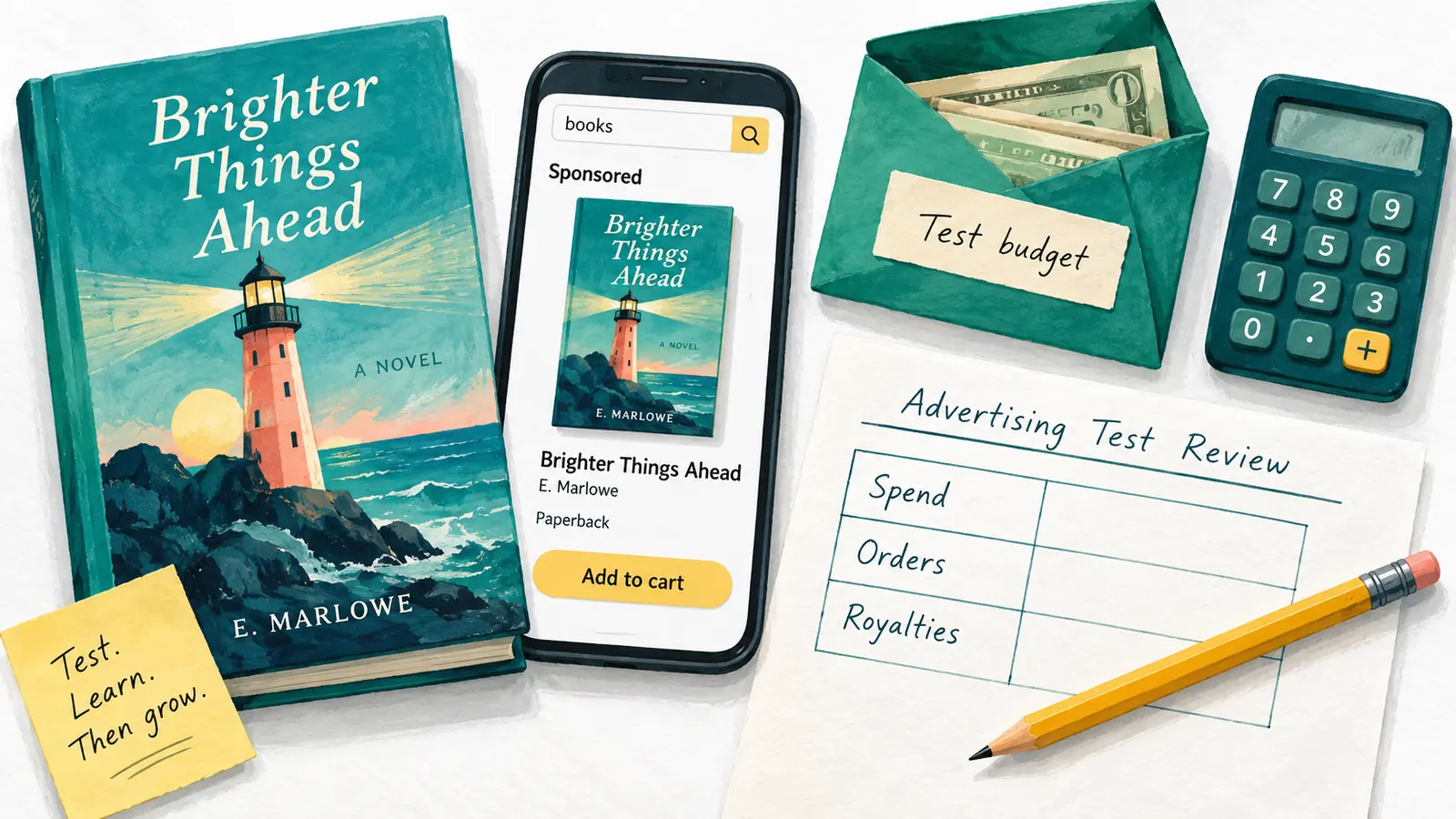
Start with the decision in front of you
Choose the book, marketplace, reader intent and an affordable test allowance. Inspect the live edition before paying for exposure. Use this directory to address the next decision, not to run every advertising format at once.
Understand the product and prepare a first test
Use Amazon's author Sponsored Products guide for official setup context. Verify current account, title and marketplace eligibility; save the starting settings before launch.
| Your question | Read next | Useful output |
|---|---|---|
| How do I begin responsibly? | Amazon Ads for KDP beginners | Readiness checks and a bounded first test |
| What happens between an ad and a purchase? | How Amazon Ads for books work | Delivery, click, destination and reporting distinctions |
| Which advertising product fits? | Amazon Ads types explained | Product differences and eligibility checks |
Plan targeting, effective bidding and cash separately
Targets choose the context, bids affect auction exposure, and budgets allocate spending. More budget cannot repair every delivery problem. Plan each control against the book's retained contribution.
| Task | Read next | Useful output |
|---|---|---|
| Choose reader-intent tests | Keyword strategy | Research, discovery and scoped exclusion decisions |
| Control auction exposure | Bidding strategy | Conditional click-cost planning and effective bid checks |
| Allocate affordable cash | Budget strategy | A test envelope, reserve and monitoring rule |
A daily setting is not a strict loss cap
Daily budgeting uses monthly averaging and can draw on unused amounts for additional daily exposure. Check Amazon's budgeting policy and active rules. Keep a separate affordable loss allowance and monitor actual spending rather than treating a schedule as a guaranteed lifetime cap.
Read a metric before acting on its color
CTR compares clicks with impressions. ACOS and ROAS relate spend to attributed retail sales, not royalty income or proven incremental sales. Compare matching dates, markets and attribution scopes.
| Metric | Read next | Main caution |
|---|---|---|
| ACOS | ACOS explained | Retail sales are not retained contribution |
| ROAS | ROAS explained | An attractive sales ratio can still lose money |
| CTR | CTR explained | Attention does not establish purchase fit |
Fresh reports may still change. A zero denominator is unavailable, not a favorable ratio. Save exports and pause new exposure at your cash limit while existing data matures.
Find the weak stage before rewriting the book page
Check delivery, then clicks, then purchases and contribution. A description cannot repair an ineligible campaign; higher bids cannot repair a broken destination. Follow the actual symptom.
| Symptom | Read next | First distinction |
|---|---|---|
| Almost no delivery | No impressions | Eligibility, status and funding versus demand |
| Impressions without clicks | No clicks | Thin evidence versus reader-promise mismatch |
| The campaign seems broken | Why Amazon Ads is not working | Technical support issue versus strategic repair |
A current status does not prove last week's status, and a click-filtered report does not reveal every unclicked query. Preserve dates and messages; do not create test clicks or coordinated purchases.
Improve the purchase journey or the cost, as appropriate
When suitable traffic exists, inspect the advertised edition, description, sample and costs. A clearer promise and a scoped exclusion solve different problems. Evaluate retained earnings, not conversion rate alone.
| Question | Read next | Useful output |
|---|---|---|
| Why do suitable clicks not convert? | Improve conversion | Edition, description, sample and optional A+ checks |
| Why is ACOS high? | High-ACOS diagnosis | Cost, purchase-rate, sales-value and mix explanations |
| How should I reduce avoidable spending? | Lower ACOS | Controlled exclusions, bidding and allocation sequence |
Use the actual edition's royalty rules and applicable costs. Do not add all account-wide reading earnings or assumed future series sales to justify a losing test.
Choose ongoing optimization, expansion or a launch plan
Optimization reviews an existing campaign; scaling tests the next increment. First-campaign readiness and launch sequencing are also separate jobs. Choose the guide that matches the decision.
| Task | Read next | Useful output |
|---|---|---|
| Run a repeatable review | Optimization strategy | Bottleneck triage and one-change decision log |
| Test additional exposure | Scale book advertising | Readiness, marginal economics and rollback criteria |
| Prepare a new title's first campaign | Ads for a book launch | ASIN, eligibility, destination and submission checks |
| Sequence release activity | Launch strategy | A conditional calendar and phase cash gates |
Record the hypothesis, original setting, change date, spending allowance and next review. Stop or reverse a test when its limits are reached; do not spend merely to protect a launch schedule.
Keep paid exposure separate from organic discoverability
An ad placement is not an organic position, and BSR does not count visitors. Use the discovery plan, the ranking explanation and the BSR measurement guide for those questions.
KDP does not guarantee top search placement. Record concurrent promotion; a rank change alone does not establish profitable advertising.
Sources and scope
Official Amazon Ads and KDP sources checked: 15 October 2026. Nineteen specialist guides provide the detailed workflows. Account eligibility, reporting scope and current controls must be verified before committing spend.
Frequently asked questions
Where should a new book advertiser start?
Start with the beginner guide and verify the intended edition, marketplace, destination and affordable test allowance. The ad-types guide helps check which product fits; current account eligibility should be verified before relying on a feature.
Which guide should I use when a campaign performs poorly?
Follow the observed weak stage: delivery, clicks, purchases or contribution. No impressions, no clicks and high ACOS have different diagnostic paths. Repair the concrete problem before changing every control.
Do ACOS and ROAS show author profit?
Not automatically. They use attributed retail sales relative to advertising spend. Evaluate the relevant retained contribution and applicable costs, with matched reporting scope and maturity, rather than treating the sales column as payout.
Should I raise budget to get more impressions?
Only if funding is the relevant constraint and the next test is affordable. More budget may not help a campaign that already underspends. Daily settings follow averaging rules, so maintain a separate cash stop rule and monitor actual exposure.
What is the difference between the two launch guides?
Ads for a book launch covers first-campaign readiness and setup. Launch strategy covers dates, conditional phase allowances, coordination with other promotion and later review. Both allow a justified delay or stop.
Does advertising guarantee better organic ranking?
No. Paid placement, search position and sales rank are distinct observations. Log concurrent promotion and assess actual outcomes; a rank movement does not by itself prove profitable or causal advertising impact.