

Free Amazon Book Reviews: Build a No-Paid-Budget Reader Plan
Find interested readers without purchasing review delivery or promising yourself a fixed review count.
Use a four-week outreach plan, a realistic time allowance and usable reading copies. Public reviewing remains the reader's choice.
Free Amazon book reviews: start with a realistic project
You cannot order a dependable number of free Amazon book reviews by following a checklist. You can make a suitable book easier for interested people to discover, provide a usable reading copy and leave any public response to the reader. This guide turns that limited, controllable work into a small project without a paid promotion budget.
Free means no purchased placement in this plan, not zero cost. Your time has a cost, and print copies, postage, file preparation or an existing email subscription may still require money. Decide what is already available before recruiting anyone. A digital-only project with a modest time allowance is different from mailing ten paperbacks.
Keep the policy boundary short and clear
KDP's customer-review guidance permits free or discounted book copies without requiring or influencing a review; additional incentives invalidate reviews. A free copy is not a guaranteed route to publication. Use the review rules guide for the broader conditions, rather than treating this project plan as permission for every participant.
Prepare a reading offer before finding more people
Write one sentence identifying the book's likely reader: genre or subject, reading level, format and the particular experience offered. A cozy mystery for readers who enjoy village settings is a better starting point than a book for everyone. Do not recruit by the rating you hope to receive.
Check the actual file on a phone and an ereader if those are your intended formats. Open the table of contents, inspect chapter breaks and confirm that the first page is not an obsolete draft. Name the file consistently and put the edition date in your private delivery record. Fix broken access before increasing outreach.
Separate reading readiness from review readiness
If the manuscript still needs structural feedback, ask for private beta reading instead. People identifying confusing chapters are doing different work from readers deciding whether they want to discuss a finished book publicly. The alternatives comparison helps choose the right output before using anyone's time.
Choose two reader channels you can support
Begin where the book's subject already makes sense and where contact is welcome. Read a group's current participation rules before posting, and ask its moderator when the invitation category is unclear. Public membership is not consent to private sales messages. Avoid harvesting contact details or repeating the same post across unrelated communities.
| Channel | Useful starting action | Cost or constraint to record |
|---|---|---|
| Existing permissioned newsletter | Invite readers interested in this specific subject | List maintenance and delivery support; no assumed response |
| Genre community allowing author posts | Use the designated invitation thread | Moderator rules, frequency limits and time spent participating |
| Your website or book back matter | Offer a clear reader-interest signup | Existing traffic and the cost of maintaining the destination |
| Relevant book club | Ask its organizer whether a reading copy fits | Reading schedule, format availability and possible postage |
These are channel types, not verified listings of currently open groups. Check each actual destination. Friends or professional contacts may help you understand positioning, but a personal connection does not automatically make someone a suitable public reviewer. Amazon's review explanation identifies close relationships and financial interests as restrictions.
Use a four-week plan with a fixed time allowance
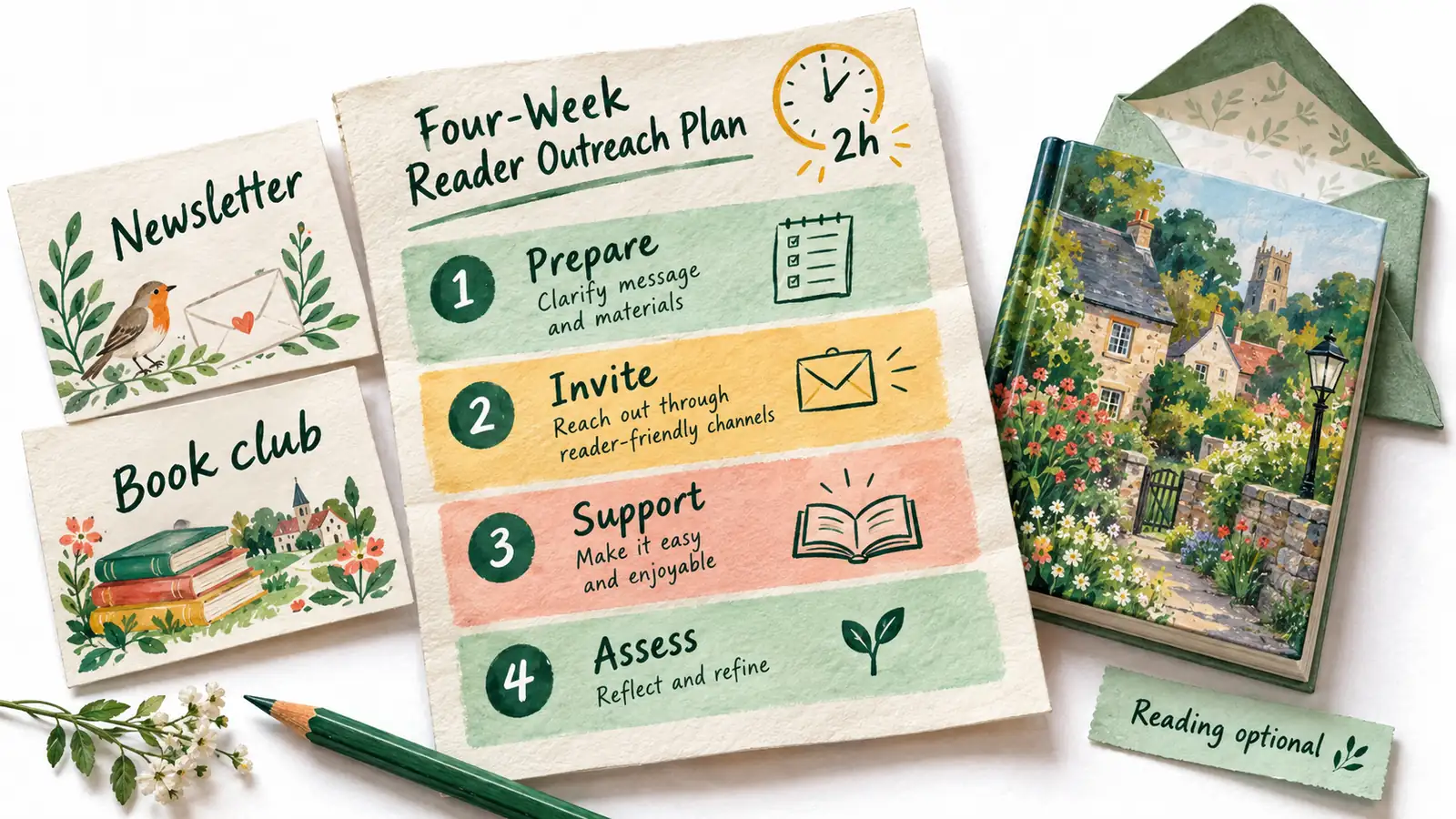
The following schedule is a fictional planning example, not a tested review-acquisition formula. Suppose you can devote two hours per week and already have a finished digital copy and a permissioned mailing list. Eight hours is the project limit, not a promise that a particular number of readers will respond.
| Week | Work within two hours | Completion evidence |
|---|---|---|
| 1: Prepare | Test the file, define reader fit and inspect two channels | Working copy, invitation draft and dated channel rules |
| 2: Invite | Publish one permitted invitation and send one relevant newsletter | Actual posts, audience scope and contact preferences |
| 3: Support | Resolve access questions and answer reader replies | Delivery problems resolved without asking for review proof |
| 4: Review the project | Send only agreed follow-up and inspect channel usefulness | Hours used, reader questions and the next decision |
Reduce volume before increasing your workload
If delivery support consumes the entire third week, pause invitations. Repeatedly sending copies while leaving readers unable to open them is not progress. Keep a small buffer for unexpected format questions and stop at the time limit rather than chasing a launch-day review target.
Make the invitation about the book and the reader
Describe what the person will receive, how to access it and how to decline further contact. Explain substantial content limitations or sensitive themes where relevant. Do not imply that accepting the copy signs the reader up for an additional service, a mailing list or a publishing obligation.
A fictional invitation
Fictional example: "I have a finished digital copy of a short village mystery featuring an amateur gardener. If that sounds like your kind of reading, reply for the file details. There is no public-review obligation, and you can stop further messages at any time. Please tell me if the file does not open."
This is an example of scope, not an approved legal or platform template. Adapt it to the actual offer. For additional invitation and decline-path examples, see the optional outreach guide. Do not turn a preference question into a filter that admits only people willing to praise the book.
Support the reading experience without policing publication
Use a delivery record containing only information needed to provide the copy and respect contact preferences. A practical minimum is a reader's chosen contact address, requested format, delivery date and unresolved access issue. Restrict access to that record and define when it will be deleted or anonymized, subject to applicable recordkeeping needs.
Set expectations for messages before sending them. A reader may welcome a single availability update and reject weekly reminders. Use a clear opt-out, act on it and do not move the person into another campaign to continue the same pressure. If nothing has changed, there may be no useful follow-up to send.
Keep operational statuses about delivery
Statuses such as requested, delivered, access issue and contact stopped help you do the work. A public-review screenshot should not be the gate for completing this optional-copy project. If an existing system requires that proof or withdraws a benefit for not posting, use the workflow replacement guide before describing the offer as optional.
Measure effort and fit, not a promised review yield
Record time by channel, copies actually requested, delivery failures and substantive reader questions. These observations show whether the process reaches interested people and whether support is manageable. They do not reveal why an individual Amazon review was accepted or removed.
Keep definitions stable. If you calculate a request rate, divide unique copy requests by unique people actually reached through a measurable channel, not by an estimated group membership. If that denominator is unavailable or zero, report the rate as unavailable. A small response count is not enough to establish a reliable conversion benchmark.
Use public outcomes only as context
A visible review can be noted as an observation, not assigned to a reader as a debt. Do not claim that slower outreach makes reviews permanent or that a particular posting pattern avoids moderation. Compare project usefulness with the time spent, not with an invented industry success rate.
A worked project log, not a review forecast
Fictional example: an author sends 24 delivered invitations to distinct newsletter recipients, receives six copy requests and resolves two file-access problems within the eight-hour project limit. Six requests divided by 24 delivered invitations is 25%, but that is a request-to-invitation ratio. It does not establish how many people read the message, finished the book or could publish on Amazon.
The next decision is to keep the relevant newsletter and correct the delivery instructions. Public-review outcomes remain unknown; no recipient owes the author a contribution. If a book-club invitation has no measurable audience count, record its requests separately without inventing a denominator.
Choose the next improvement from the observed bottleneck
Classify the question before changing outreach: use the reader-path diagnostic for a low count, the timing guide for a reported submission, or the purchase-badge explanation for a visible review's label.
If nobody requests a copy, inspect relevance, invitation clarity and whether the channel permits the offer. If people request but cannot read it, fix delivery. If they read but offer little private feedback, revisit whether you actually asked for private feedback and whether that was a separate, voluntary activity.
If your real problem is discoverability or sales, build a wider book marketing plan instead of treating review count as the entire launch. A small permissioned audience can become an ongoing relationship; the author email list guide covers that separate task.
For a book shared before release, use the ARC-to-Amazon handoff to record versions and the correct edition link. If you actually need private comments on presentation or a passage, write a focused feedback brief rather than disguising an editorial task as an obligation to review.
At the end of the month, retain the useful channel, stop the unproductive one and choose one concrete repair. The result may be a clearer offer and several satisfied readers without any new public review. That can still be useful work, provided it is reported honestly rather than presented as guaranteed review delivery.
Use the Amazon book review guides to find the next step for reader recruitment, review rules or visibility problems.
Sources and scope
Official KDP and Amazon explanations linked above were checked on 16 October 2026. Direct Community Guidelines retrieval returned a 503 response; consult the link on KDP's page for the applicable current rules. The time plan, project log, channel comparison and invitation are original practical examples, not measured outcomes. No specific community, reader account or review decision was assessed.
Frequently asked questions
Can I get a guaranteed number of free Amazon book reviews?
No. You can organize relevant outreach and reading access, but cannot guarantee public contributions or their continued visibility.
Does free outreach have no cost?
No. Time, files, existing subscriptions and possible print or postage costs still matter. State which expenses your project excludes.
Where should I start if I have no promotion budget?
Start with an existing permissioned audience or a relevant community that explicitly allows the invitation. Check the actual channel rules first.
Should I ask every reader for a screenshot of their review?
Do not make public proof a completion requirement for an optional reading-copy project. Track delivery and access support instead.
What if my outreach produces no public reviews?
Inspect reader fit, invitation clarity and delivery. Do not turn the lack of reviews into a participant penalty or an invented conversion claim.
Should I build an ARC team before the manuscript is ready?
Use private beta feedback for a manuscript that still needs revision. Organize finished reading copies as a separate task.