

How to Increase Amazon Book Sales With a Measurable Plan
Choose one justified improvement, one suitable introduction and a review point before spending more.
Use clear evidence boundaries and a contribution calculation so a larger unit total is not mistaken for profitable growth.
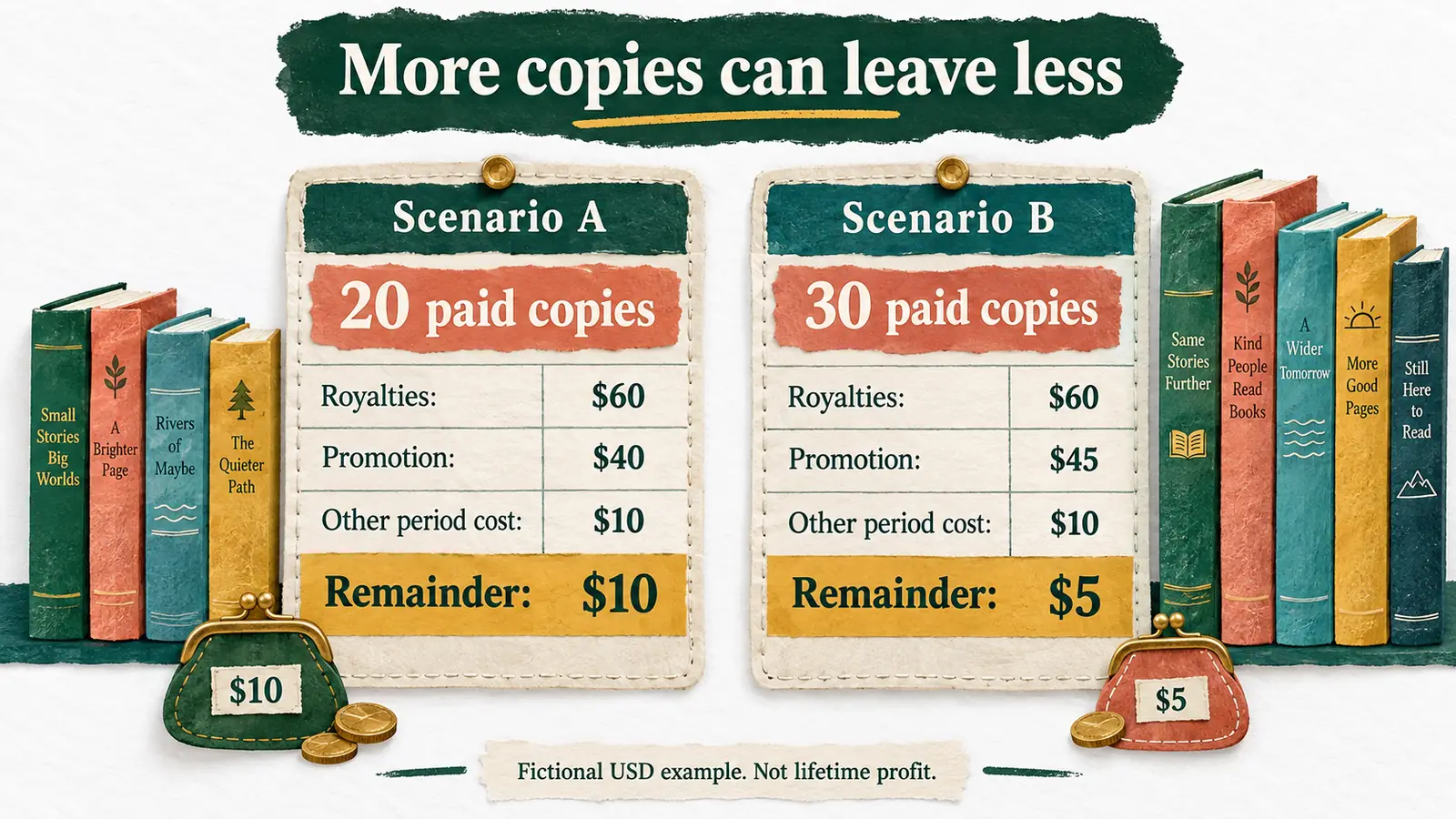
Choose an improvement objective beyond more copies
To increase Amazon book sales responsibly, define what better means before changing the listing or purchasing promotion. You may want more qualifying paid units, improved retained value after a bounded campaign, or evidence that a suitable introduction is worth repeating. Those objectives need different measures. A larger unit total is not automatically a better financial result.
If the cause of weak performance is still unclear, start with the sales diagnosis. If the selected report is at zero, complete the reporting and availability checklist. This plan begins when you can name a plausible problem and choose an action connected to it.
Write the boundary of the test
Record the book, edition, market, baseline period, proposed change, cost allowance and review date. State what would make you continue, revise or stop. A broad goal such as "build momentum" is too flexible: nearly any outcome can be used to justify another payment or redesign.
Repair the actual offer before increasing exposure
Verify the destination used in the promotion and inspect the selected format, current price, purchase option and available sample. Resolve a broken link or misleading promise before testing discretionary delivery. Necessary corrections are publishing work, not optional marketing experiments.
Make the distinction visible without inventing a new book
Our fictional Coastal Paths for Slow Weekends offers manageable coastal walks, not an endurance expedition manual. A description that clearly states the route length, level and actual contents gives a suitable reader a fairer choice. It should not promise features, downloadable material or expertise the edition does not provide.
Follow KDP's metadata rules and the permitted update process. Some published fields are locked. Do not casually rename the book or create a duplicate edition as a growth tactic. Retain the old and corrected records so you know what readers saw during each period.
Write one hypothesis that leads to an inspectable action
| Observed issue | Proposed action | Check and decision |
|---|---|---|
| Description obscures the short-walk focus | Clarify the actual route level and contents | Verify accuracy, then review a bounded introduction |
| Previous placement reached unrelated readers | Select a route serving the intended walking audience | Verify delivery and scoped response before repeating |
| More units left less after costs | Review per-copy value and campaign allowance | Continue only with acceptable retained value or a stated learning goal |
| Outcome evidence is incomplete | Define reporting scope and review timing | Do not scale from an unresolved measurement gap |
Separate factual repair from optional testing
If several claims are inaccurate, correct them together and describe the work as a combined correction. Do not retain a misleading field to protect experimental purity. For optional changes, keep the intervention small enough to explain. Even then, an uncontrolled before-and-after comparison cannot establish causality on its own.
Choose one suitable introduction, not every channel
Select a route based on the real audience and the evidence available: a useful email to willing subscribers, an approved community placement, a relevant promotion service or a bounded advertising campaign. Check the actual deliverable, destination, dates and conditions. Neither a large audience label nor a high view count proves that suitable readers will buy.
Use the route's own measurement
Amazon's book-advertising report documentation explains the campaign and targeting views available for paid introductions. Keep those metrics scoped to the campaign and its definitions. A search-term report is not a measure of every organic query, and attributed purchases are not added on top of total KDP units as extra copies.
Use the author email workflow, the promotion-site comparison or the advertising guide map for route-specific execution. Start with one inspectable introduction rather than paying for several overlapping placements you cannot evaluate.
Check retained value before calling a test successful
Use the royalty retained per qualifying copy, not retail price, as the starting point for the contribution calculation. Review the actual format's rules and deductions; KDP's eBook royalty reference explains why list price alone is not the amount earned. Use the royalty calculator with verified inputs, not assumed eligibility.
For a real period, sum the relevant royalty records when price, format or buyer territory varies rather than applying one assumed rate to every copy. The fixed per-copy figures below are teaching inputs; they do not establish this book's royalty eligibility or take-home income.
| Scenario | Paid units | Royalty per copy | Royalties | Promotion cost | Other period cost | Remainder |
|---|---|---|---|---|---|---|
| A | 20 | $3.00 | $60.00 | $40.00 | $10.00 | $10.00 |
| B | 30 | $2.00 | $60.00 | $45.00 | $10.00 | $5.00 |
| C | 24 | $3.00 | $72.00 | $60.00 | $10.00 | $2.00 |
The formula is paid units multiplied by assumed net royalty per copy, minus promotion and other period costs. Manufacturing or delivery deductions are already reflected in the assumed royalty; do not subtract them twice. Scenario B sells more units than A but leaves less. Scenario C retains the same per-copy royalty as A yet higher promotion spending reduces the remainder.
Do not treat the remainder as lifetime profit
The table deliberately excludes production recovery and several other costs. It is not a return-on-investment forecast or proof that the campaign caused all period orders. Use the project ROI worksheet when the question includes upfront costs, and keep any learning allowance explicit rather than relabeling a loss as profitable growth.
Run a bounded sequence with checkpoints
Use the following original four-stage sequence as a planning aid, not a guaranteed 30-day launch formula. The timing of publication, channel delivery and report completion can differ. Let those actual events determine when a comparison becomes meaningful.
- Prepare: retain the baseline, verify the edition and correct necessary factual problems.
- Confirm: check that the intended update is reflected before discretionary promotion begins.
- Introduce: deliver the selected placement within its time and cost allowance.
- Review: reconcile the report scope, costs and other activity before deciding what to repeat.
Set stop conditions that do not move with your mood
Stop new exposure if the destination becomes unavailable, the agreed allowance is exceeded or the delivered placement is materially different from the plan. Pause for clarification when reporting remains unresolved. Do not extend the budget simply because more clicks make success feel imminent. A decision rule written beforehand is useful precisely when the outcome is disappointing.
Interpret the result without claiming an isolated causal lift
Compare like reporting scopes and record changes in price, other promotions and edition availability. KDP's Orders Report definitions help establish which units belong in the view. Paid units, free units and reading activity remain different measures. Add costs once and retain the currency and date range.
Use continue, revise, stop and inconclusive as real options
A delivered placement with weak response may justify a more relevant introduction, not more of the same. A clearer accurate description can remain even if sales evidence is inconclusive. An apparent improvement during several simultaneous changes belongs to the combined period. Do not claim that one phrase or image produced it from those records alone.
Fictional review note: "The intended edition remained available and the placement was delivered. Paid units rose, but the period remainder fell after promotion costs. Do not scale this version; review the audience and allowance before another bounded test."
Repeat deliberately while protecting reader choice
Repeat only when the evidence, economics and workload justify it. Increase scope cautiously and keep the same reporting discipline. Do not substitute a public rank or a temporary badge for the outcome you originally defined. A book can be accurately presented and still have a limited commercial opportunity.
Do not manufacture social proof
KDP's customer-review guidance allows independent review copies without requiring or influencing a review. Do not compensate for favorable opinions or coordinate transactions to create a ranking signal. Build the next cycle around a truthful book and a suitable audience. For a broader schedule across releases, use the long-term strategy guide instead of turning this test into an endless launch.
Use the KDP troubleshooting guides to distinguish listing, indexing, sales and account problems before choosing a fix.
Sources and scope
Primary Amazon documentation rechecked on 16 October 2026. The book, test plans, monetary inputs and review note are fictional. All table values are illustrative assumptions, not measured benchmarks or predicted sales. This guide offers a bounded working process, not a guaranteed increase in units or income.
Frequently asked questions
What is the first step to increasing Amazon book sales?
Define the edition, period and desired outcome, then diagnose a plausible problem. Verify the offer before purchasing extra exposure.
Should I change the cover, price and keywords together?
Correct necessary factual problems promptly. For optional tests, keep the intervention explainable and record simultaneous changes; a before-and-after total alone cannot isolate their effects.
Do more paid copies always mean a better result?
No. Lower per-copy royalties or higher promotion costs can leave less even when units rise. Compare retained value and the stated learning objective.
Can I add ad-attributed purchases to total KDP orders?
Do not treat attributed purchases as additional copies on top of the corresponding total. Reconcile compatible scopes and preserve reporting differences.
How long should a sales-improvement test run?
Set a bounded review point appropriate to the publication, delivery and reporting events. There is no universal duration that guarantees a useful result or a sale.
Can review copies be used to guarantee positive social proof?
No. KDP permits independent free or discounted book copies without requiring or influencing a review. Do not pay for favorable opinions or make review obligations part of the test.