

KDP Book Not Indexed? Build a Scoped Search Check
A missing result is an observation, not access to Amazon's private index.
Establish an available edition, record controlled searches and decide whether you need a correction, a support investigation or ordinary discovery work.
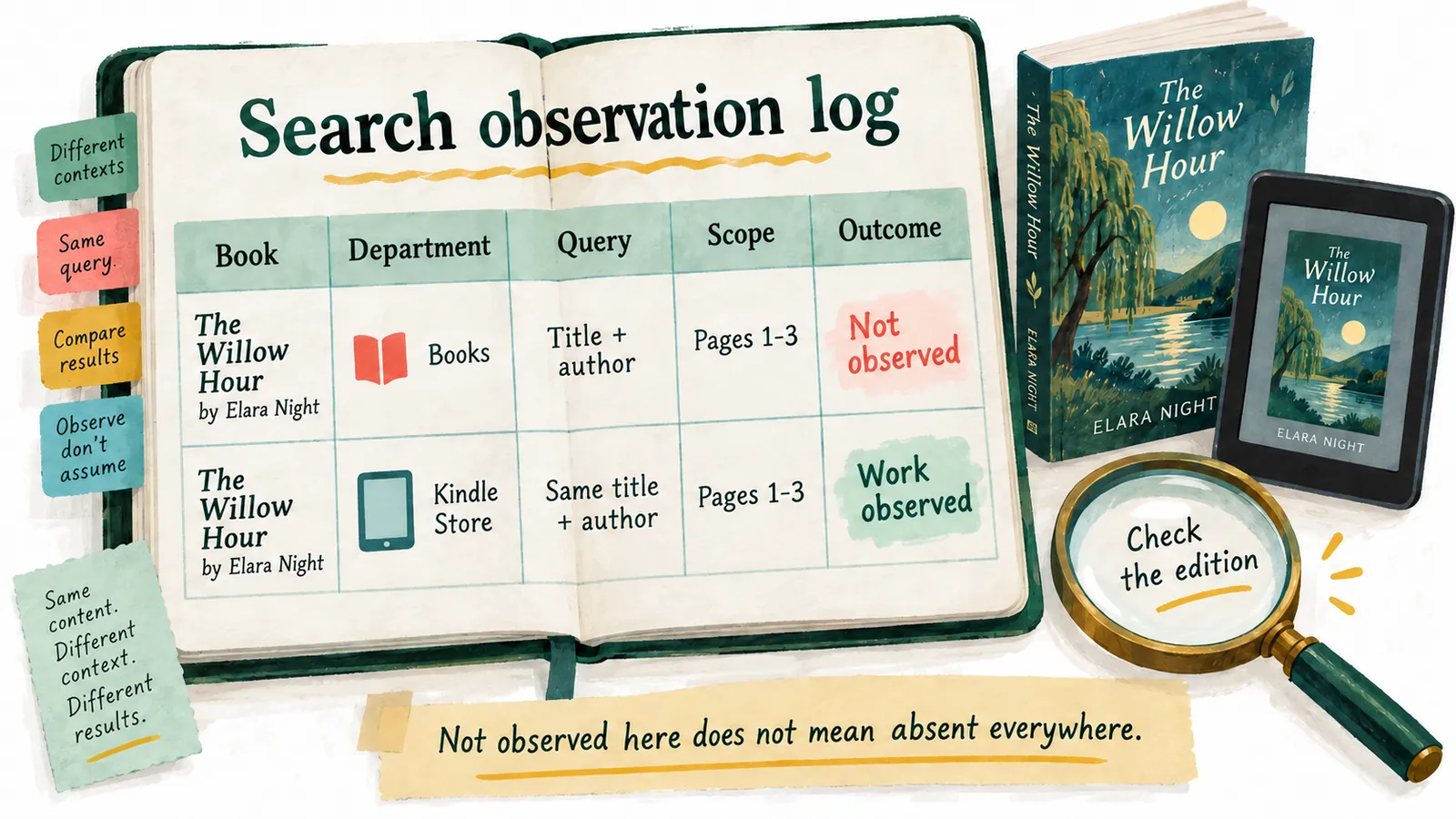
An indexing claim needs more than an absent search result
"My KDP book is not indexed" often means "I could not find it for this query." Those statements are not equivalent. A shopper sees a particular search response, not Amazon's complete internal retrieval system. The practical goal is to establish whether a reproducible listing or search-availability problem exists, while keeping uncertainty explicit.
This guide uses "not observed" for a miss within a recorded search scope. It reserves stronger conclusions for evidence that actually supports them, such as a specific support explanation. Amazon store search and Google indexing are separate systems. Not finding an Amazon page in Google does not establish a failure in Amazon's own search.
Choose the right investigation
If you have not confirmed a working retail page, start with the missing-book triage. If a previously working direct page now fails, use the disappeared-listing workflow. This guide is for investigating search observations after separating those availability problems.
Establish the listing baseline before testing keywords
Record the affected format, ASIN or ISBN, direct page URL, marketplace and Bookshelf state. Check whether the page opens and whether the intended edition is available in the observed region. Save the latest relevant submission and Live confirmation times. A title still being processed is not a clean baseline for testing a new keyword.
Check the applicable estimate in KDP Timelines. The new-eBook search row starts after the book is Live; initial review, updates and print marketplaces have separate timing. Treat an estimate as context, not a countdown that certifies indexing when it ends.
Freeze the facts that identify the test
Keep a copy of the relevant metadata as it was when the observation was made. If you change it later, record what changed and when the new version became visible. Otherwise you may compare results from different book records while assuming they are the same experiment. Do not include confidential account or tax data in that working copy.
Use a small repeatable search protocol
- Select the intended marketplace and note the delivery country or region.
- Choose Books for print or Kindle Store for the eBook.
- Clear optional filters and record the remaining search context.
- Search the actual title and author as entered for the edition.
- Record the inspected result range and whether the matching work appears.
- Inspect the selected edition on any matching product page.
- If needed, repeat in a clean private session and label it as another observation.
The department and clean-session checks are supported by KDP's find-your-book guidance. Start with a specific identity query before trying broad topics. Keep exact query text, including punctuation, so another person can repeat the check rather than guess what you searched.
Set an inspection boundary
Decide how much of the returned result set you will inspect and write that boundary down. This is a practical workload limit, not an Amazon rule. If you inspect three pages, report three pages. Do not call the result "absent from Amazon" when uninspected results, other departments and other contexts remain unknown.
Interpret positive and negative results asymmetrically
| Observation | Supported statement | Unsupported extension |
|---|---|---|
| Matching work appears for title and author | It was retrievable in that checked context | Every backend keyword is indexed |
| No match in inspected results | It was not observed within that scope | It is absent from every Amazon index |
| Direct identifier URL opens | The specific destination is accessible | Every topic query should return it |
| Another edition is displayed | A format of the work appears | The intended format was removed |
A positive appearance answers a narrow availability question. A negative check needs more context because retrieval, presentation and inspected depth can differ. KDP's Search Results guidance explains that ordering changes and top placement is not guaranteed. An unobserved broad-query position is not a technical diagnosis.
Do not treat ASIN-plus-keyword as a magic validator
A search combining an identifier and a phrase is still a query with its own behavior. Its presence or absence does not provide field-by-field confirmation of Amazon's private index. Record it if useful, but do not sell the result to yourself as a definitive keyword eligibility report. Likewise, an advertising impression is not proof of a corresponding organic position.
Inspect settings connected to the observed symptom
Review the territory selection for the affected format and confirm that it matches rights you actually hold. Check the intended primary audience accurately; do not change a truthful classification to obtain broader exposure. KDP's troubleshooting page explains territory effects and restrictions for sexually explicit images or titles. A platform-imposed classification is not a setting to evade.
Separate a metadata defect from weak placement
Compare visible title, author and format with the submitted record. A misspelled author or misleading phrase is a concrete correction candidate. A relevant but competitive phrase failing to show the book in the inspected results is a different problem. Use the keyword research workflow for relevance, not speculative stuffing.
KDP's find-your-book page also flags titles exceeding 200 characters as a search-display problem. If that condition applies, inspect the current title and required correction process. Do not shorten or rebuild a locked published title casually: KDP's book-details update rules identify fields that may require a new edition.
Keep an evidence log another person can reproduce
| Recorded context | Observation | Next question |
|---|---|---|
| Day 1, 10:00 UTC; intended store; Books; title and author; first three pages | Paperback not observed; direct page opens | Does the same scoped miss recur after applicable processing? |
| Day 2, 10:00 UTC; same query and scope; clean session | Work appears; Kindle format displayed | Is the paperback accessible from its own destination? |
| Day 2, 10:15 UTC; broad topic query; first page only | Work not observed | Is this a placement issue rather than missing availability? |
Store screenshots with the exact URL, timestamp and time zone. Retain filters, selected department, delivery region, format identifiers and result range in adjacent notes. A screenshot cropped to a single row may omit the very setting that explains the difference. Keep the private original and share a redacted copy when necessary.
Do not turn repeated checks into a percentage
Three manually selected observations are not a representative sample of all Amazon searches. A two-out-of-three appearance rate would describe only those selected checks, not a market-wide indexing score. Use the log to locate inconsistencies and communicate them, not to invent an exposure metric that the data cannot measure.
Fictional comparison: a title-and-author query misses the work in Books but finds it in Kindle Store. Those are different departments, not a before-and-after test of one unchanged search. Record the store, time and edition identifiers as well; changing the context can explain a different observation without proving that an indexing problem was repaired.
Choose correction, support or ordinary discovery work
Once a concrete problem is established, follow the documented correction and verification workflow. If the question concerns entered descriptors, use the keyword failure audit; if it concerns shelves or displayed ranks, use category troubleshooting. Choose the repair from the evidence rather than treating every symptom as a keyword defect.
If a submitted field is demonstrably wrong, make the permitted correction and record the operation. If the applicable processing estimate has elapsed and identity searches still reproducibly miss an available edition, provide KDP with the scoped evidence and ask it to investigate search availability for that identifier. If the title is retrievable but broad phrases perform weakly, use the discovery guide map instead.
Fictional support request: "This edition's page is accessible in the recorded store. Attached are two title-and-author searches, their department, filters, delivery region and inspected scope, plus Bookshelf status and timing. Please check whether a listing or search-availability issue explains these observations."
Let the response determine the next step
A request for a correction, a confirmed operational issue and an explanation of ordinary search ordering need different responses. Keep the reply with the original evidence. Do not promise yourself a first-page position as the definition of a resolved case, and do not replace the actual explanation with a preferred hidden-algorithm theory.
Monitor without distorting the test
Choose a modest recheck schedule and retain a stable context. Do not repeatedly unpublish, duplicate the book or coordinate searches and purchases to force a result. Those actions add new variables and are not an indexing diagnosis. Necessary policy or factual corrections take priority over keeping an experiment unchanged; just document the combined intervention honestly.
Close with a bounded finding
Your conclusion might be "title retrievable in the checked context," "available page with repeated scoped identity-search misses referred to KDP," or "specific listing correction confirmed." These are actionable without pretending to know the whole index. For ongoing query performance, continue with scoped position tracking and keep availability, relevance and ranking as separate questions.
Use the KDP troubleshooting guides to distinguish listing, indexing, sales and account problems before choosing a fix.
Sources and scope
Primary KDP documentation rechecked on 16 October 2026. The search protocol, log and support wording are original practical examples. No actual listing was tested for this article. There is no private index access, guaranteed search outcome or claim that a single identifier query validates every keyword.
Frequently asked questions
How can I tell whether my KDP book is indexed?
You can document whether the matching work appears in a specified search context. That observation does not reveal Amazon's entire internal index or validate every keyword.
Does an ASIN-plus-keyword search prove keyword indexing?
No. It remains a query with its own behavior. Its result is not definitive field-by-field confirmation of Amazon's private retrieval system.
What if the direct page works but title searches keep missing it?
Check the appropriate department, marketplace, filters, timing and edition. If scoped identity-search misses recur after applicable processing, send the evidence to KDP for investigation.
Is absence from Google the same as absence from Amazon search?
No. Google indexing and Amazon store search are separate systems. Keep the search engine, query and destination explicit in every observation.
Should I change all my keywords after one failed search?
No. Inspect factual settings and relevance first. Changing several fields together obscures the comparison and does not establish that an indexing defect existed.
What belongs in a search observation log?
Record the edition identifier, URL, date and time zone, marketplace, delivery region, department, exact query, filters, inspected results and the observed outcome.