

Book Disappeared from Amazon: Document What Changed
Start with the exact edition and URL that used to work, not a broad search or an assumed account penalty.
Separate page failure, missing purchase options and search changes, then protect active promotions while resolving the actual discrepancy.
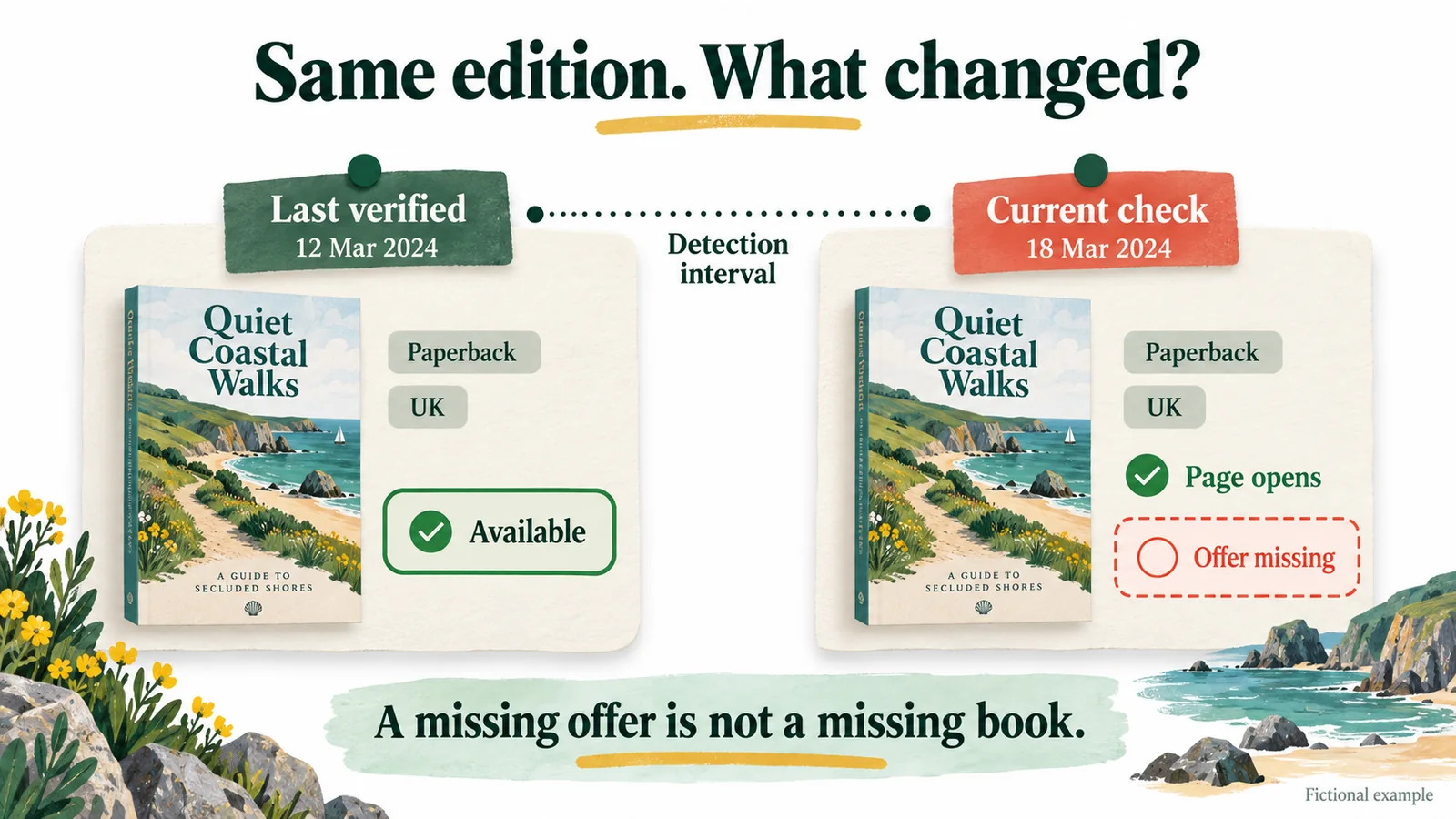
Treat a previously working listing as an incident to document
When a book disappears from Amazon, the first question is what changed at the exact destination that used to work. Losing a familiar search position is not the same as losing a product page. A missing purchase option is not the same as the deletion of every edition. Start with the old URL and identifier rather than a fresh broad search.
Record the last time someone actually verified the affected edition. A link in a scheduled newsletter proves that the link was prepared, not that the page was live at that moment. If there is no previous verified availability, use the first-publication troubleshooting guide instead. A good incident report distinguishes a new publication still processing from a confirmed regression.
Use a precise incident title
"Paperback purchase option missing for the recorded UK delivery region" is a better working title than "my account is banned." The first names an inspectable surface. The second assumes a cause. Leave the cause open until the status, an actual notice or support establishes it.
Preserve the before-and-after record before editing
Save the original store URL, format, ASIN or ISBN, marketplace and last-known-working timestamp. Then capture the current result at that same URL. Include the displayed message exactly, whether another edition is selected, and whether the page redirects. Keep originals in a private incident folder and redact copies shared outside support.
Build a short chronology
List verified events in order: previous availability, submitted update, observed Bookshelf state, first failure, any notice and later checks. Mark an approximate time as approximate. Do not assign an exact outage start simply because that is when you discovered it. The period between the last good check and the first bad check is a detection interval, not proof of continuous failure throughout it.
Check the links in active ads, your site and queued emails against the retained URL. Do not replace them all immediately: you may accidentally hide the original error or send readers to the wrong edition. Preserve the record first, then make a documented correction where the destination is demonstrably wrong.
Separate page access, offer access and search appearance
| Current symptom | Useful evidence | Question to investigate |
|---|---|---|
| Old direct page cannot be opened | Original URL, identifier and current message | What changed for this edition's destination? |
| Page opens without intended purchase option | Format, marketplace and delivery region | Is this offer available in this context? |
| Another format appears instead | Identifiers and format selector | Is the expected edition linked or separately available? |
| Page works but a search no longer finds it | Exact query, department and inspected results | Is this search context reproducibly different? |
For the search-only branch, use the indexing observation workflow. KDP's search troubleshooting covers territorial availability and format display. A changed visible format or local offer does not justify a claim that Amazon removed the whole work.
Use a second check without manufacturing activity
Repeat the old URL in a clean session and record the market and delivery region. If another person checks, ask for the URL and observed message, not repeated searches, purchases or reviews intended to influence ranking. A second observation helps identify scope; it is not a representative survey of every shopper.
Check the current status and any actual KDP notice
Open the affected format on Bookshelf and save its displayed state. Compare it with the retail symptom. KDP's status reference says Live update-review and update-publishing states retain purchase availability. Do not explain a disappeared offer simply by saying "I edited the description yesterday." The temporal sequence is worth reporting, but it does not establish the cause.
If the book is explicitly Blocked
The same status reference directs publishers to the email explaining the block and its reply channel. Read that actual message and respond to its stated issue. Do not infer a block from a search miss, and do not create another account or duplicate submission to evade a restriction. Verify suspicious messages through your normal KDP access rather than following an unexpected login link.
If status and retail page disagree
Record both sides. "Bookshelf reports Live; this exact page shows this message in this market" is a concrete discrepancy. Support can investigate that combination more usefully than a list of speculative causes. Keep unrelated ranking worries outside this incident unless the evidence connects them.
If an actual notice identifies a publishing concern, use the policy-audit workflow for the stated issue. If only a written review is missing while the offer works, use the review-record investigation. Do not combine these different incidents into an assumed account-wide penalty.
Check release history without confusing it with removal
A never-released print page can be intentionally hidden. KDP's scheduled-release documentation describes that behavior for eligible new print books. It is not a general explanation for a previously live edition vanishing, and print scheduled release is not Kindle eBook pre-order. Verify that the identifier and publication history actually fit before choosing this branch.
Also check whether the affected format was intentionally unpublished by someone with authorized access. KDP's unpublishing guidance distinguishes removal from sale from Bookshelf archiving. Archiving hides a title from the default Bookshelf view without changing its status; it does not unpublish the retail offer. Used copies may remain offered by third parties after unpublishing.
Do not expect every surface to change simultaneously
A retained product page or third-party offer does not prove the KDP edition is still being sold as before. Match each surface to its own operation. Use the relevant publication and update estimate rather than assuming instant disappearance or instant restoration. Keep the actual submission and confirmation times with the case.
Contain avoidable damage while preserving the diagnosis
| Affected activity | Proportionate action | Record to retain |
|---|---|---|
| Paid traffic to a broken destination | Pause new discretionary exposure | Campaign, URL and pause time |
| Queued email linking the affected edition | Delay or verify a truthful alternative | Original link and revised message |
| Working edition in another format | Check reader suitability before substituting | Correct identifier, price and availability |
| Search-only visibility change | Retain working direct links and investigate scope | Query log and direct-page check |
Avoid emergency changes without a reason
Do not replace title, cover, price, categories and keywords together because a single result disappeared. You would lose a stable comparison and might introduce new inconsistencies. Necessary corrections should follow the KDP update process; a new edition is appropriate when that process requires one, not as an improvised reset button.
Escalate the actual discrepancy, not a ranking theory
Prepare one concise case with the edition identifier, last verified availability, current direct-page result, Bookshelf status, store, delivery region and relevant changes. Attach the before-and-after evidence and any associated case number. State the concrete request: investigate why this edition's previously working offer is no longer accessible in this recorded context.
Fictional incident note: "The retained paperback URL worked at the last dated check. It now opens without a purchase option for the same recorded delivery region, while Bookshelf reports Live. The eBook page still opens. Screenshots and identifiers are attached. Please investigate the paperback offer rather than search placement."
Keep the case current
Add a material state change or requested document to the existing correspondence where appropriate. Repeating the same allegation across unrelated tickets does not add evidence. Do not promise customers a restoration date you have not been given. If the book has an explicit restriction, use that notice's response process rather than a generic discoverability complaint.
Verify the affected surface before resuming the launch
Reopen the retained URL in the original market and check the intended format and purchase option. Record the time and result. Verify any replacement links you introduced during containment, then update queued messages and resume only the traffic that has a suitable destination.
Close the incident with a bounded conclusion
"Paperback offer available again in the checked region" is a defensible outcome. "Amazon restored all visibility" is not established by that check. Preserve the chronology even if the cause remains unknown. If the retail issue is resolved but discovery is still weak, use the discoverability hub to plan the separate marketing task. Incident recovery and long-term audience growth are different jobs.
Use the KDP troubleshooting guides to distinguish listing, indexing, sales and account problems before choosing a fix.
Sources and scope
Official KDP references checked on 16 October 2026. The incident note and containment table are fictional teaching examples. This guide does not diagnose a specific account, assert a hidden penalty or guarantee restoration. Actual notices and format-specific publishing instructions take priority.
Frequently asked questions
Does disappearing from search mean Amazon deleted my book?
No. A search-only change is different from a failed direct page or missing purchase option. Check the previously working edition URL and document the actual symptom.
Can I assume a routine update made my Live book unavailable?
No. KDP describes Live update-review and update-publishing states as retaining purchase availability. If retail evidence disagrees, preserve both observations and ask support to investigate.
Does archiving a book on Bookshelf remove it from sale?
No. Bookshelf archiving hides it from the default view without changing its status. Unpublishing is a different action that removes the KDP offer from sale.
Why is a scheduled print book's page hidden?
Eligible new print books scheduled for release have a hidden detail page before release. That is not a general explanation for a previously live edition disappearing, and it differs from an eBook pre-order.
What should I do if Bookshelf explicitly says Blocked?
Read the actual KDP email explaining the block and use its response channel. Do not infer the same status from a search miss or create duplicate submissions to evade it.
How do I confirm that the incident is resolved?
Recheck the original store URL, intended format and purchase option in the recorded region. Save the outcome and verify any temporary replacement links before resuming traffic.