

Amazon KDP Account Terminated: Prepare a Factual Response
Read the actual decision before acting. Amazon termination and author-requested closure are different events.
Build a clear case file, follow the stated appeal route and keep access, publishing permission and payment questions distinct.
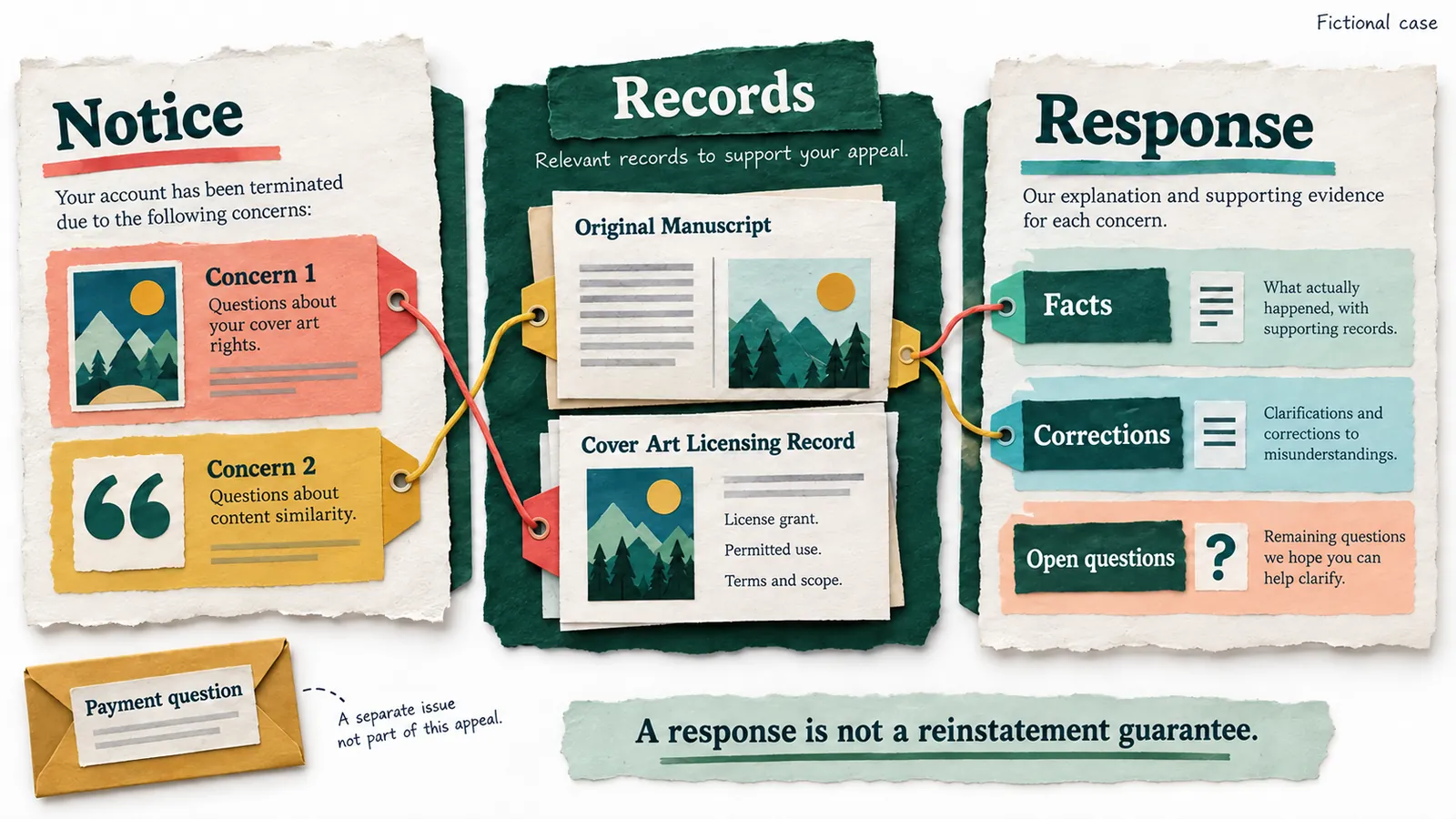
Read the termination decision before planning an appeal
A KDP account termination is not the same task as resetting a password or correcting a single book listing. Start with the actual Amazon notice: its date, stated concern, affected scope and response instructions. Do not infer termination from a failed login or a missing book. If you have no such notice, first use the account-restriction triage guide to establish what is known.
Section 3 of the KDP Terms and Conditions says Amazon will notify publishers of termination and provide appeal instructions if they believe it is erroneous. An appeal route is not a reinstatement guarantee. Use the instructions for your case rather than assuming every message accepts the same form or has the same outcome.
Extract the decision, not an imagined explanation
Keep the complete notice and distinguish its wording from your interpretation. If it names particular books or conduct, identify those records exactly. If it is broad, do not fill the gap with a confident theory about a competitor, network address or automated detector. Ask a precise question about the unresolved scope and retain the answer.
Do not apply voluntary-closure instructions to every termination
The help page What happens when I close my KDP account? describes an author-requested closure as permanent and not restorable. It is not a substitute for the appeal provision covering Amazon-initiated termination. Preserve this distinction when reading search results or advice that quotes the closure FAQ without its context.
| Event | Relevant record | Response boundary |
|---|---|---|
| Amazon termination notice | Decision and appeal instructions | Request review through the stated route |
| Author-requested closure | Closure request and confirmation | Read the permanent-closure FAQ |
| Authentication failure | Sign-in or security-code error | Recover access; do not invent enforcement |
| Title-only problem | Edition status and associated message | Resolve the named book issue separately |
Do not submit a voluntary closure request as a way to reverse an enforcement action. Likewise, restoring authentication is not a decision to reinstate publishing privileges. For those access tasks, follow the account recovery guide and keep its outcome separate from the termination case.
Preserve a usable publishing archive without attempting unauthorized access
Collect records already in your possession: the original correspondence, manuscript versions, cover source files, permissions, production invoices, edition identifiers and previously downloaded reports. If normal access remains available, retain the relevant records through the permitted interface. If it does not, mark them unavailable and ask through the appropriate support route; do not attempt to enter through someone else's account.
Make the archive useful to another reader
Separate originals from working copies. Name files by subject, version and date, and keep a short index explaining what each item proves. An image of a folder full of contracts is less useful than the particular agreement covering the disputed artwork. A timestamp without context does not establish ownership, permission or compliance.
Keep sensitive information out of public posts and sample appeal drafts. Store any necessary unredacted records privately and disclose them only through a suitable verified channel. An adviser can often assess the initial problem from a redacted chronology before needing a specific document.
Build a case file around the stated concern
Use a chronology with distinct entries for submission, notice, response, correction and decision. Link each event to its underlying record. Do not combine a proposed correction with a completed correction or treat a support receipt as a favorable review. These distinctions make it possible to describe the case accurately if another person needs to help.
| Case component | Useful content | Avoid |
|---|---|---|
| Concern map | Each stated issue and affected identifier | Unstated allegations presented as facts |
| Evidence index | Relevant version, agreement or communication | Unrelated bulk attachments |
| Correction history | Action, scope and completion date | Backdated or merely planned actions |
| Open questions | Specific ambiguity and requested clarification | Requests to reveal every internal signal |
Separate a factual dispute from a corrective plan
If you believe a decision rests on a mistaken fact, show the relevant evidence. If you identify a genuine error, describe it and the correction honestly. Do not confess to conduct you did not perform because a template tells you to, and do not deny a documented action to make the message sound stronger. Uncertainty belongs in the record as uncertainty.
Prepare a concise appeal that is specific to the decision
Address the stated concern directly, identify the case and organize the material in the order a reviewer needs it. Explain what you are requesting: review of a particular factual error, clarification of scope or consideration of documented corrections, as appropriate. Keep claims proportional to their evidence. A document supports the use it actually covers, not every title in your catalog.
A fictional outline, not a universal appeal letter
Fictional outline: "This response concerns the notice and identifiers listed below. The stated issue is recorded here. These facts are supported by the indexed records. These actions are completed, while these questions remain open. I request the review or clarification described in the notice."
Replace every part with truthful case-specific information; do not send the outline as if it were evidence. Follow the actual submission instructions and any deadline. Avoid mass-emailing competing versions, fabricated legal threats or a paid service's guaranteed approval language. No public guide can infer your reinstatement probability from the word termination.
Keep a copy of the submitted version and confirmation. If a reply requests more information, answer that request with the relevant addition. Repeating the same unsupported assertion does not strengthen its factual basis.
Treat royalties and payment access as a separate documented question
Do not assume either automatic payment of every displayed amount or automatic loss of every royalty. Section 5.4 of the KDP Terms contains payment conditions, withholding and offset provisions. The applicable facts and notice matter. A dashboard estimate, a payable statement and a bank receipt are different records.
Ask a bounded accounting question
Identify the reporting period, currency, marketplace and statement concerned, using records you lawfully hold. State whether the issue is missing access to a report, an unclear adjustment or an unpaid amount you believe is due. Ask what record or explanation is available rather than combining the question with a demand for a guaranteed future payout.
For an author-requested closure, the closure FAQ says a sign-in attempt offers a contact option for payment questions. Do not present that instruction as an appeal route for Amazon-initiated termination. For an enforcement case, retain the notice's route and ask which channel handles the specific accounting question.
For a material payment or rights dispute, obtain qualified legal advice about your jurisdiction and actual documents promptly. This article does not interpret contractual deadlines for your circumstances. Keep the appeal chronology and accounting chronology connected by case references but distinguish their requests so neither becomes lost in the other.
Protect continuity without bypassing the termination
The account rules in section 4.2 prohibit establishing a new account after termination. A new email, a purchased publisher account or a relative's identity is not a legitimate recovery method. Do not transfer files to another account to evade the decision or describe that route as a fresh start.
Check commitments before making distribution changes
Inventory the files you own, third-party permissions, collaborator obligations and any existing distribution commitments. Do not assume loss of account access automatically releases every agreement or exclusivity obligation. If a proposed new distribution step depends on an unresolved right, get that point clarified before proceeding.
Review scheduled advertising, website purchase links and reader communications against verified availability. You can maintain an accurate author website, preserve your archive and continue writing while a case remains unresolved. Do not announce that all editions are removed, or that Amazon has reversed a decision, unless you can substantiate that statement.
Record the actual decision and verify its scope
Distinguish an acknowledgment, a request for documents and a final response. Retain the wording and date. If access changes, check the affected functions and named editions rather than treating one successful login as proof of complete reinstatement. Document any unresolved accounting or title question separately.
Finish with facts, including an unfavorable result
If the decision is maintained, record that result without inventing a workaround or a secret escalation guarantee. If a further review route is offered, follow its stated requirements with any genuinely new evidence. If the issue turns out to be a listing defect rather than account termination, return to the KDP troubleshooting hub for the correct specialist workflow.
Sources and scope
Official KDP references rechecked on 16 October 2026. The current Terms and the voluntary-closure FAQ address different events. The case-file structure and outline are original educational examples, not an assessment of a private account, legal advice or a promise of reinstatement, payment or a particular response time.
Frequently asked questions
Can a KDP termination be appealed?
Section 3 of the KDP Terms provides for appeal instructions in the termination notice when a publisher believes the decision is erroneous. An appeal does not guarantee reinstatement.
Does the permanent-closure FAQ apply to every termination?
No. That FAQ describes author-requested closure. Read the actual Amazon termination notice and applicable Terms for an enforcement case.
What belongs in a termination appeal?
Identify the decision and affected records, address the stated concern, index relevant evidence and distinguish completed corrections from proposed actions.
Will I receive all outstanding royalties after termination?
Do not assume either full payment or total loss. Payment conditions, withholding, offsets and the facts of the case require separate review.
Can a service guarantee reinstatement?
No public checklist or third-party wording can establish the outcome of your private case. Avoid sharing credentials or relying on guaranteed approval claims.
Does a working login prove my publishing account was reinstated?
No. Retain the decision and verify the affected functions, editions and any unresolved accounting questions separately.