

KDP Book Ranking Dropped: Compare Before Reacting
A changed rank is a scoped observation, not a sales counter or an automatic account penalty.
Identify the surface, preserve equivalent records and select a response grounded in availability, activity and costs.
Identify the rank before explaining a drop
When a KDP book ranking drops, first record which number changed. Overall Best Sellers Rank, a category rank and a position in a particular search are different observations. They have different comparison sets and cannot be exchanged in a before-and-after story. A missing category line is different again: it may be a display question rather than a measured decline.
For a numbered rank, a larger number means a worse position within the same list. Saying "rank fell" can be ambiguous, so preserve both values and the list name. If the issue is a missing category, use the category workflow. If it is search retrieval, use the scoped search checks.
Do not make BSR stand for every kind of visibility
A book can remain available while its sales rank changes. It can also appear in one query and not be observed in another. Start with the actual surface, then decide whether you need a ranking review, listing investigation or marketing diagnosis. The KDP troubleshooting map separates those paths.
Build a comparable before-and-after record
Retain the identifier, format, marketplace, exact rank label, page URL, timestamp and time zone. Keep the original screenshot, including enough surrounding detail to identify the surface. A paperback number in one store and a Kindle number in another are not successive measurements of one series.
Record Free or Paid when applicable. Kindle Free and Paid are separate lists; the number during a free promotion cannot be compared directly with the Paid position after it ends. Also distinguish format-specific BSR from a Books category rank, which can aggregate activity across qualifying formats. Keep the exact list label rather than inferring its scope from the cover shown.
| Pair of observations | Comparable? | Defensible statement |
|---|---|---|
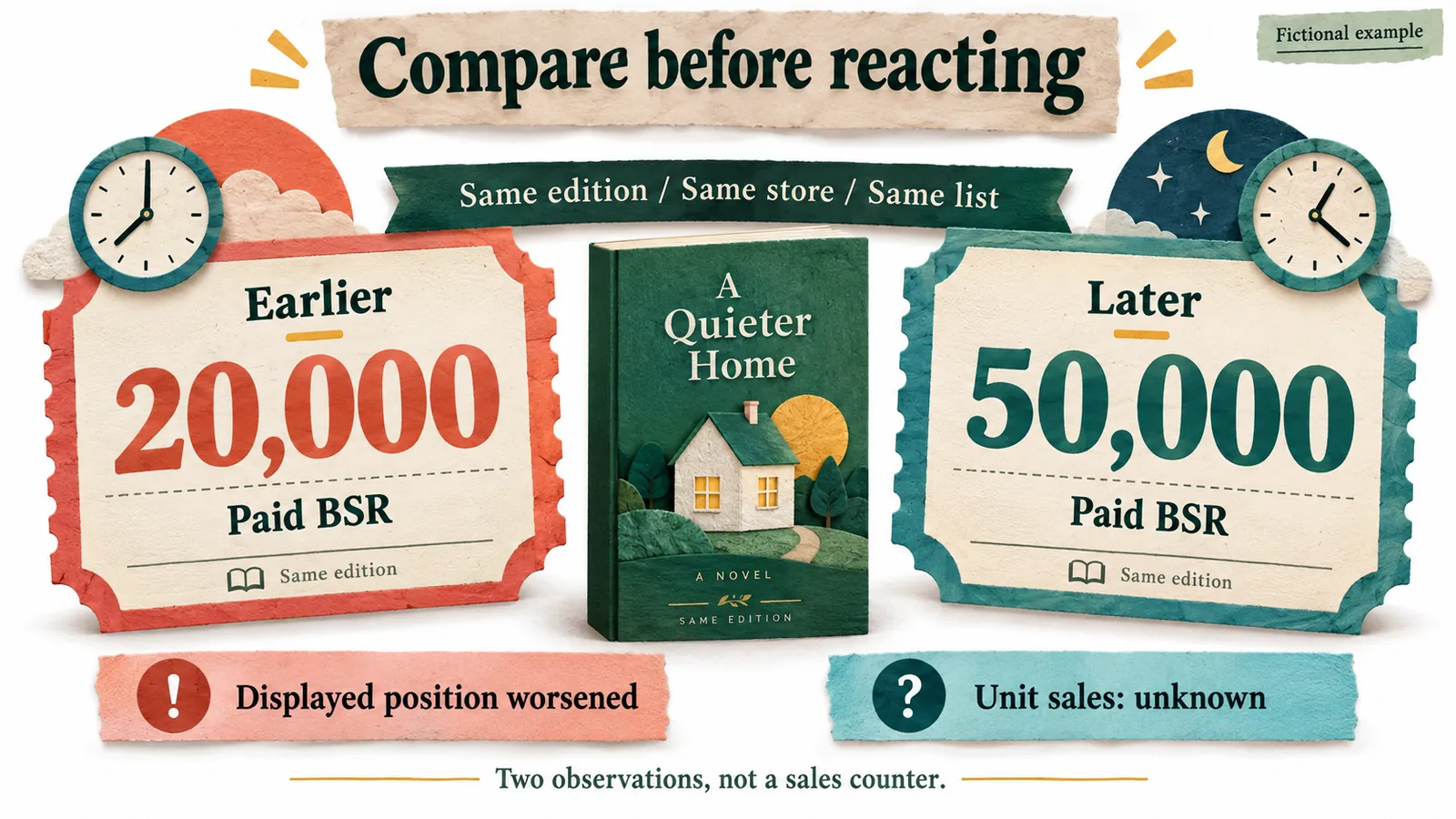
| Same edition, store and BSR: 20,000 then 50,000 | Yes, as two scoped snapshots | The displayed position worsened; unit sales remain unknown |
| Kindle BSR then paperback BSR | No | Different format records were inspected |
| Overall BSR then a category rank | No | Different ranking surfaces were inspected |
| Category rank then no visible category line | Not a numeric comparison | Investigate the display and classification context |
Leave missing measurements missing
If the earlier screenshot does not show the edition or list, label the comparison uncertain. Do not reconstruct a convenient baseline from memory. Start a new dated record with a stable context. That is more useful than assigning a precise decline to values that may describe different things.
Interpret relative movement without inventing sales volume
KDP's Sales Ranking reference describes rankings as relative customer activity with recent and historical components. Your position can change even if your own activity is unchanged. The source does not give you the complete transaction histories of competing books or a universal formula converting each position into daily sales.
A position difference is not a sales percentage
In the fictional 20,000-to-50,000 example, the displayed rank worsened. That does not establish a 150% increase in competition, a 60% fall in sales or any other sales percentage. Rank is an ordinal position, not a linear unit counter. Use your own scoped reports for transaction questions.
For the distinction in more depth, use BSR versus discoverability and the limits of BSR-to-sales estimates. A model can be labeled an estimate; it should not replace the actual publishing record or become the sole reason for a large promotion purchase.
Review the timeline before naming a cause
Put rank observations beside relevant events: promotion delivery and ending, price or category updates, an unavailable offer, and the reporting periods you can verify. Record events without declaring them causal. A rank change after an ad stopped is compatible with several explanations; sequence alone does not isolate one.
The ranking reference notes that changes can take time to display. KDP's Timelines table also distinguishes initial rank appearance and category-related updates. These are not identical promises of a fixed refresh interval. Avoid inferring a penalty from one snapshot or demanding that a particular order move the rank immediately.
Compare relevant report periods
Use KDP's Orders Report definitions to check the selected edition, market, paid/free scope and processing state. Print shipment timing and eBook payment processing can differ. A recent rank screenshot and an unfinished reporting period are not a synchronized explanation of customer activity.
Check for a separate availability or display problem
Open the retained direct URL and verify the intended edition and purchase option in the recorded region. If the page no longer works, use the disappeared-listing incident workflow. A failed destination deserves its own evidence even if rank also changed.
Check search separately
Record a title-and-author query in the appropriate department if search availability is in question. KDP's Search Results guidance does not guarantee top placement. A lower topic-query position does not prove a worse BSR, and a worse BSR does not prove universal non-indexing.
If reviews disappeared at the same time, investigate them through the missing-review workflow. Coinciding symptoms do not establish that one caused the other or that the whole account is restricted. Preserve any actual notice rather than replacing it with an algorithm theory.
Choose a proportionate response from the evidence
| Verified situation | Useful response | Avoid |
|---|---|---|
| Comparable rank movement, offer still available | Review scoped activity and promotion history | Declaring a hidden account penalty |
| Broken retail destination | Investigate the edition's availability | Buying more traffic to the broken link |
| Category line changed after an update | Check selection, publication and display timing | Treating the missing label as a numeric rank |
| Sales and retained value below the objective | Use the sales diagnosis and a bounded plan | Spending solely to restore a former number |
Do not manufacture the desired movement
A coordinated purchase burst, cancellation scheme or scripted search exercise is not a diagnostic check. Choose a truthful introduction to suitable readers if promotion is justified, with a cost allowance and outcome beyond a screenshot. Use the sales diagnosis to decide whether that is actually the next problem to solve.
Report a reproducible discrepancy, not disappointing placement
If a page or displayed record appears inconsistent, retain the identifiers, exact surfaces, timestamps and relevant change history. Ask the appropriate support channel to investigate the concrete discrepancy. A request for clarification is different from asking Amazon to guarantee a previous rank or provide competitors' private sales data.
Fictional case wording: "The retained category label changed after the recorded update. Attached are the same edition and marketplace before and after, with the submitted hierarchy and current display. Please clarify the display or classification discrepancy; I am not requesting a guaranteed ranking."
Keep an ordinary rank review out of an unrelated appeal
If you received an explicit publishing notice, follow its stated instructions and preserve the correspondence. Do not present a rank screenshot as proof that the notice is mistaken. Conversely, do not claim a restriction when the only evidence is a changed public number.
Monitor without turning the number into the objective
Choose a modest review schedule and keep comparable records. Add the actual orders, costs and interventions needed for your publishing decision. Repeated refreshing does not improve the quality of the evidence. An explanation may remain uncertain even when the visible change is real.
Finish with a bounded finding
"Displayed BSR worsened between two comparable observations" is a valid conclusion. It is not a claim of a specific sales loss, suppression or lost market share. If the business result needs improvement, continue with the bounded sales plan. A profitable, appropriate introduction is more meaningful than recovering a particular screenshot.
For a separate concern about inaccurate descriptors or weak topic-query fit, use the keyword audit. Do not infer a keyword defect from a rank pair alone or change every metadata field to chase the old number.
Sources and scope
Primary KDP references rechecked on 16 October 2026. All numeric rank pairs and case notes are fictional examples. No actual listing or account was inspected. This guide does not reveal a private ranking formula, certify sales estimates or guarantee rank recovery.
Frequently asked questions
Why can my book rank worsen when my sales seem unchanged?
Rank is relative to other activity and reflects more than one instant. Your own selected order total does not reveal the complete comparison set or private ranking calculation.
Does a larger BSR number mean a better position?
No. Within the same numbered list, a larger number means a worse position. Retain the list, edition and marketplace before comparing two values.
Can I calculate a sales-loss percentage from a BSR change?
Not from the rank pair alone. Rank is ordinal, not a linear sales count. Use compatible reports for transaction questions and label modeled estimates as estimates.
Is a ranking drop proof that my book is not indexed?
No. Search retrieval, retail availability and a displayed sales rank are different surfaces. Investigate the actual symptom separately.
Should I buy promotion solely to restore my former rank?
Define a reader-facing or economic objective first. Use a bounded allowance and relevant introduction rather than spending to recreate a screenshot.
What belongs in a ranking discrepancy record?
The identifier, format, marketplace, exact rank label, page URL, timestamps, screenshots and relevant update or promotion history, with facts separate from hypotheses.