

Amazon BSR Calculator
Compare explicit sales and per-copy royalty assumptions, with the limits of rank-derived units visible.
Amazon.com / USD only. The legacy rank lookup is uncalibrated; use your own daily baseline when available.
Build a sales scenario
Amazon.com / USD scenarios only. Rank-derived units are an uncalibrated legacy heuristic, not observed sales or a forecast. No review counts, KU income, refunds, ads or taxes are modeled.
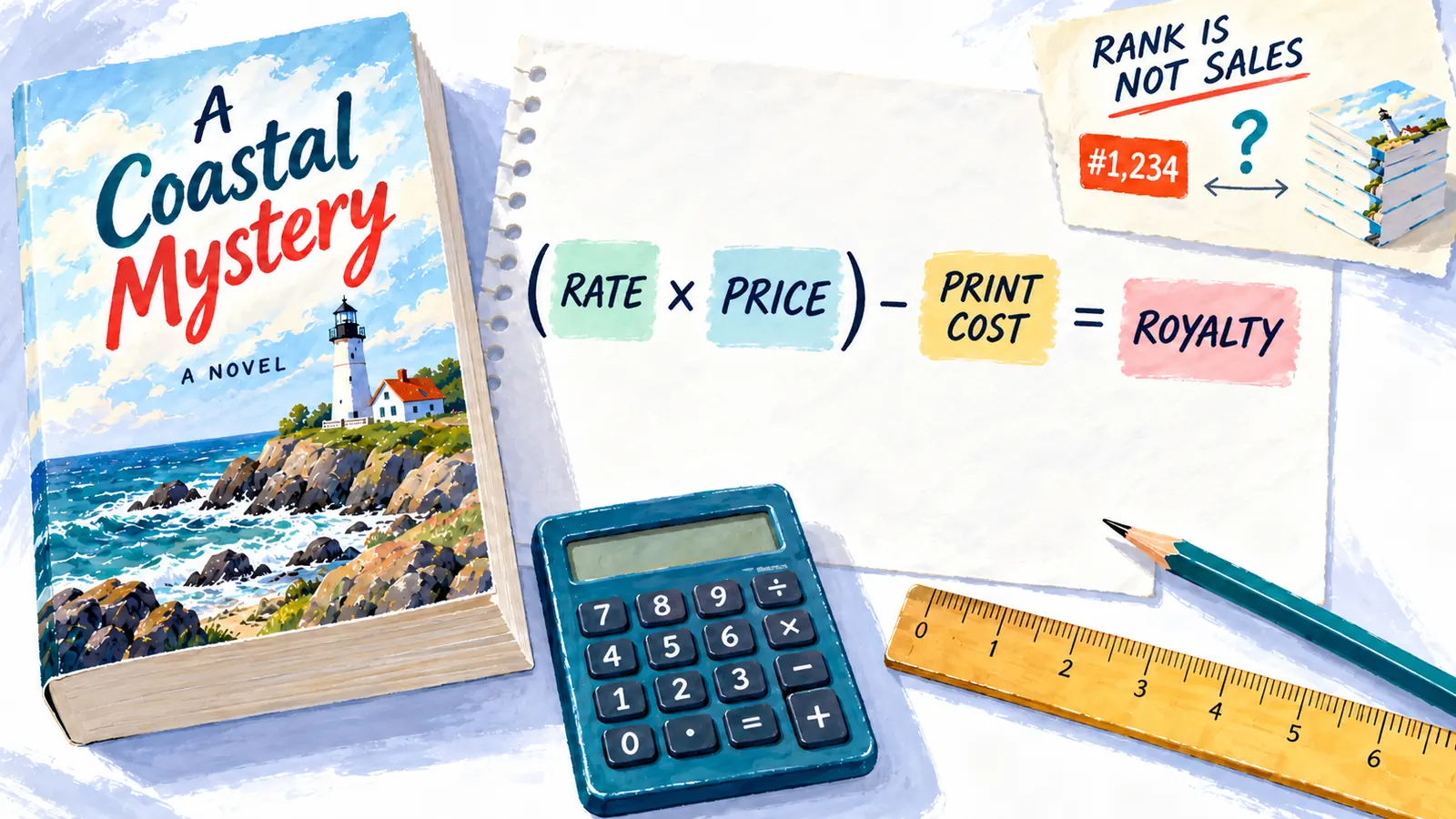
Rank is not a sales report
The calculator supports two starting points: the previous tool's fixed BSR lookup, now labeled as an uncalibrated legacy heuristic, or your own average paid units per day. Neither option observes transactions. Use a manual baseline from your reports when you have one.
KDP describes sales rank as relative customer activity. It is not an exact count of copies sold. Match the marketplace and edition, and do not substitute a category rank for an overall book rank.
| Overall BSR range | Kindle units/day | Paperback units/day |
|---|---|---|
| 1-100 | 500 | 200 |
| 101-500 | 150 | 80 |
| 501-1,000 | 80 | 40 |
| 1,001-5,000 | 30 | 15 |
| 5,001-10,000 | 10 | 5 |
| 10,001-50,000 | 3 | 2 |
| 50,001-800,000 | 1 | 0.5 |
The jumps between rows are artifacts of this coarse lookup, not Amazon sales thresholds. The table has no supplied calibration dataset or error bounds. A result should not be presented as a competitor's actual sales or used alone to justify a publishing budget.
Separate units, gross list value and royalty
This version models Amazon.com in USD. Paperback scenarios use the published US royalty thresholds: 50% below $9.99 and 60% from $9.99, less printing. The built-in printing table covers white/cream-paper black ink and standard/premium color with regular or large trim. Use your KDP quote for other supported specifications, such as groundwood, rather than assuming this table covers them.
Kindle uses the net royalty per paid copy you enter from KDP. It does not infer eligibility, delivery costs or buyer territory from the list price. Check eBook royalty guidance and your edition's pricing preview before supplying that amount.
For an original worked scenario, a 150-page regular-trim black-ink paperback has a modeled printing cost of $2.80. At $15.99, the modeled per-copy royalty rounds to $6.79. Those cost assumptions do not establish how many copies will sell. Royalties also are not profit: editing, design, advertising and other expenses are outside this calculation.
Use repeatable assumptions, not repeated random results
- The same inputs now give the same result. There is no random percentage adjustment.
- The default holds the daily baseline constant across actual calendar days. Twelve monthly rows account for the selected starting quarter and year.
- The optional seasonal profile is illustrative, not measured demand. It redistributes the annual modeled units without increasing them.
- Summary totals sum the displayed monthly figures. Fractional units represent an average scenario, not partial transactions.
- The result excludes KU page-read income, returns, tax withholding, advertising costs and review counts. It cannot determine an ARC team size or cause a rank improvement.
Read the step-by-step guide, use the rank-interpretation routine, and compare the model with BSR-to-sales evidence limits. The KDP Earnings and KDP Tools directories connect the surrounding decisions.
Official references checked on 16 October 2026. The illustration and legacy lookup are conceptual planning material, not measured market results or official Amazon reporting.
Frequently asked questions
Does the BSR lookup show actual book sales?
No. It preserves fixed tiers from the previous calculator as an uncalibrated heuristic. Their jumps are model artifacts, not verified Amazon sales thresholds.
Can I enter my own sales baseline?
Yes. Select My daily unit assumption and enter a stated average paid-unit figure. The tool uses that assumption without verifying it against an account.
Why do unchanged inputs now produce the same answer?
Random variation has been removed. Calendar rows and totals use one shared deterministic model in Astro and React.
Which royalty scenarios are supported?
Amazon.com in USD. Paperback supports the stated US printing table or your KDP quote. Kindle uses the net royalty per paid copy you provide from KDP, rather than inferring eligibility or delivery costs.
Can this estimate reviews or business profit?
No. It models units, gross list value and royalty under stated assumptions. Review counts, KU income, returns, tax withholding, advertising and other business expenses are excluded.