

Puzzle Books on KDP
A puzzle book is a solving experience, not a stack of generated pages. Rules, correctness, difficulty and physical usability need separate checks.
Use a fictional word-search collection to connect the production brief, family-specific validation, answer coverage and final proof.
A puzzle book is a solving experience, not a stack of generated pages
Choose the task the reader wants to solve, then design the rules, challenge, layout and answer support around it. Sudoku, word search, crosswords and mazes share a broad entertainment purpose, but they do not share one correctness test or one production workflow.
A theme can make a collection recognizable. It does not establish that puzzles are valid, appropriately demanding or comfortable to use. A generated file can look finished while containing repeated tasks, broken numbering or answers that belong to an earlier version.
Choose one clear starting brief
Our fictional Garden Word Sessions is an adult print collection of 60 distinct word-search puzzles, each with a target list and a linked answer. The garden theme organizes vocabulary; it does not promise botanical instruction, cognitive treatment or a measured learning outcome.
Start with the reader-task process and relevant product comparisons. This guide focuses on making a defensible puzzle product, not declaring a profitable niche from the family name.
Compare the validation work before choosing a family
The table describes editorial checks, not a live market ranking. Choose a family whose rules and validation you can review competently, using reliable tools and appropriate human checking.
| Family | Core production check | Common issue to catch |
|---|---|---|
| Sudoku | Validate givens, the intended unique solution and agreement with the answer grid. | A valid-looking layout with contradictory givens or a mismatched answer. |
| Word search | Check every target word in the allowed directions and link its location to the answer. | A listed word missing from the grid, an unexpected direction or incorrect answer coordinates. |
| Crossword | Check entries, crossings, clue accuracy, numbering and answer consistency. | A clue pointing to the wrong entry or a crossing that breaks an otherwise plausible answer. |
| Maze | Check the intended entrance, exit, traversable route and any promised path restrictions. | A blocked route, ambiguous endpoints or a solution that crosses a wall. |
Do not apply Sudoku's unique-solution requirement indiscriminately to every activity. Some designs allow multiple routes or incidental word occurrences. State the rules, then check the property you actually promise rather than rejecting valid tasks under an unrelated test.
Write the collection specification before generating the interior
Rules and content
Record the puzzle type, intended reader, allowed operations or directions, content boundaries and answer method. For the fictional word-search book, specify whether backward and diagonal words are allowed and how the target list treats spaces or punctuation.
Review the vocabulary against the theme and intended audience. A decorative plant illustration does not make an inaccurate or unsuitable word list acceptable. Keep source and rights information for any supplied word lists, artwork or other assets.
Counts and identifiers
Define what counts as one distinct puzzle. Instructions, answer diagrams and repeated grids do not become extra puzzles merely because they occupy pages. Keep stable IDs so layout changes do not quietly detach an answer from its task.
Difficulty and physical layout
Record the internal difficulty approach, grid size, page arrangement and answer placement. A working specification makes later claims inspectable. Avoid choosing a page count first and filling it with whatever a generator can produce.
Validate the source tasks and preserve the results
Use a reliable existing validator or established engine appropriate to the puzzle family. Save the result against the exact source version. Do not assume the generator's success message proves every advertised property or validates the exported book.
For the word-search example, check that all listed targets occur under the stated rules and that answer locations match. Review any duplicates or incidental occurrences according to those rules. Inspect numbering, target lists and directions alongside the grid, not as separate files with no linkage.
For crosswords, mechanical crossing checks do not replace a review of clue meaning. For Sudoku, an apparently complete solution does not establish uniqueness. For mazes, a drawn line is not evidence of a valid route if it passes through a wall.
Keep validation failures in the production log until corrected. A large collection is not ready because most tasks passed. Review a changed item and all linked supporting material again after repair.
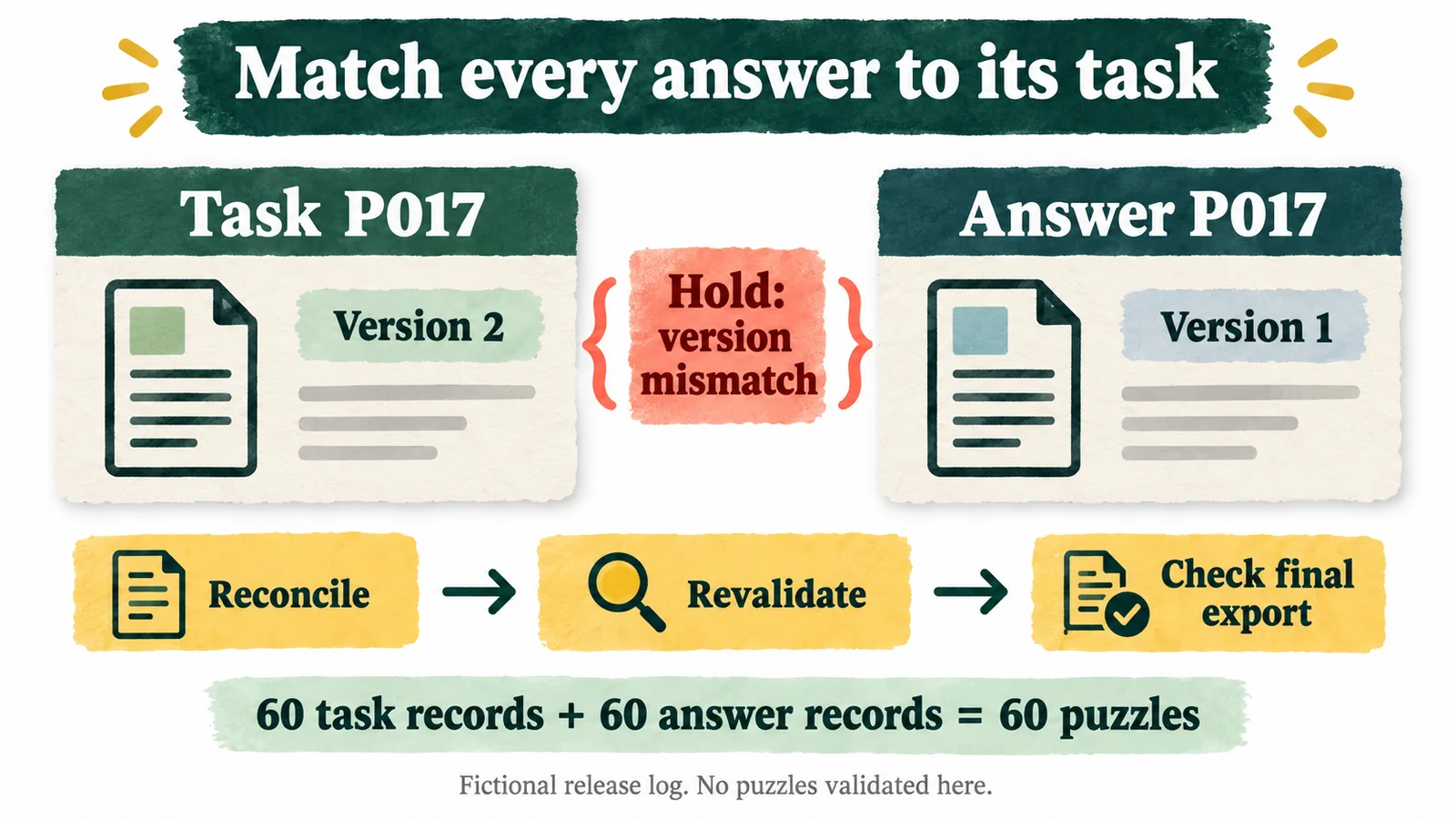
In a fictional release ledger, IDs P001-P060 identify 60 distinct tasks with 60 linked answer records: 120 records, but only 60 puzzles. Task P017 is version 2 while its answer remains version 1. Hold that pair, reconcile the answer with the revised task, rerun the appropriate validation and inspect the final export. Matching IDs or versions alone cannot establish correctness. No actual puzzle collection was validated for this example.
Validate the advertised property, preserve the evidence and repeat the check when the task or its presentation changes.
The final exported file needs another review
| Stage | Evidence to retain | Failure to resolve |
|---|---|---|
| Source validation | Task IDs, source version, rules and family-appropriate results. | Broken tasks, unsupported difficulty or unintended duplicates. |
| Layout reconciliation | A final-file check of grids, clues, lists, numbers and linked answers. | Cropped content, changed symbols or answers from an older version. |
| Physical proof | Actual page inspection for readable task and answer content. | Cramped solving space, weak contrast or inner-margin problems. |
| Release record | Final count, specification, proof corrections and accurate public claims. | A description or cover promising a different collection. |
A font substitution can change symbols; a crop can hide a clue; an inserted page can shift answer references. Inspect the exact file intended for publication. Reconcile every numbered item with its answer section rather than relying only on a spot-check of attractive pages.
Use a physical proof to inspect solving space and answer legibility. The answer section may be smaller than the task pages, but it still needs to be usable. A readable puzzle with an unreadable answer is not a complete supported experience.
Difficulty, audience and large print are separate claims
Difficulty
Describe how your internal bands are assigned and inspect representative tasks. Do not present a generator's easy or hard label as a universal certification. Different puzzle families require different difficulty judgments.
Audience
Vocabulary, instructions, prior knowledge and presentation determine the intended audience. Adults are not automatically advanced solvers, and a cheerful theme does not establish suitability for children. Avoid unsupported brain-training, treatment or intelligence promises.
Legibility
A large trim size can still contain small grids or crowded type. Check actual cells, letters, numerals, clues, lists and answers at print size. Do not equate large print with easy difficulty or infer accessibility for every reader from one physical proof.
Use the puzzle keyword guide to keep discovery wording aligned with those checks. A narrower phrase is not better when it promises a property the book has not established.
Resolve format and classification from the actual book
KDP's low-content guidance says puzzle books are not generally low-content, with exceptions. Software generation does not itself determine the classification. Review the complete interior.
The Kindle quality guidance separately lists puzzle books among content unsuited to Kindle, especially activities that require writing on pages. Do not assume a print collection becomes suitable by uploading scans or changing keywords. A genuinely instructional book about solving techniques is a different product requiring its own assessment.
Medium-content, as used in the activity-format guide, is descriptive shorthand rather than an approval decision. Compare repeated-entry products when the actual project is a log or notebook rather than a puzzle collection.
Prepare a controlled release and a relevant next step
Confirm the rights to content and assets using content guidelines. Match the title, description and sample to the actual type, count, difficulty approach and answer support using metadata guidelines.
- Keep distinct task counts separate from pages and answers.
- Validate with the correct family-specific method.
- Recheck the final export and every linked answer.
- Test physical legibility without inventing a universal certification.
Use the economics guide to include validation and proofing in the production plan. Use keyword research for language and discoverability for later visibility questions. None of those tasks substitutes for correct puzzles.
For the Sudoku branch, continue with Sudoku books, then investigate easy, hard, children's or large-print requirements separately. Those labels should follow evidence, not lead it.
Explore the KDP niche research guides to compare reader needs, competition and publishing formats.
Sources and scope
Official primary guidance rechecked on 17 October 2026. All worked examples are fictional; no actual planner, teaching activity or puzzle collection was validated.
Official KDP references were checked on 17 October 2026. The collection, validation protocol and release records are original fictional examples. No actual puzzle files, live niche demand, clinical benefit or sales result was audited. The schematic illustration is not a playable puzzle sample or proof of correctness.
Frequently asked questions
Do all puzzle families use the same validation test?
No. Sudoku, word search, crosswords and mazes have different rules and failure modes. Use a reliable family-appropriate method and inspect the advertised properties.
Does generation software prove that a book is ready?
No. Check the source tasks, linked answers, numbering, final export and physical proof. A correct source can be damaged during layout.
Should every maze or word search have the same uniqueness rule as Sudoku?
No. Some designs allow multiple routes or incidental word occurrences. State the actual rules and validate the property promised for that activity.
What counts as a puzzle in the collection?
A distinct task under the stated rules. Instructions, answer diagrams and repeated grids do not become extra puzzles merely because they occupy pages.
Does large print mean easy difficulty or a children's audience?
No. Legibility, challenge and audience are separate claims. Check actual printed tasks and answers rather than inferring them from trim size or theme.
Are the pictured layouts playable or validated puzzle samples?
No. They are conceptual illustrations. No actual puzzle files, solutions or market demand were audited for this guide.