

How to Find KDP Niches
Turn a broad subject into a specific book you can deliver. Define the reader task, inspect relevant evidence and test a small piece before committing the manuscript.
A fictional watercolor project shows how to compare ideas, state exclusions and choose a go, hold or stop decision without inventing demand.
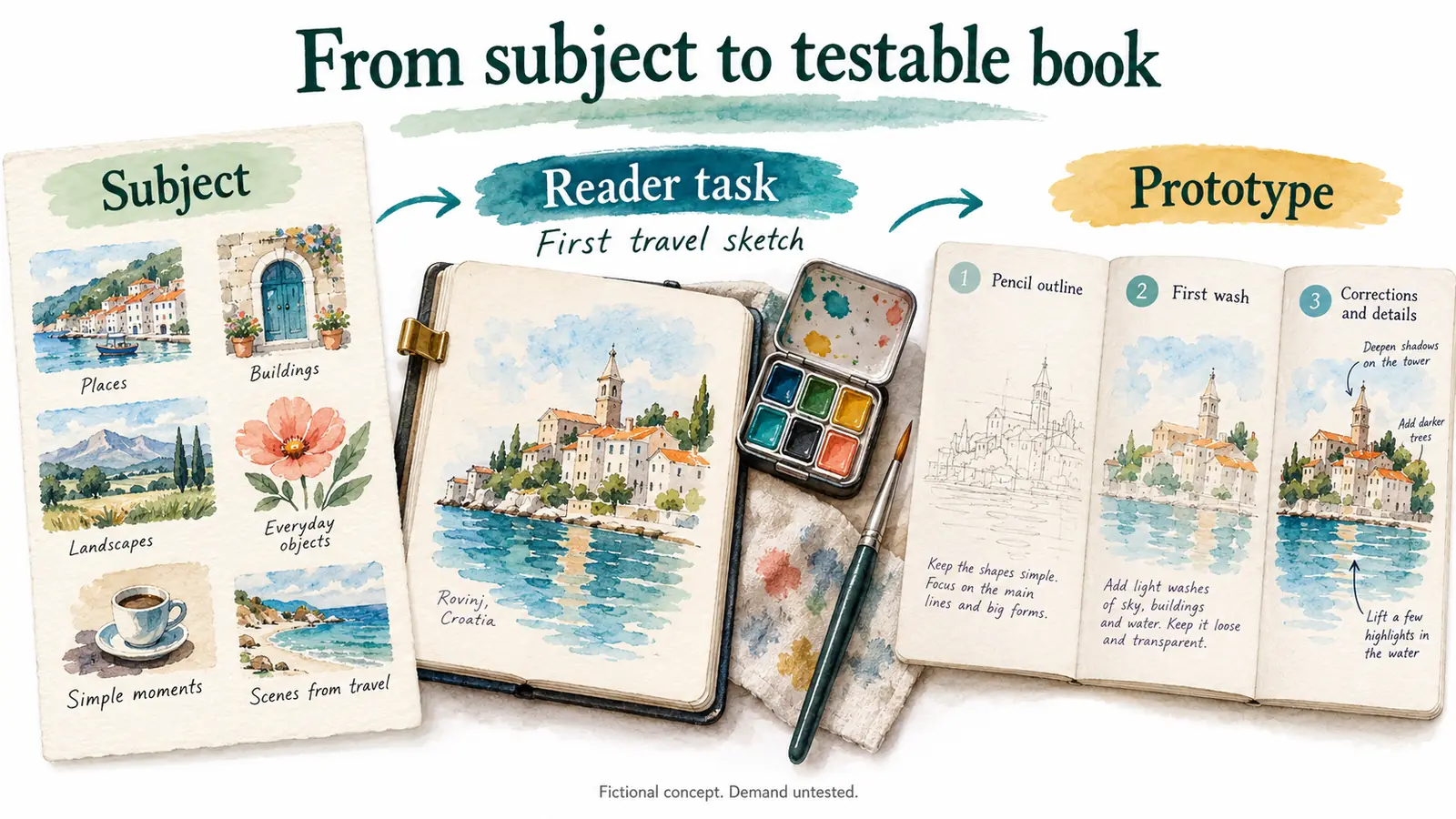
Find a niche by defining a reader task, not collecting attractive labels
A useful KDP niche hypothesis names a reader, a task or experience, and a constraint that changes the book they need. Watercolor is a subject. A portable watercolor lesson book for adults making their first travel sketches is a more specific publishing concept. It tells you what to investigate and what a sample lesson should demonstrate.
Specificity alone is not evidence of demand. You can invent an extremely narrow audience that few people recognize or that you cannot reach. Treat the concept as a hypothesis until you have inspected comparable books, tested a representative piece of content and identified the uncertainties that remain.
Write a sentence with boundaries
Try: "This book helps adult beginners make simple location sketches with a small watercolor kit, through worked examples and short practice tasks." Then record what it does not promise: advanced studio painting, children's activities, professional certification or guaranteed artistic results.
That sentence is a research control, not final marketing copy. If a candidate phrase or category needs a promise outside the boundaries, investigate the mismatch before expanding the project.
Check your ability to deliver before judging the market
Make an evidence inventory
List the instruction, original examples, illustrations, permissions and review work the proposed book requires. For the watercolor concept, the author needs to demonstrate actual steps, explain materials clearly and supply usable images. Enjoying finished paintings is different from being able to teach how to make one.
Mark what you can create yourself, what needs a collaborator and what remains uncosted. A seemingly quiet niche can be impractical if production requires expertise, assets or checking you do not have. Do not substitute AI-generated confidence for subject review.
Check the format early
A compact instructional paperback, a blank sketchbook and an illustrated eBook serve different tasks. Decide which one you are proposing before comparing them. Keep any paper, color, layout or device requirements in the production brief rather than discovering them after writing the manuscript.
Research can expose an idea worth learning more about. It does not oblige you to publish in a field you cannot serve competently.
Compare three concepts before choosing one
This is an original fictional planning exercise, not an audited marketplace comparison. Assume the author can teach basic watercolor, create original step images and test a sample lesson with adult beginners. No search volume, actual competing titles or sales estimates are supplied.
| Concept | What would make it useful? | Next decision |
|---|---|---|
| Small-kit travel watercolor for adult beginners | A complete first sketch, clear prerequisites and realistic portable materials. | Go to prototype: matches the author's stated teaching capability. |
| Advanced studio oil-painting techniques | Specialist demonstrations, technique review and production knowledge the author lacks. | Stop for this project: an adjacent art topic is not equivalent expertise. |
| Blank travel sketchbook with prompts | Useful page design and prompts, rather than a full instructional sequence. | Hold as a separate product: different task, format and classification questions. |
The go decision approves a small test, not a full print run or a profitable niche. The hold decision keeps an alternative without confusing it with the instructional book. The stop decision protects the project from a mismatch that keyword research cannot fix.
Investigate language and shelves without calling them demand counts
Select the Amazon marketplace, language and format you intend to study. Begin with a few plain descriptions of the reader task. Record the query, date, department and whether a result is sponsored. Inspect the book's actual page before treating its cover as a relevant comparison.
The KDP keyword guidance supports accurate content-based wording. Public suggestions can provide vocabulary, but they do not give you verified purchase counts. Visible listings do not reveal publishers' backend keyword entries.
Use KDP's category guidance to understand relevant shelves and available options. A category is not a complete niche definition, and an obscure shelf is not proof of easy entry. Stay with accurate content fit rather than selecting an unrelated category because it looks less crowded.
For a bounded collection process, use the keyword hub and the manual research notebook. For the actual competitor comparison, continue with Amazon book niche research.
Turn an apparent gap into a testable question
Describe the missing job precisely
"Competitors are weak" is not a usable observation. "The inspected samples show finished pictures but do not demonstrate the first pencil outline" is more specific. Record which books and samples you inspected and what they actually showed.
Even that observation does not establish an unmet market. The missing step might appear later in the full book, the sample might be unavailable, or experienced readers might not need it. State the alternative explanations before calling the gap a commercial opportunity.
Design a small falsification test
For the example, create a lesson that includes the outline, first wash and correction notes. Ask intended readers to attempt it. If they cannot begin without extra materials or explanation, the proposed beginner promise needs repair. If they can use it, you have evidence about lesson usability, not proof of future purchases.
A niche hypothesis becomes useful when you can name what would make you revise or abandon it.
Test one representative lesson before expanding the manuscript
Build the sort of lesson the book will repeatedly deliver, not a polished introduction that avoids the difficult instruction. Include prerequisites, materials, a worked example and a practice task. Keep the format close enough to the intended edition that image and layout problems are visible.
Recruit a small, clearly described group of intended readers for feedback. Ask where they stalled, what they needed to assume and whether the task matched the description. Do not portray a convenient sample of acquaintances as a representative buyer survey.
A useful question is: "What were you able to do from these pages without asking me for help?" Another is: "What did the description lead you to expect that was missing?" These questions locate content gaps without asking readers to predict Amazon sales.
In a fictional prototype check, the first wash asks for a second brush that was not listed in the small kit. Mark the lesson Hold: either revise the method to use the declared kit or correct the prerequisites, then re-test without extra coaching. A completed thumbnail does not resolve that missing requirement or establish demand.
Feedback and newsletter interest are not obligations to buy or post public reviews. Keep any public-review request separate and optional; use the ARC team guide for a structured reader-feedback process.
Use a go, hold or stop gate before committing the full book
| Gate | Question | Action if unresolved |
|---|---|---|
| Reader task | Can you describe a recognizable use case and its boundaries? | Hold: narrow or reframe the concept. |
| Comparable books | Have you inspected relevant editions and actual content signals? | Hold: compare books before calling the shelf empty or crowded. |
| Delivery capability | Can you create and review the promised instruction and assets? | Stop or find qualified help before committing. |
| Prototype and feasibility | Does the sample work, and is the production burden understood? | Repair or test again; do not upgrade uncertainty to approval. |
- Keep observations separate from interpretations.
- Define the smallest useful next test.
- Record missing evidence instead of inventing a niche score.
- Do not label a prototype decision as a sales forecast.
BSR can be recorded in a separate observation log, but it does not replace these gates. Use BSR research for the rank-specific context and limitations.
Finish with a book brief, not an unqualified niche label
Record the intended reader, task, format, prerequisites, exclusions, example plan, production requirements and unresolved questions. Include the evidence that changed your decision. This gives writing, illustration and positioning a common reference.
Before turning the brief into a title or description, check KDP metadata guidelines. Research does not authorize inaccurate promises. For the broader publishing and visibility context, use the discoverability hub.
Choose the next action honestly: build the prototype, inspect another relevant book, resolve a rights issue, find a reviewer or stop. Progress is a better-defined decision, not necessarily another book in production. Use the niche research hub to move from this brief to the relevant format, validation or economics guide.
Sources and scope
Official primary guidance rechecked on 17 October 2026. The examples are fictional; no live marketplace audit or reader trial was conducted.
Official KDP references were checked on 17 October 2026. The watercolor concepts, decision gates and prototype questions are original editorial examples. No live niche demand, competitor inventory, reader study, production quotation or sales result was audited. The illustration is conceptual rather than a tested lesson.
Frequently asked questions
What should I start with when finding a KDP niche?
Write a reader-task hypothesis: who the book serves, what they want to do or experience, and which constraints change the book they need. Treat it as a question to test, not proof of demand.
Does a narrow topic prove that a niche is viable?
No. A specific concept still needs relevant comparisons, delivery capability and a realistic way to test its promise. Narrow wording alone does not establish buyers.
Should I choose a niche before checking my expertise?
Check capability early. Identify the instruction, original examples, assets, permissions and review work needed to deliver the promise competently.
What does a go decision mean in this guide?
It means proceed to a bounded next test, such as a representative lesson. It is not approval for a full investment or a forecast of profitable sales.
Can prototype feedback prove future purchases?
No. It can reveal whether intended readers can use the content and whether the description matches it. A small feedback group is not a representative buyer survey.
What should the research handoff contain?
The reader, task, format, prerequisites, exclusions, content plan, production requirements, evidence and unresolved questions. That is more useful than an unqualified niche label.