

Sudoku Books on KDP: Build a Checked Puzzle Collection
A Sudoku book needs more than a stack of grids: each puzzle, answer and difficulty claim must survive the publishing process.
Build a collection specification, separate mathematical validation from reader testing, and choose a format that fits the solving experience.
A Sudoku collection starts with a reader promise
Choose the solving experience before choosing a cover or puzzle count. Is the book a first introduction, familiar practice, or a demanding collection for experienced solvers? Specify the rules, intended techniques, hint provision and print format. "Hundreds of puzzles for everyone" leaves the most important production decisions unresolved.
For classic Sudoku, Nikoli's rules require digits 1 through 9 in the grid, with every row, column and bold-bordered 3-by-3 block containing those digits. State variant rules separately if you add constraints. Do not assume a familiar-looking grid explains a different puzzle.
Write a one-page collection brief
Record the audience, exact number of distinct puzzles, difficulty policy, grid size on paper, answer format and instructional scope. Decide what the book will not provide. A practice collection with final answers is not a step-by-step teaching course, and an adult beginner product is not automatically suitable for children.
Choose a Sudoku direction deliberately
Difficulty, audience and physical readability are separate product decisions. The directions below help define a brief; they are not verified demand rankings or a claim that any branch is profitable. A large grid can contain a hard puzzle, and an easy puzzle can still be printed too small to use comfortably.
| Direction | Reader promise | Specific check |
|---|---|---|
| Easy Sudoku | Approachable solving within a stated technique range | Check complete solving paths and unexplained difficulty jumps. |
| Hard Sudoku | A deliberate reasoning challenge for experienced readers | Calibrate the grading profile and inspect logical bottlenecks. |
| Large-print Sudoku | A clearly specified, readable physical layout | Inspect digits, candidate space and answer pages at actual size. |
| Sudoku for children | Instructions and tasks suited to the intended learner | Check prerequisites, guidance and age-related positioning separately. |
Do not confuse an audience label with a design change
Relabeling the same interior for different readers does not establish suitability. If a proposed edition changes only its cover, acknowledge that limited differentiation. Compare the actual pages, not merely the names of competing books.
Research the actual solving product
Use a repeatable niche-research process in the intended Amazon marketplace. Record query, date, print format, edition and visible interior features. Separate classic Sudoku from variants and mixed puzzle collections. A result count combining these products does not measure direct competition or sales.
Where samples are visible, inspect instruction depth, puzzle density, difficulty labels, hint structure and answer readability. Mark unavailable interiors unknown. A review describing a wrong answer suggests a quality question to investigate; it does not prove every title from that publisher is defective or that your alternative will sell.
Keep an evidence sheet with observations, interpretations and tests. Convert "readers mention cramped grids" into a proposed layout test. Before producing multiple editions, identify the reader benefit that would justify a genuinely different interior.
Build a traceable puzzle-to-answer pipeline
Use an established generator or solver rather than asking an image or text model to improvise production grids. Record the tool, version, settings and source or permission basis. Tool availability does not by itself establish rights to republish downloaded collections, illustrations or explanatory text.
Validate every puzzle, not a sample of the batch
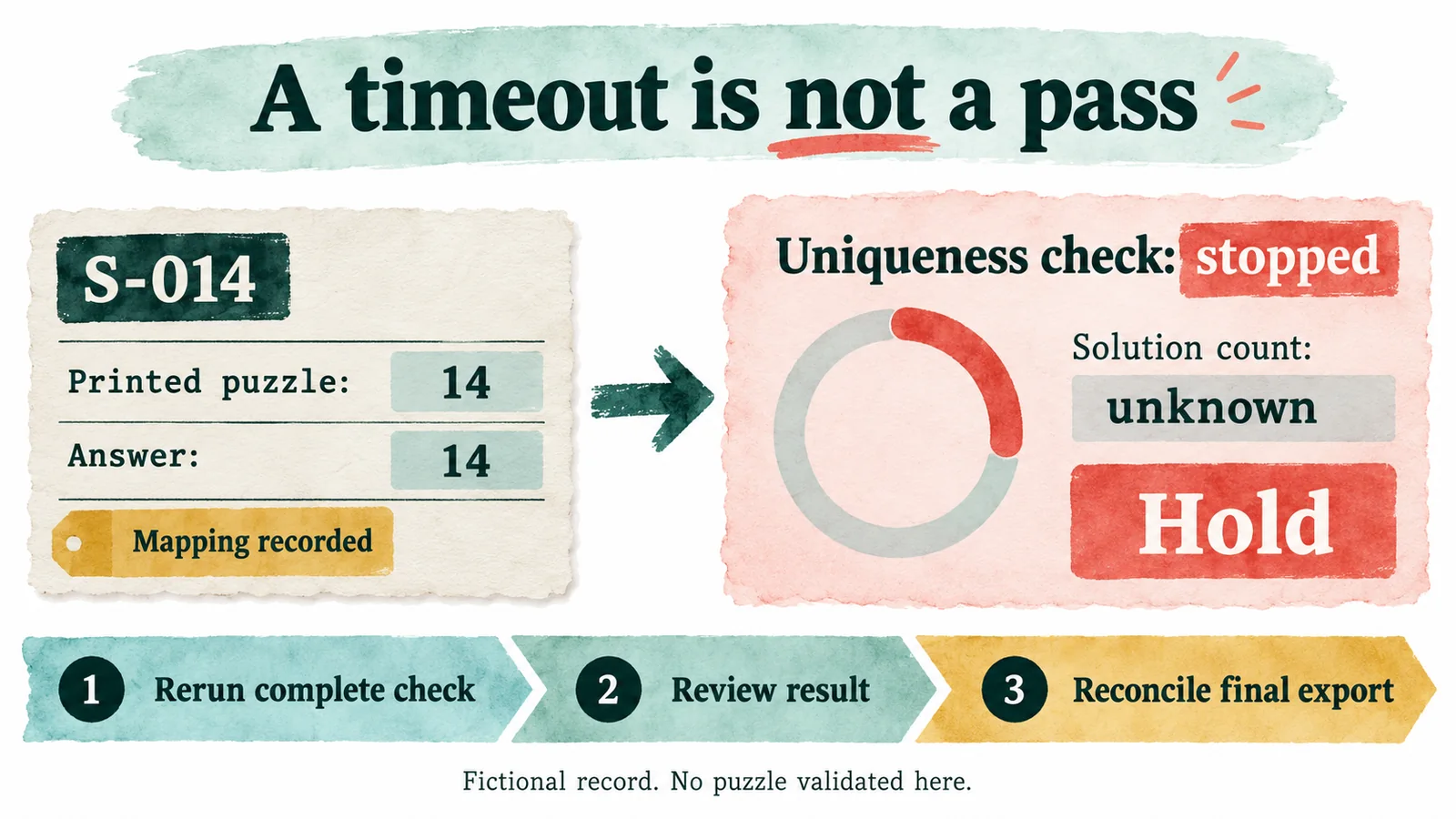
Assign a stable internal ID to each starting grid and its answer. Check dimensions, permitted symbols and conflicting givens. Then use a reliable validator to count solutions, stopping after a second solution is found. Zero solutions means invalid; two or more fails a unique-solution collection; a timeout or incomplete search means unknown, not passed.
A solver finding one completed grid is not a uniqueness check. Verify that the answer preserves every given and satisfies every row, column and block. Checking only a total such as a row sum is insufficient: repeated digits can still produce the expected total. Confirm the actual required digit set.
Reject exact duplicates before layout. Where your product promises distinct underlying puzzles, also decide whether rotations, reflections or digit relabelings count as repeats. Record the normalization policy rather than implying that a visually transformed grid is necessarily new content.
A fictional production record might link internal item S-014 to printed puzzle 14, answer 14, a source-grid fingerprint and a validation result. That describes traceability; no grid or validation run is supplied here. Generate puzzle and answer pages from the same records so that manual copying cannot silently break the link.
Extend the fictional S-014 record with printed puzzle 14 and answer 14 correctly linked, but a uniqueness search that stopped before completion. Its solution count stays unknown and its release decision is Hold. Re-run a complete check on the exact source, review the result and reconcile the final export; matching identifiers do not turn an unfinished search into one verified solution. No actual solver run is reported by this example.
Grade difficulty separately from correctness
Uniqueness establishes a mathematical property, not a reader's experience. Use a documented logical solving profile for difficulty selection, then test representative puzzles with intended readers. A search algorithm's speed does not tell you how readily a person will notice the next deduction.
Keep grading reproducible
HoDoKu's creator documentation describes configurable technique levels and scores, not an absolute difficulty scale. Record the chosen configuration and retain the solving trace. Treat its label as evidence under that profile, not a universal comparison with every publisher.
Do not use clue count as the only difficulty label. Inspect the techniques required, interruptions in progress and consistency across the sequence. If the collection promises logical solving without guessing, reject any item for which your review has not established such a path. That is a separate gate from a brute-force uniqueness check.
Carry the evidence through layout and export
Choose puzzle density after testing the intended final page size. Leave room for writing and, when relevant, candidate notes. Make block boundaries distinct without overwhelming the digits. Put puzzle numbers where they remain visible during use, and make hints optional rather than accidentally exposing them beside the grid.
| Gate | Evidence to retain | Reason to stop |
|---|---|---|
| Puzzle integrity | Complete validation and unique-solution result per item | Conflict, multiple solutions or an unfinished check. |
| Difficulty fit | Fixed grading profile and reviewed solving trace | A puzzle falls outside the stated technique range. |
| Answer mapping | Stable ID linking starting grid, printed number and answer | A missing, misnumbered or mismatched solution. |
| Printed usability | Export inspection and physical proof observations | Clipped digits, cramped writing space or unreadable answers. |
Inspect the exported PDF, not just the source template. Check every puzzle and answer mapping after pagination; compare rendered givens against source records where tooling permits. A perfect data file cannot prevent a font substitution, clipped cell or wrong page insertion.
Order and inspect a physical proof of the chosen configuration. Try writing near the binding and reading the answer section. A home printout can reveal layout issues but does not establish the final paper or binding experience. Do not imply lay-flat construction or certified accessibility without an appropriate basis.
Set up an accurate KDP product
KDP's low-content guidance places puzzle books among examples that are not generally low-content, with exceptions. "Medium-content" is descriptive publishing shorthand, not an official approval category established by that guidance. Classify the finished book rather than copying notebook setup choices.
KDP identifies write-on-page puzzle books as unsuited to Kindle. A static eBook is not an equivalent solving surface. Follow the metadata guidelines: match cover and title, describe the actual difficulty scope, and state whether final answers, hints or worked explanations are included.
Count distinct playable puzzles accurately. Repeated grids, answer diagrams and instructional examples are not additional collection items unless clearly distinguished. Do not imply an app, erasable pages or accessories that the print product does not supply.
Release only a collection that meets its brief
- Every puzzle has a completed integrity and uniqueness check.
- Every answer preserves its linked starting grid.
- Difficulty evidence uses a recorded configuration.
- Instructions, hints and capacity match the listing.
- The exact exported file and physical proof have been inspected.
Check production costs with the profitability framework; more puzzles can increase page count or reduce usable space. Use keyword research to describe the real product. The broader puzzle-book guide covers other puzzle families, while discoverability guidance connects accurate positioning with relevant searches. None of these steps guarantees sales.
Explore the KDP niche research guides to compare reader needs, competition and publishing formats.
Sources and scope
Primary references rechecked on 17 October 2026. Worked production scenarios are fictional; no collection validation, reader study or print proof was performed.
Official KDP pages, Nikoli's classic rules and HoDoKu's creator documentation linked above were checked on 17 October 2026. Production gates and the fictional record are editorial recommendations, not an executed puzzle audit. The illustration is a conceptual layout, not a playable puzzle, verified answer or tested commercial product.
Frequently asked questions
Are Sudoku books low-content on KDP?
KDP lists puzzle books among examples that are not generally low-content, with exceptions. Classify the actual interior. Medium-content is descriptive shorthand, not an official approval category established by that guidance.
Does finding one solution prove a Sudoku puzzle is unique?
No. A completed grid proves that at least one solution exists. Use a reliable solution-counting check and reject unresolved checks or puzzles with multiple completions.
Can clue count determine Sudoku difficulty?
Not by itself. Review the logical techniques and solving path under a recorded profile, then calibrate with intended readers.
What should connect each puzzle to its answer?
Keep a stable ID linking the starting grid, validation result, printed puzzle number and answer. Recheck those links after pagination and export.
Can I use the same collection for easy, hard and large-print editions?
Difficulty and layout are separate requirements. A new label does not establish suitability; define and test the actual promise of each edition.
Can a write-in Sudoku book be a Kindle eBook?
KDP identifies write-on-page puzzle books as unsuited to Kindle. A static eBook is not equivalent to a physical solving surface.