

Easy Sudoku Books on KDP: Design a Clear First Solving Experience
An easy Sudoku collection should let its intended reader understand the rules and make progress without an unexplained leap in technique.
Define the permitted solving methods, separate beginner instruction from unguided practice, and test the printed experience before making easy or relaxing claims.
Easy Sudoku needs a defined starting reader
Decide whether the reader has never solved Sudoku, knows the rules but wants practice, or prefers familiar low-effort sessions. These are different promises. A book labeled easy may still frustrate a first-time reader if it assumes candidate notation or skips the explanation of a block.
Write the intended starting knowledge into the brief. Specify classic 9-by-9 Sudoku or explain any variant. Describe whether the book teaches techniques or simply provides practice. Avoid a claim such as "anyone can finish every puzzle in five minutes"; solving time depends on the person and conditions, not just the label.
Separate difficulty from age and print size
Easy does not mean a children's product, and larger digits do not make the logic easier. For audience-specific decisions, see Sudoku for children; for physical presentation, see large-print Sudoku. Keep those requirements separate from the difficulty profile.
Define what easy permits
Use the classic rules accurately: each row, column and 3-by-3 block must contain digits 1 through 9. Explain that the task is placement, not arithmetic. Then define the techniques the reader is expected to use before selecting the collection.
HoDoKu's singles documentation distinguishes a last missing digit, a digit with only one possible position in a unit, and a cell with only one remaining candidate. These are different ways of finding a forced placement. Teach the ones your collection requires rather than introducing every advanced technique.
| Design choice | What the reader needs | Editorial boundary |
|---|---|---|
| Last missing digit | Recognize the digit absent from a nearly complete unit | Explain row, column and block before expecting this move. |
| Only possible position | Check where one digit can still fit in a unit | Show the exclusions in an original checked example. |
| Only remaining candidate | Combine row, column and block restrictions for one cell | Explain candidate notation if the book uses it. |
| Techniques outside the brief | Understand when the book expects more advanced logic | Exclude them or teach them explicitly and revise the positioning. |
Freeze the selection profile
Record the solver version, enabled techniques and grading settings. HoDoKu's rating guidance makes clear that its configuration affects labels. Use a saved profile for consistent filtering, then inspect complete traces. The setting named easy in one tool is not a universal industry threshold.
Research beginner expectations through actual interiors
Use niche research in one intended marketplace. Separate first-lesson books from unguided practice collections and mixed-difficulty editions. Record visible instruction pages, grid density, hint provision and answer format. A promising cover is not evidence that the interior supports a novice.
Maintain an evidence sheet. If readers mention an abrupt increase in difficulty, investigate the collection's selection policy in your own prototype. Do not translate a few comments into a demand estimate or assume a high puzzle count is the reader's main priority.
Build a first-lesson-to-practice sequence
Consider the fictional "First Steps Sudoku" brief: a short rules introduction, four worked teaching examples, sixty distinct practice puzzles and linked final answers. This is a proposed collection, not a generated or validated book. The four teaching examples and answer grids are not included in the count of sixty practice puzzles.
Teach one deduction at a time
In a worked example, identify the relevant unit, explain what is already excluded, and justify the next placement. Make sure the explanation is true at that exact state. Do not use an answer key to assert a value without showing why the stated rules force it.
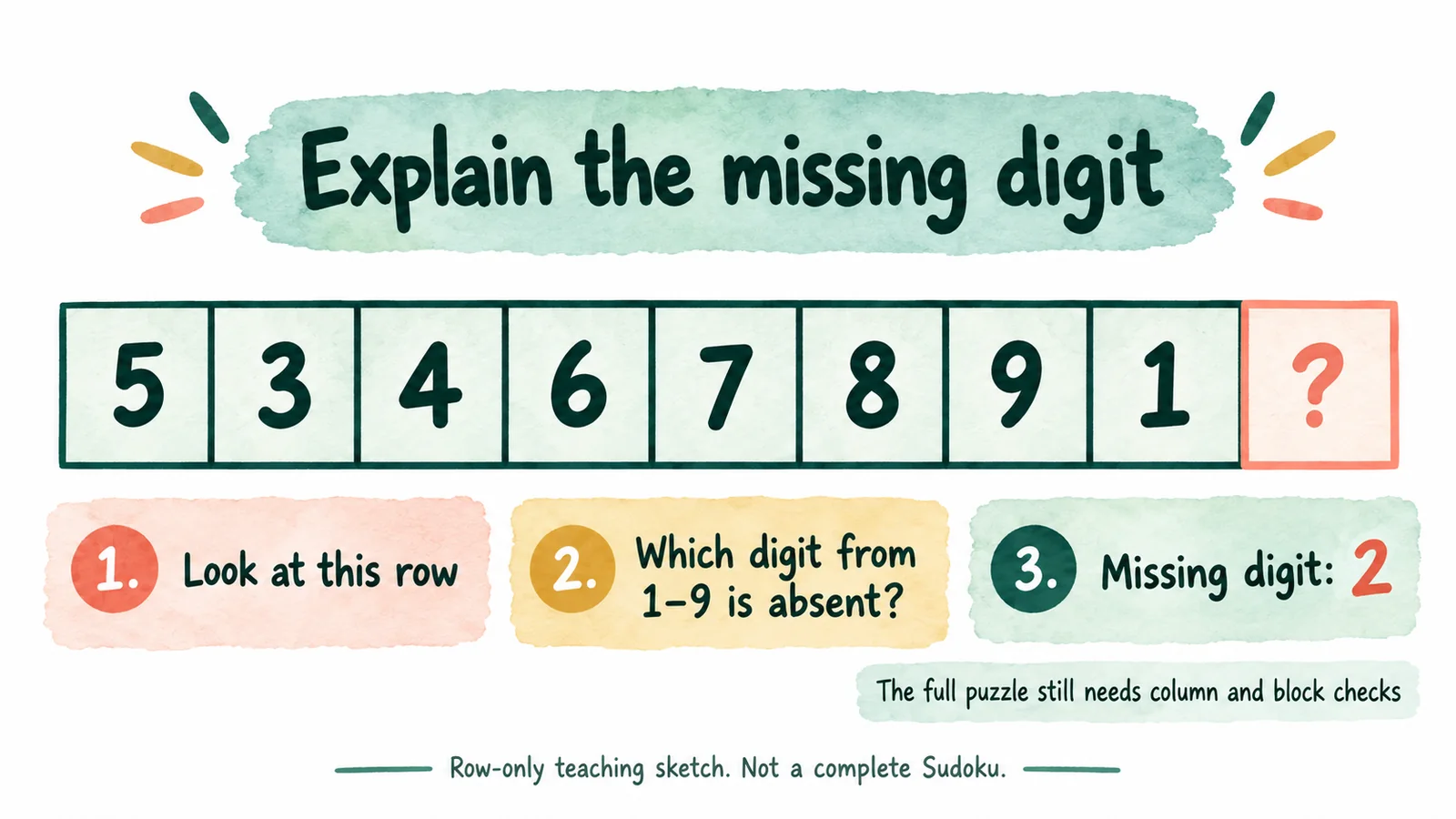
For a row-only teaching sketch, consider 5, 3, 4, 6, 7, 8, 9, 1, [blank]. Of the digits 1-9, only 2 is absent. A staged explanation first identifies the row, then asks which digit is missing, then names 2. This checks a last-digit inference for one unit only: the full puzzle still needs compatible column and block constraints, and no whole-grid validity or uniqueness follows from this sketch.
Order early practice so readers can apply what has been explained. If later sections require a new method, introduce it before those puzzles. Do not create an unexplained jump simply because the next generated grid happened to have a higher score. Easy practice can remain consistent instead of escalating toward advanced material.
Explain how to restart or check a mistake without presenting mistakes as failure. A concise statement about preserving givens and erasing only the reader's entries can help distinguish the puzzle from the solving process. Keep instruction readable and separate from the space needed for actual solving.
Provide optional help without exposing the answer
Use a graduated hint structure
A first hint might direct attention to a unit. A later hint can identify the relevant digit or cell; the final explanation shows the justified placement. Keep each stage separately labeled and located so the reader does not accidentally reveal the whole solution while looking for a small nudge.
Bind hints to the exact puzzle ID and state. A hint written for the opening grid may be confusing after a reader has taken a different valid path. State whether it applies to the initial position or to a displayed intermediate position. When an intermediate diagram is needed, verify that every added value and candidate exclusion is justified.
Do not call a completed grid a step-by-step solution. Final answers support checking; worked explanations support learning. Say which you provide. If the product has no hints, make that clear instead of suggesting that assistance is included through a decorative help icon.
A useful beginner hint explains the next justified action. It does not merely reveal a number from the answer and ask the reader to trust it.
Validate the whole collection and test the reader journey
Apply the production checks in the Sudoku publishing guide to every item: valid givens, exactly one solution, a correct linked answer and duplicate control. Reject a timeout or incomplete uniqueness check rather than treating it as success. Mathematical correctness is necessary, but it does not establish ease.
Review complete logical traces under the chosen profile, not just the first few moves. Then ask intended beginner readers to try representative puzzles on paper. Do not coach every next move during the test; that would conceal the gaps you need to find. Allow them to stop, ask questions or use the published hint path.
| Test moment | Observe | Possible revision |
|---|---|---|
| First instructions | Can the reader explain the rule and identify a block? | Rewrite terminology or add an original checked diagram. |
| First independent move | Can a taught technique be applied without prompting? | Improve the example or change the opening selection. |
| Later sticking point | Is the required deduction within the stated scope? | Replace the puzzle or teach the missing method. |
| Printed use | Can digits, notes and answer references be read comfortably? | Reduce density or improve contrast and numbering. |
Record the puzzle ID, point of confusion and hint used. Time can describe that session but should not become a guaranteed completion promise. A small usability test does not establish learning gains, mental-health benefits or market demand.
Preserve usability in the print product
Inspect the exported file and a physical proof at the chosen trim size. Test space for ordinary handwriting, candidate marks where needed, binding-side access and the answer section. A crowded answer page can undo otherwise readable puzzle pages. Check numbering after any pagination change.
KDP lists puzzle books as not generally low-content, with exceptions; classify the real interior. Its quality guidance identifies write-on-page puzzles as unsuited to Kindle. Do not assume notebook settings or a static eBook are equivalent choices.
Use the metadata guidelines to describe the actual reader, format, puzzle count, hints and answers. Avoid unsupported claims of therapeutic effects, universal accessibility or guaranteed relaxation. A clear beginner practice brief is a more defensible promise than an outcome the book has not demonstrated.
Publish only within the defined beginner scope
- Rules and prerequisites are clear before the first practice grid.
- Every puzzle passes integrity and uniqueness checks.
- Complete traces stay within the stated technique policy.
- Hints and worked examples match their exact puzzle states.
- The proof supports comfortable solving and answer lookup.
Compare the distinct challenge promise in hard Sudoku rather than silently mixing the two. Check costs with the profitability framework, then use keyword research and discoverability guidance to position the actual collection. Revise when the first independent solving experience fails the brief.
Explore the KDP niche research guides to compare reader needs, competition and publishing formats.
Sources and scope
Primary references rechecked on 17 October 2026. Worked production scenarios are fictional; no collection validation, reader study or print proof was performed.
Official KDP guidance, Nikoli's rules and HoDoKu's singles and creator documentation linked above were checked on 17 October 2026. The collection brief, hint policy and test plan are editorial proposals. Only the missing-digit set calculation in the conceptual row-only sketch has been checked. No complete Sudoku, collection, solving trace, reader study or learning outcome was validated.
Frequently asked questions
What should easy mean in a Sudoku book?
Define the intended reader and permitted techniques, then check complete solving paths. Easy should describe a reviewed scope rather than a universal time limit or clue-count rule.
Does easy Sudoku automatically mean Sudoku for children?
No. Age suitability, instruction and physical readability need separate consideration. An adult beginner collection is not automatically appropriate for every child.
What is the difference between a hidden and a naked single?
A hidden single gives a digit only one possible position in a unit. A naked single leaves only one possible digit in a cell. Explain the methods the collection expects.
Are answer grids the same as worked solutions?
No. Final answers support checking, while worked solutions explain justified steps. State whether the book includes answers, hints, worked explanations or a combination.
How should I test a beginner collection?
Validate every grid and answer, review the full technique path, and observe intended beginners using representative printed puzzles without coaching every move.
Can I promise that every easy puzzle takes five minutes?
A fixed completion guarantee is not supported by a difficulty label. Session time depends on the reader, route and conditions.