

Hard Sudoku Books on KDP: Calibrate Challenge, Not Clue Count
Hard Sudoku should offer a deliberate reasoning challenge, not a broken grid, tiny type or an arbitrary shortage of clues.
Set a grading profile, inspect the solving path and test with experienced readers. Then carry the evidence through hints, answer pages and the final print file.
Hard Sudoku needs a challenge contract
Define the reasoning experience before applying the word hard. Is the collection intended for solvers comfortable with candidate notes, readers practicing named techniques, or people seeking sustained unguided challenges? State prerequisites, hint provision and any excluded methods. "Almost impossible" is not a production specification.
Use the classic rules accurately, as described by Nikoli, unless the book explicitly introduces a variant. Keep difficulty separate from physical readability: tiny digits and cramped cells make a book inconvenient, not logically demanding. An experienced reader still needs room to reason and write.
Distinguish a challenge collection from a course
If the book assumes advanced knowledge, say so. If it claims to teach techniques, provide original, checked explanations before expecting their use. A final answer grid alone is not a lesson or a documented logical solution. For the foundational workflow, use the Sudoku collection guide.
Separate four different kinds of evidence
A valid grid, a unique solution, a high software rating and a difficult human solving session are not interchangeable. Keep separate records for each claim. A fast computer search may confirm an answer without offering the kind of reasoning your readers expect.
| Check | What it establishes | What it does not establish |
|---|---|---|
| Rule validity | Givens and completed answer obey the specified constraints | That no second completion exists. |
| Uniqueness | Exactly one completion under the stated rules | A particular difficulty or a human-readable solving path. |
| Logical grading | A result under recorded techniques and settings | A universal rating shared by every publisher. |
| Reader calibration | How selected intended readers encounter the puzzle | A guaranteed solving time or proof of market demand. |
Reject clue count as the sole difficulty rule
Removing more givens is not a sufficient grading policy. Record clue count as a descriptive property, but evaluate the actual deductions. Symmetry and visual sparsity also do not prove challenge. A broken puzzle with no valid solution is defective, not exceptionally hard.
Research the advanced solving promise
Start with niche research in the intended marketplace. Separate classic collections, variants, technique manuals and mixed-level books. Compare visible candidate space, explanation depth, hint provision and how difficulty is described. A title saying expert does not reveal its grading method.
Keep an evidence sheet with query dates and visible features. Treat comments about inconsistent challenge as a testable question, not an automatic opportunity. Do not infer sales volume from result counts or assume that experienced readers all want the same techniques.
Identify a concrete product difference: a stated method range, staged hints, consistent challenge bands or more usable working space. If the distinction is only a dramatic adjective on the cover, the production brief is still incomplete.
Make the grading profile reproducible
HoDoKu's creator documentation explains that technique levels and scores are configurable. Preserve the version and configuration used for filtering. Its rating is not an absolute measure; changing settings can change a label without changing the puzzle.
Record the profile, not just the output label
Retain enabled techniques, their order, weights, thresholds and whether search or guessing is allowed. Save the starting grid, the result and a readable trace under a stable ID. If the tool supports reproducible generation settings, retain those too. Do not invent a supposedly universal score cutoff for hard Sudoku.
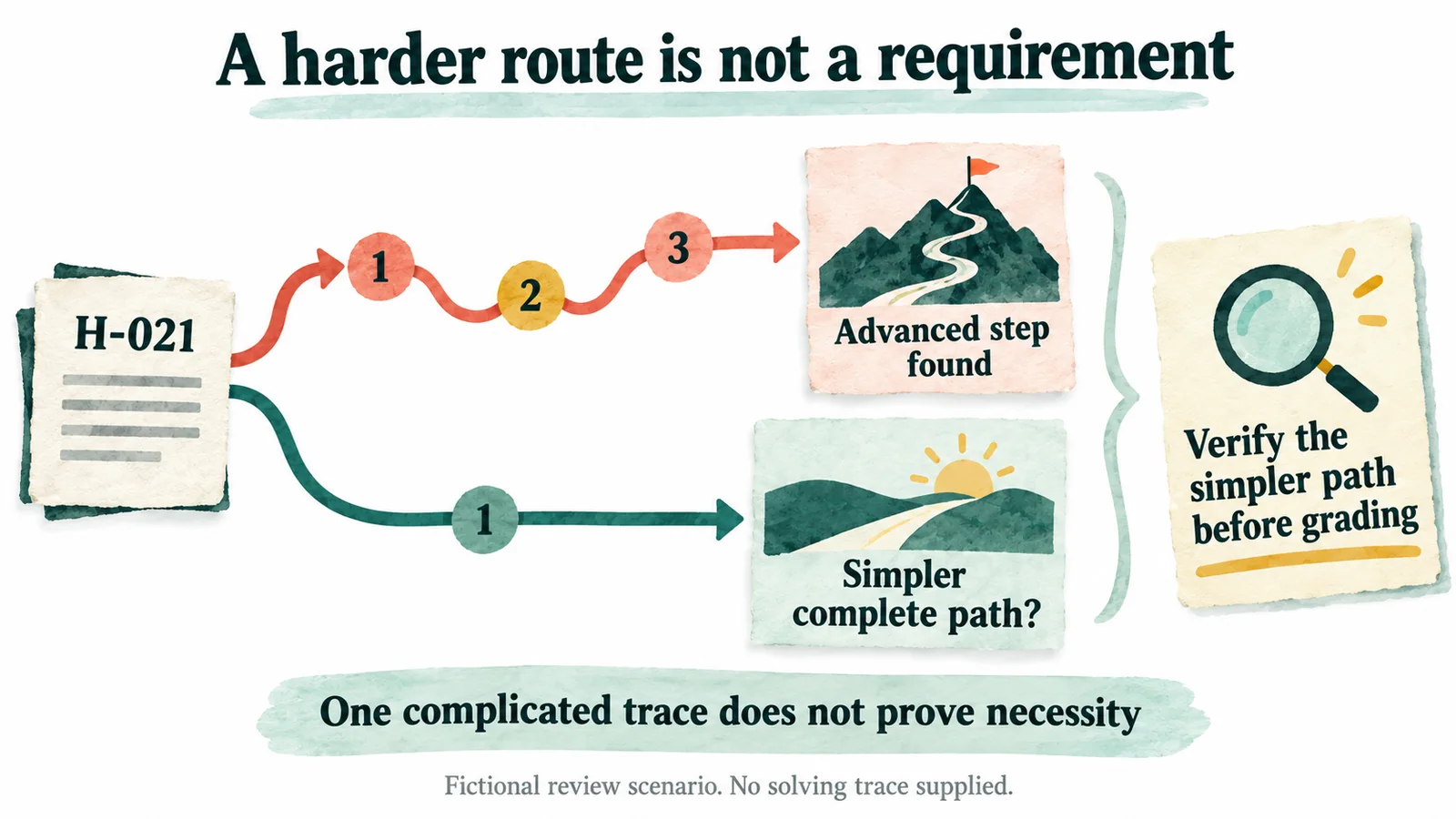
A logical trace shows one route, not necessarily the easiest route. If a complex step appears, check whether simpler allowed deductions can bypass it. A puzzle that has a complete easy path should not be presented as requiring advanced logic merely because a solver found a longer route.
Use an established solver or validator and review its documented behavior. A uniqueness check based on complete search serves a different purpose from a logical grader. Techniques that assume uniqueness must not substitute for independently checking that the starting puzzle actually has one solution.
Inspect bottlenecks, explanations and hint states
For a no-guessing collection, retain a verified logical path to completion for every puzzle. When a grader stops, determine whether the puzzle lies outside the enabled technique set, the configuration is wrong, or the item should be rejected. Do not describe an incomplete logical check as proof that guessing is required or that the puzzle is exceptionally difficult.
A named pattern needs its full conditions
HoDoKu's X-Wing explanation describes a digit confined to the same two columns in two rows, allowing eliminations elsewhere in those columns; the roles can be reversed. Four marked cells alone are not enough if other candidate positions invalidate the pattern. Do not paste a technique label onto an unchecked diagram.
A hard collection need not require X-Wings in every puzzle. Choose techniques according to the actual brief. If hints explain a bottleneck, bind each hint to a reproducible position, identify the relevant deduction and verify all candidate marks. Readers may follow another valid route, so distinguish an opening-state hint from an intermediate-state explanation.
Preserve the reason for an elimination, not merely the resulting answer. Software success and a convincing printed explanation are separate checks.
Calibrate a collection, not one impressive puzzle
Consider the fictional "Focused Challenge Sudoku" brief: forty-eight distinct puzzles in four editorial bands, twelve per band, with optional hints and final answers. These bands are internal ordering choices, not official difficulty categories. No puzzle set or grading run has been created for this guide.
In a fictional H-021 review scenario, suppose a simpler permitted route is verified to completion alongside a trace containing an advanced step. Regrade or exclude it from an advanced-required band; the complicated trace does not prove necessity. Removing it from the proposed 48-item collection leaves 47 retained items, not a finished 48-puzzle book. A replacement needs all integrity, uniqueness and grading checks. This is a conditional editorial scenario, not an executed solving trace.
Ask experienced intended readers to solve representative items from each band without receiving the answer in advance. Record the puzzle ID, route, sticking points, hints and any suspected defect. Completion time is contextual evidence, not a promise. Do not discard feedback simply because it disagrees with the tool's score.
| Finding | Investigate | Possible decision |
|---|---|---|
| An easy alternative route | Whether simpler techniques complete the puzzle | Downgrade or replace it rather than claim advanced necessity. |
| A solver stops | Profile limits and completeness of the logical review | Mark unresolved; do not label the interruption a passed check. |
| Readers disagree strongly | Different prerequisites, routes and candidate habits | Clarify the audience or rebalance the selection. |
| A hint fails at its shown state | Incorrect candidates, numbering or version mismatch | Repair the hint and recheck its linked puzzle. |
Validate every puzzle for rule integrity, exactly one solution and answer correspondence, regardless of which items receive reader testing. Control duplicates, including transformed repeats when your distinctness promise requires it. A new clue pattern is not automatically a new underlying challenge.
Keep demanding logic physically usable
Test the proposed grid size with realistic candidate notes and ordinary handwriting. Inspect block boundaries, digit distinction, erasure space and binding-side access. Do not reduce everything to fit an inflated puzzle count. More writing room may be more useful than decorative difficulty badges.
Reconcile each starting grid with its numbered answer and any hint after layout. Inspect the exact exported PDF and a physical proof. Check that candidate diagrams remain legible in print and that answer pages have not been compressed beyond usability. Changing pagination can break otherwise correct references.
Use the large-print guide for the separate presentation intent. Do not imply accessibility certification, guaranteed lay-flat binding or universal writing-tool compatibility from a screen preview. Difficulty should come from reasoning, not avoidable production obstacles.
Publish an accurate challenge promise
KDP identifies puzzle books as not generally low-content, with exceptions, and write-on-page products as unsuited to Kindle. Classify and format the actual book. Under the metadata guidelines, describe real contents rather than unsupported ranking or outcome claims.
- Every item has completed validity and uniqueness checks.
- The grading configuration and logical traces are retained.
- Advanced necessity is not inferred from a single complicated route.
- Hints, answers and printed numbers match the same records.
- The proof supports candidate notation and answer lookup.
Keep easy Sudoku as a different reader promise, not filler inside an advertised hard collection. Check costs with the profitability framework. Use keyword research and discoverability guidance to describe the verified scope; no rating, puzzle count or cover claim guarantees sales.
Explore the KDP niche research guides to compare reader needs, competition and publishing formats.
Sources and scope
Primary references rechecked on 17 October 2026. Worked production scenarios are fictional; no collection validation, reader study or print proof was performed.
Official KDP guidance, Nikoli's rules and HoDoKu's creator and basic-fish documentation linked above were checked on 17 October 2026. Calibration bands and production checks are editorial proposals, not executed engine tests or a reader study. The illustration is conceptual, not a playable puzzle, valid candidate state or demonstrated logical proof.
Frequently asked questions
What makes a hard Sudoku collection credible?
A clear challenge brief, completed integrity and uniqueness checks, a saved grading profile, reviewed logical paths and calibration with intended experienced readers.
Does an advanced step in one trace prove it is necessary?
No. Another valid route may use simpler deductions. Check for easier alternatives before claiming that advanced logic is required.
Are difficulty scores directly comparable across tools?
Do not assume so. HoDoKu documents configurable levels and scores; preserve the version and settings and avoid presenting one output as a universal standard.
Does a solver stopping prove that a puzzle requires guessing?
No. The enabled techniques or configuration may be insufficient. Mark the logical review unresolved until the claim has been established.
Can a uniqueness-dependent technique replace a uniqueness check?
No. A method that assumes uniqueness does not independently prove that the starting grid has exactly one solution.
Should hard Sudoku use smaller grids to increase challenge?
No. Physical inconvenience is not logical difficulty. Provide usable digit and candidate space and verify the printed layout separately.