

Planner Niches: Build a Schedule That Fits the Reader
A planner niche is a recurring planning problem with a page layout that helps the reader decide what happens next.
Compare dated and undated formats, develop an undated weekend-project example, and check task capacity, calendar accuracy and physical usability before publishing.
Planner niches begin with a recurring decision
A planner niche is a recurring planning problem, not simply a calendar with a themed cover. Identify who makes the plan, how far ahead they look, and what decision the page supports. Scheduling appointments, choosing weekend tasks and coordinating an event require different layouts even when buyers use the same word, "planner."
Write a short brief: "This reader uses this page at this interval to decide these actions within this capacity." Capacity matters. A page that invites twelve priorities for a two-hour session encourages an unrealistic plan. A useful structure should expose constraints rather than disguise them with motivational language.
Separate planning from retrospective recording
A journal may record what happened; a notebook leaves capture open. A planner focuses on what comes next. Reflection and notes can support that job, but they should not displace the schedule or make every entry a lengthy exercise.
Compare dated, undated and project-based formats
Choose the time structure before designing decorative pages. Dated products give the reader a fixed calendar; undated products require date entry but can accommodate breaks. Neither format establishes demand or guarantees productivity. The following directions are product hypotheses, not a bestseller list.
| Possible format | Reader's planning job | Main design risk |
|---|---|---|
| Dated weekly planner | Place commitments in a known calendar period | Incorrect weekday alignment or too little room on busy days. |
| Undated weekly planner | Plan selected weeks without filling skipped periods | Repeated date entry or unclear week-start convention. |
| Project-session planner | Choose a feasible next step and required materials | Excessive fields for a short, informal session. |
| Event-preparation planner | Sequence tasks before a reader-supplied event date | Assumed lead times or missing responsibility and dependency fields. |
Do not force all planning styles into one book
An hourly workday grid and a flexible hobby-session page solve different problems. Combining both can create unused sections. State which decision the main spread serves, then remove features that belong to another audience. Specialized financial, health or professional planning claims require more than a generic checklist.
Research routines and competing formats
Start with niche research and identify the intended marketplace, reader and period. Separate current dated editions from older editions and undated alternatives. Record the query date, calendar coverage and format. An outdated planner's presence in search is not evidence that buyers still want that year.
When interiors are visible, compare actual task capacity, appointment intervals, page order and note space. Mark unavailable interiors unknown. Review complaints can suggest tests: cramped weekends, tiny date boxes or unclear carry-forward pages. These are hypotheses to evaluate with your own layout, not reasons to copy a competitor's proprietary design.
Keep an evidence sheet linking each proposed feature to an observed need or a direct usability question. If the product is only a generic weekly grid with a different cover, acknowledge that limited differentiation. Search visibility and cover appeal alone do not establish a workable business case.
Develop an undated weekend-project planner
Consider the fictional "Weekend Project Planner" for adults organizing informal creative hobbies. It is not a safety manual, training course or commercial project-management system. One spread holds a reader-entered date, a modest session goal, available time, materials already owned, materials to obtain, and the next action.
Start with the constraint, then the task
Use an example such as preparing materials for a handmade paper display. The reader has one short session and cannot complete the entire display. The planner should help them choose a feasible preparation step, not encourage a full project commitment. Include a place to record a blocker without treating it as personal failure.
Keep a small continuation area for unfinished work. Carry-forward should preserve the next action and relevant context, not require recopying every detail. A skipped weekend should not break the page sequence. If the product is sold as undated, do not print a hidden annual dependency that makes later pages unusable.
Determine how many complete planning spreads fit after introductory material and notes. A book with fifty spreads does not automatically provide a full year of weekly planning. State the actual usable capacity, and distinguish the fictional sample entry from content included in the final product.
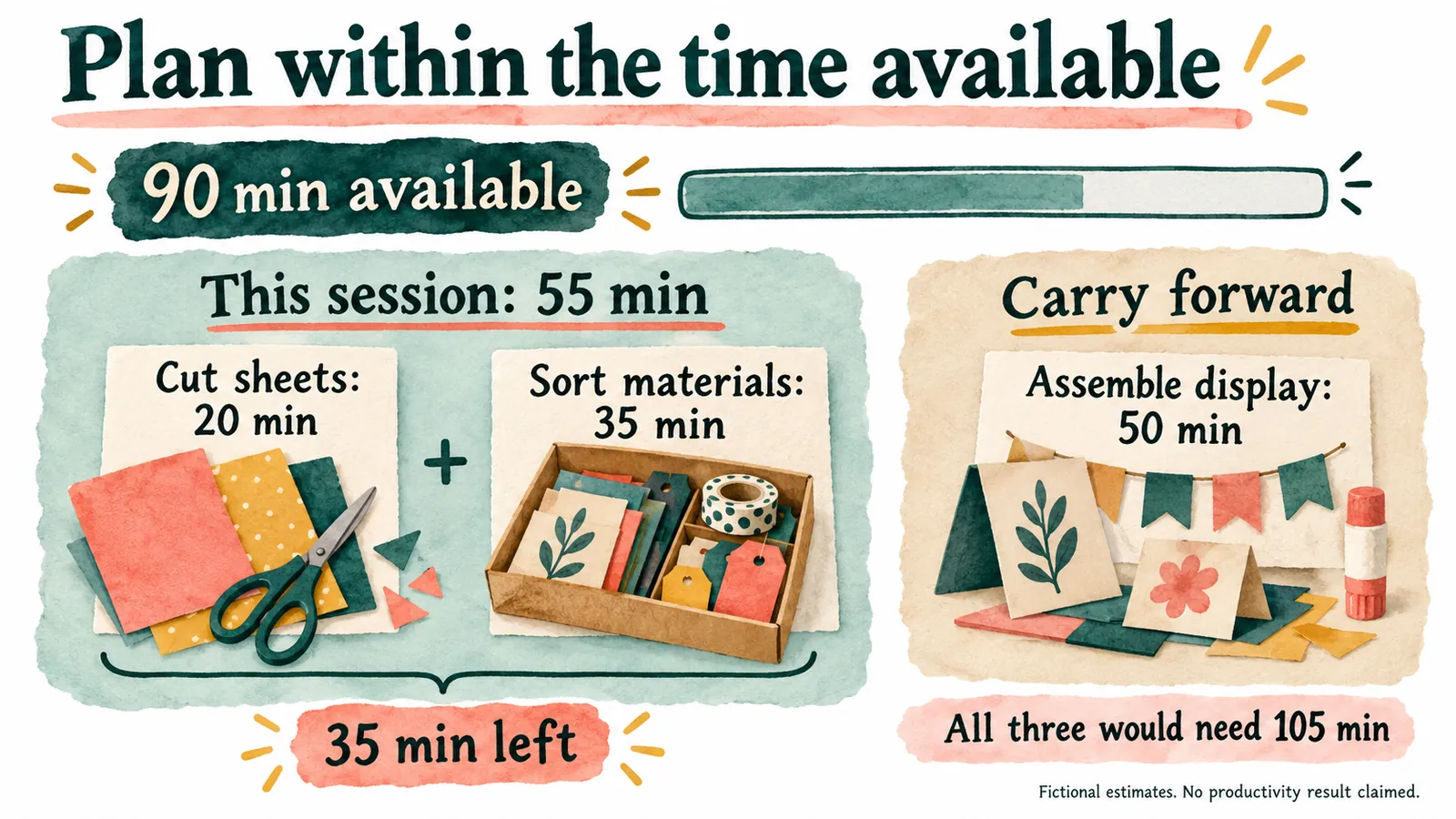
For a fictional 90-minute session, estimate 20 minutes to cut sheets, 35 to sort materials and 50 to assemble a display. All three total 105 minutes, exceeding capacity by 15. Choosing the first two gives 55 planned minutes and 35 unallocated; carry the 50-minute assembly task forward with its materials and next action intact. These are invented estimates, not measured task times or evidence of improved productivity.
Audit every calendar dependency
Dated products need a date-level audit
For a dated edition, create a reference dataset for the exact coverage period and compare every printed date against it. Use a trusted date library or calendar source for the underlying sequence, then independently inspect the exported file. Verify month lengths, weekday alignment, leap days where applicable, and transitions between months and years.
Define week start, date format and locale explicitly. Monday-first and Sunday-first layouts are not interchangeable. If including holidays or regional observances, identify the intended jurisdiction and verify them against authoritative sources for that year. Omitting holidays is preferable to presenting an unchecked universal calendar.
Undated does not mean structure-free
Check the labels and sequence even when dates are blank. An undated weekly spread still needs consistent weekday order, enough date-entry space and a clear explanation of how to begin. If you include annual or monthly reference pages, they introduce separate date dependencies. This example deliberately includes no preprinted calendar and makes no claim about a specific year's dates.
Audit the exported page, not just the template. A correct source calendar can still become an incorrect printed spread through pagination, copying or export mistakes.
Test an ordinary week and a difficult one
Print sample spreads at final size. Ask intended readers to plan representative fictional sessions before using private schedules. Observe whether they understand the fields, can fit realistic tasks, and can resume after interruptions. Do not claim that completing a trial proves improved productivity.
| Planning state | What to test | Possible correction |
|---|---|---|
| Normal session | Can a goal, materials and next action fit naturally? | Resize fields based on real responses, not symmetry. |
| Overloaded session | Can the reader see that tasks exceed available time? | Add a simple capacity field or reduce priority slots. |
| Blocked task | Can the missing item or dependency be recorded? | Provide a concise blocker area rather than more generic notes. |
| Skipped or unfinished session | Can planning resume without losing context? | Clarify carry-forward and keep date entry independent. |
Inspect a physical proof after early paper tests. Check binding-side writing space, rule visibility, page order and whether the final spread has a usable ending. Record the file version and proof configuration. Do not promise lay-flat construction, universal pen compatibility or certified accessibility based on a screen preview.
Align classification, description and edition
KDP lists planners as common low-content examples, while noting exceptions. Classify the actual interior. Use the low-content publishing guide for identifier and presentation choices, rather than assuming the word "planner" settles every setup decision.
Follow KDP's metadata guidelines with a title matching the cover. State dated or undated, coverage if dated, week-start convention where relevant, trim size and complete planning capacity. Do not use obsolete year references to describe a new edition or imply appointments, stickers or accessories that are not supplied.
Products primarily designed for writing on pages are unsuited to Kindle. Do not advertise a static eBook grid as equivalent to a physical write-in planner. A substantive planning manual would be a different product with different reader expectations.
Choose publish, revise or stop
- The planning horizon and main decision are explicit.
- Dates and locale-dependent features are checked when present.
- Normal, overloaded and interrupted sessions remain usable.
- The stated capacity matches complete spreads in the final file.
- The description and proof support the same physical product.
Check costs and seasonality in the profitability framework. Use keyword research to describe the real format and discoverability guidance to connect it with relevant searches. Revise a planner that looks organized but cannot accommodate ordinary use. Stop when the claimed specialization cannot be supported by its pages.
Explore the KDP niche research guides to compare reader needs, competition and publishing formats.
Sources and scope
Official primary guidance rechecked on 17 October 2026. All worked examples are fictional; no actual planner, teaching activity or puzzle collection was validated.
Official KDP low-content, metadata and Kindle-quality guidance linked above was checked on 17 October 2026. Planner concepts and workflow tests are editorial proposals, not verified sales opportunities. The undated illustration is conceptual, not an audited calendar or evidence of a finished product's construction.
Frequently asked questions
What makes a planner niche useful?
A clear reader, planning horizon, recurring decision and realistic capacity define the layout. A themed cover alone does not demonstrate that the planner solves a particular problem.
Is a dated or undated planner better?
Dated planners supply a fixed calendar and need date-level verification. Undated planners require reader-entered dates and can accommodate breaks. Suitability depends on the reader's routine.
What should I audit in a dated planner?
Verify coverage, weekday alignment, month lengths, leap days when relevant, week start, date format and exported page order. Check any regional holidays against authoritative sources for the exact year and jurisdiction.
Can an undated planner still have calendar errors?
Yes. Weekday order, inconsistent labels or dated reference pages can create problems. Check all calendar-dependent elements, even when the main date fields are blank.
How do I handle unfinished tasks in the layout?
Test a concise carry-forward method that preserves the next action and necessary context without requiring the reader to copy every detail.
Does completing a planner prototype prove higher productivity?
No. Prototype sessions can reveal layout and workflow problems, but they do not establish productivity gains, sales demand or universal usability.