

Large-Print Sudoku Books on KDP: Make the Whole Book Readable
Large digits are only one part of the promise. Instructions, writing space, hints and solutions must work together.
Specify the interior, measure the usable grid area and test the complete solving task on a physical proof.
Large-print Sudoku is a whole-book readability promise
A large-print Sudoku book should make the complete solving process easier to see and navigate: the givens, blank cells, instructions, hints and answers. Enlarging the puzzle digits while shrinking everything else leaves a reader with an avoidable obstacle. Start with a specification that covers the entire interior, not a badge added after pagination.
RNIB describes large print as generally 16 to 18 point and giant print as larger. That is general reading guidance, not a KDP approval rule or a guarantee that one size works for every reader. A typeface's actual glyph shape, the printed contrast and the space available for writing also matter.
Define the use case before the cover claim
Is the buyer seeking larger digits, more room for pencil candidates, or a less cluttered page? Those requirements overlap but are not identical. Describe the intended improvement in concrete terms and evaluate it in print. Do not treat older readers as one ability group or suggest that large type establishes a medical or therapeutic benefit.
Write a specification for every reader-facing element
Record the chosen typefaces, digit sizes, line weights, grid dimensions and number of puzzles per page. Include the answer section in that inventory. If you advertise large print throughout, the solution digits cannot quietly become miniature to save paper. If an element must differ, make that limitation clear before purchase rather than hiding it in the back matter.
Use a fictional brief to expose trade-offs
Imagine Room to Solve Sudoku: 60 distinct classic puzzles, one puzzle per page, with proposed 24-point givens, 18-point instructions and 18-point solution digits. These are editorial starting values, not tested specifications or universal minimums. The brief still needs physical checking, a realistic answer layout and a full page-count calculation.
Inspect whether printed digits such as 1 and 7 remain distinguishable and whether the font's strokes survive printing. Region borders should be distinct from cell lines without overpowering the givens. Keep decorative textures out of the grid and avoid pale gray labels simply because they look restrained on a bright monitor.
- Specify givens, instructions, hint text, answer digits and page labels.
- Measure the grid and blank writing area, not just the nominal font size.
- Keep region boundaries visible in the selected ink and paper configuration.
- Document any smaller supporting element and reconsider the advertised promise.
- Evaluate ordinary pencil entries and erasing on the physical proof.
Calculate grid space after the margins
Choose the trim size first, then reserve the inside and outside margins, headings and navigation space. KDP's trim, bleed and margin guidance makes clear that the inside margin depends on page count and outside requirements depend on bleed. Do not reuse a margin value from a thin book after expanding the answer section.
A concrete boundary check: the current KDP table specifies a minimum 0.375-inch inside margin for 24-150 pages and 0.5 inch for 151-300 pages. A hypothetical 128-page layout that gains 24 pages becomes 152 pages and crosses that boundary. Recalculate its usable space before reusing the old grid placement. These are manufacturing minima, not guarantees of comfortable writing or universal layout recommendations.
A grid calculation you can check
For a hypothetical 8.5 by 11 inch paperback, suppose your usable layout allows a square grid 6.3 inches wide. Dividing 6.3 by 9 gives cells approximately 0.7 inches wide before accounting for border strokes. At 72 points per inch, that cell pitch is 50.4 points. A 24-point printed digit does not occupy every point of its font box, but neither does that leave the entire remainder available for writing.
The example is geometry, not a KDP margin template. Draw the actual font and borders at 100% scale, add realistic pencil candidates and check whether the cell remains clear. If the usable area is too small, change the layout or trim choice; reducing type until it fits defeats the promise.
Compare layouts by usable space, not puzzle count alone
| Layout | Potential advantage | What the proof must establish |
|---|---|---|
| One puzzle per page | More room for a large grid and pencil work | The chosen trim and margins support the measured grid without cramped headings. |
| Two puzzles per page | Fewer solving pages for the same collection | Both grids still meet the stated size and writing-space specification. |
| One solution per page | Room for a readable answer and clear ID | The extra pages remain acceptable in the book's price and handling. |
| Several solutions per page | A shorter answer section | Digits and identifiers remain readable; the layout does not contradict the listing. |
No option is automatically best. Prototype a puzzle spread and an answer spread together. A layout that works at the beginning can become awkward deeper into the binding. Avoid placing the only useful hint or answer reference against the inside edge where a reader must hold the book open to see it.
Keep print size separate from puzzle difficulty
Large-print editions can be easy, mixed or advanced. Decide which logical techniques the collection permits, record the grading profile and review representative solve paths. Large digits do not make an advanced deduction easier to understand, and fewer puzzles per page do not establish a beginner-friendly collection.
Use the easy Sudoku workflow if the promise includes an approachable technique progression, or the hard Sudoku workflow for a defined advanced challenge. If the product is specifically for children, the children's guide adds teaching and adult-support requirements that print size alone cannot satisfy.
Preserve mathematical quality through resizing
Keep stable puzzle identifiers linked to checked givens, unique solutions and any hints. Reflowing the interior must not swap answer labels or crop a clue. After export, inspect every page for missing content and check puzzle-to-answer correspondence. The main Sudoku production guide covers validation; a readable invalid puzzle is still a broken product.
Use a physical proof to test the full task
Start with the exported PDF at actual size. Check whether the export preserved the typefaces, sharp grid lines and intended dimensions. Then inspect a physical proof in the selected print configuration. A home printout can help with scale but cannot establish the final binding, paper feel or visibility through the page.
Try the first, middle and last solving pages, both left and right. Read the instructions, write candidate notes, erase an entry, find the corresponding solution and return to the puzzle. Ask intended readers which part of that sequence creates difficulty. Do not lead them by explaining how the design is supposed to work.
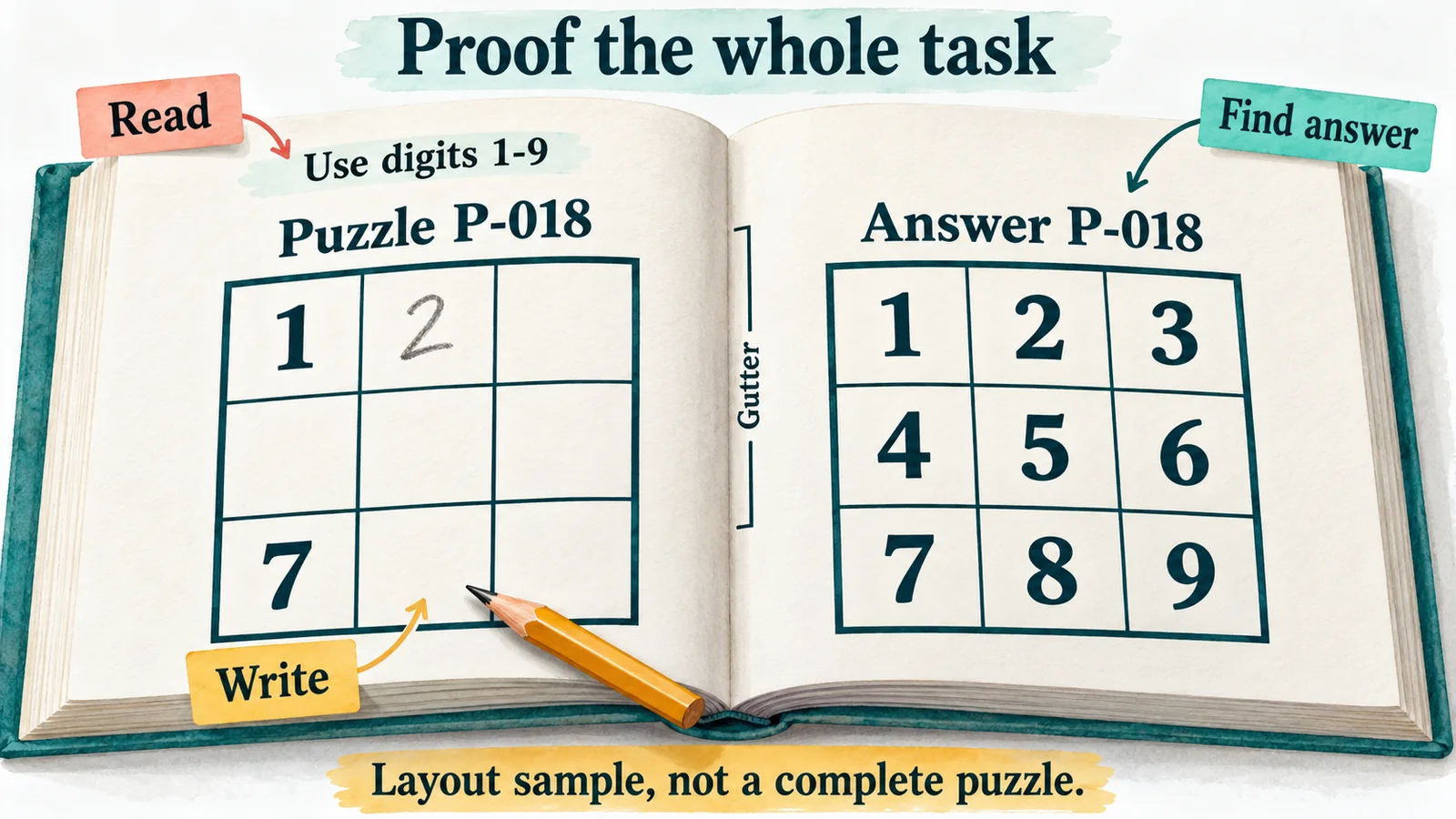
The header illustration uses matching P-018 identifiers and cropped 3 by 3 layout specimens to show reading, writing and finding an answer. They are not complete Sudoku puzzles. Neither their on-screen size nor the illustration's binding demonstrates a real printed measurement; the final PDF and physical proof still need their own checks.
| Check | Observation to record | Revision when it fails |
|---|---|---|
| Reading | Digits, instructions and IDs visible at the reader's normal working distance | Change type, weight, contrast or spacing; print the revised sample. |
| Writing | Pencil entries and candidates remain distinguishable from givens | Enlarge cells or reduce page density, not the promised digit size. |
| Handling | Inner cells and labels remain usable on both page sides | Increase usable gutter space or reconsider the format. |
| Checking answers | The matching solution can be found and read without an abrupt size change | Rework answer pagination and stable puzzle identifiers. |
A successful sample check supports a specific layout decision. It is not accessibility certification, proof of suitability for all sight conditions or evidence of a health benefit.
Price the actual page count, including readable answers
Return to the fictional 60-puzzle brief. Sixty solving pages plus sixty answer pages and eight pages of instructions and other matter produce a 128-page planning estimate. Packing the answers onto fewer pages changes that estimate, but only counts as a viable saving if the revised answers remain usable and honestly described.
Recalculate after final pagination using the actual trim, ink, paper, marketplace and price. Do not copy a competitor's price and assume the same production economics. The profitability guide separates contribution from revenue and unproven sales volume. If the readable version cannot support a workable offer, change the collection scope before cutting essential usability.
Use the royalty worksheet only after confirming the edition's method and printing cost. It calculates the entered per-copy economics; it does not validate the interior, establish demand or replace a current KDP price check.
Make the large-print claim verifiable
State the grid dimensions or digit size only when checked against the final printed file. Explain the difficulty mix, puzzle count, answer arrangement and trim size in plain language. Avoid unsupported claims such as perfect for every senior or medically beneficial. KDP metadata rules require accurate book details; a keyword opportunity does not justify a misleading promise.
Keep the format appropriate: KDP identifies write-on-page puzzle books as unsuited to Kindle. Enlarging a static grid on a screen does not reproduce a paperback's writable surface. For research, compare the actual alternatives through Amazon book niche research, then use the niche research hub to choose the next unanswered question.
Sources and next steps
RNIB supplies the general print-size context; the linked KDP pages supply platform requirements. The sample measurements, collection brief and acceptance checks are original editorial proposals, not tested products. Finalize the specification, preserve puzzle validation records and inspect a revised physical proof whenever pagination or typography changes.
Primary references rechecked on 17 October 2026. RNIB's print-size description is not an Amazon approval standard or an accessibility certification. No reader study, health outcome, completed puzzle collection or physical proof was evaluated for this guide.
Frequently asked questions
What font size counts as large print?
RNIB describes large print as generally 16 to 18 point and giant print as larger. That is general guidance, not a KDP approval rule or a universal readability guarantee; check the chosen font and complete printed layout.
Does large-print Sudoku have to be easy?
No. Print size and logical difficulty are separate. A large-print collection can be easy, mixed or advanced if both the challenge and physical presentation match the description.
Must the solutions also be large print?
Include answers in the readability specification. Tiny solutions undermine a whole-book large-print promise. If supporting elements differ, describe that limitation clearly.
Is one Sudoku per page always the best layout?
Not automatically. Test the actual grid, margins, writing area and answer arrangement. More puzzles per page are acceptable only if the stated readability requirements still hold.
Can a PDF preview replace a physical proof?
No. Actual-size PDF checks help with export and geometry, but they do not establish the final binding, paper behavior or complete writing experience.
Can I publish the same write-in book as a Kindle eBook?
KDP identifies write-on-page puzzle books as unsuited to Kindle. A static screen copy is not equivalent to a physical solving surface.