

Medium-Content Book Niches
Describe the activity the reader will actually attempt. Medium-content is descriptive shorthand here, not a publishing approval category.
Compare four content families, map instructions and practice, and choose the right way to review each activity before expanding the book.
Medium-content is a descriptive label, not a publishing decision
Publishers sometimes use medium-content to group puzzle collections, activity books, guided workbooks and coloring books. Here it is shorthand for discussing varied activities, not an official KDP classification established by the cited low-content guidance. Follow the actual interior and current setup requirements rather than treating the label as an approval category.
The term also does not establish quality, profitability or production effort. A well-designed repeated log can be useful; a varied activity book can be incoherent. More page types are not automatically more reader value. The useful question is what the reader will do and how the book supports it.
Choose a concrete product description
Instead of planning "a medium-content book," describe an adult drawing practice book, a word-search collection, a guided planning workbook or another recognizable task. That description makes the prerequisites, content checks and physical format easier to assess.
Use the repeated-interior guide for logging and planning templates, and the puzzle family guide for solving activities. Do not treat all of them as one market.
Define the reader's activity and starting point
What will they attempt?
Our fictional Shape and Leaf Sessions helps adults practice observing simple shapes and drawing them through short demonstrations and distinct exercises. It is not a botanical identification manual, a therapy program or a professional art certification. Those boundaries keep adjacent claims out of the product brief.
List what each activity asks the reader to produce: a drawing, a solved task, a written decision or another result. If the book includes multiple types, explain how they support the same purpose rather than adding variety only to increase page count.
What do they need before starting?
Record materials, prior knowledge and any setup. A brief supplies list does not prove that a complex exercise is beginner-friendly. Test whether someone at the intended starting point can understand the instruction and begin without an unmentioned tutorial.
Audience and difficulty are separate decisions. An adult activity book can be introductory; a children's label requires appropriate content and presentation, not merely cheerful illustrations. Make claims you can check against the actual activities.
Compare the work required by four activity families
These directions are original editorial examples, not a ranking of profitable niches or a list of validated market opportunities. Choose based on the activity you can design and review competently.
| Family | Reader interaction | Content work to verify |
|---|---|---|
| Puzzle collection | Solve a defined problem under stated rules. | Correctness, difficulty approach, distinct items and linked answers. |
| Coloring collection | Color original outlined artwork. | Usable boundaries, consistent detail, rights and physical page behavior. |
| Guided workbook | Apply instruction through distinct exercises. | Explanations, worked examples, prompts and a way to review the attempt. |
| Mixed activity book | Move between several related tasks. | Coherent purpose, clear transitions and appropriate checks for each activity type. |
A generator or template may help with one stage. It does not automatically supply explanations, progression, rights or final-export review. If you cannot judge whether an activity works, resolve that capability gap before expanding the book.
Build a sequence instead of a pile of page types
Introduce, demonstrate, practice, review
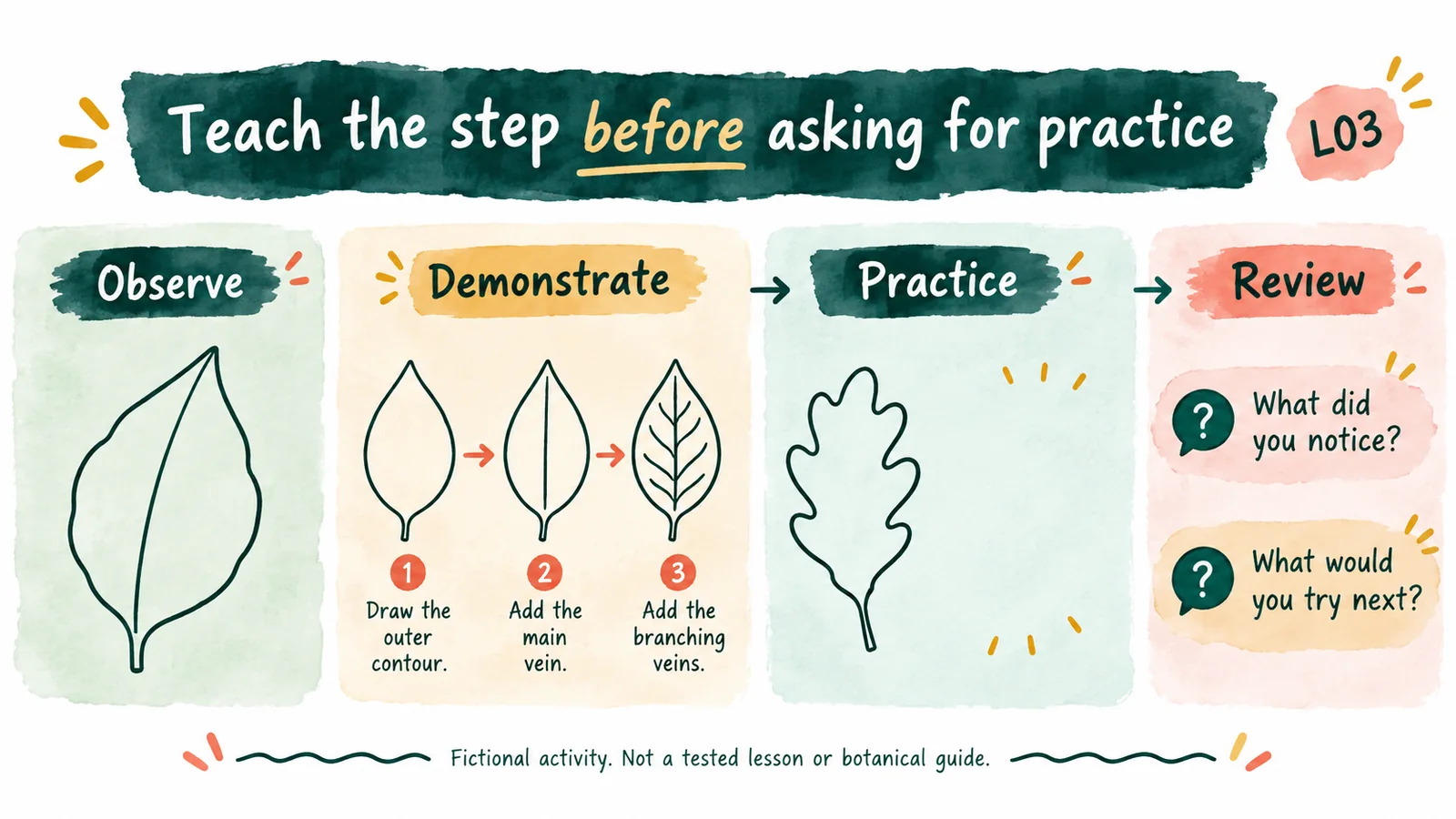
For the fictional drawing book, show the intended observation, demonstrate a simple example, provide a distinct practice task and explain what to notice in the result. These stages can occupy different amounts of space; they do not need to become four identical pages.
A demonstration should make the intermediate decisions visible. A finished picture with an empty box underneath may invite drawing, but it does not necessarily teach how to begin. Decide whether the product is instruction, free-form practice or a mix, then describe it accurately.
Give progression a reason
Move from simpler observations to combinations only when that sequence supports the reader's task. Record the prerequisite for each exercise. Do not call a random ordering a course or a measured learning progression without the work to support that promise.
Keep a page map with activity IDs, instructions, assets and any answer or review reference. This prevents corrections to one exercise from leaving its supporting page out of sync.
Test one complete activity before multiplying it
| Stage | Test question | What to change if unclear |
|---|---|---|
| Instruction | Can the reader state what to do and what materials are needed? | Clarify the task, prerequisites or supplies. |
| Demonstration | Does the example reveal the steps the reader is expected to apply? | Add the missing intermediate decision or illustration. |
| Practice | Can the reader attempt a distinct task in the space provided? | Revise task scope, layout or page space. |
| Review | Is there a useful way to inspect the attempt without inventing an exact answer? | Provide appropriate guidance or a valid solution where one exists. |
Open-ended drawing and a logic puzzle need different feedback. Do not invent one correct creative outcome, and do not replace a puzzle's required answer with vague encouragement. The review method should match the activity.
Ask intended readers to try the prototype without live coaching. Record where they stall and what the description led them to expect. A small usability test is not a representative learning study or proof that buyers want the entire collection.
In a fictional review of activity L03, instruction version 1 jumps from the outer contour to branching veins while demonstration version 2 adds the missing main-vein step. Hold the activity until instruction, demonstration and practice references agree. Then re-test the sequence without coaching. A matching version label alone does not establish usable teaching, and open drawing still needs review questions rather than a fabricated single correct answer.
Distinct activities add work: each needs a clear purpose, a usable page and the right kind of checking.
Assess the actual interior and intended format separately
A few demonstration pages do not automatically settle how a mostly repetitive workbook should be classified. Inspect the complete interior rather than a favorable sample. The medium-content label should not stand in for that review.
The Kindle quality guidance separately identifies books mainly intended for writing or coloring on pages as unsuitable for Kindle. A physical activity book is not made suitable by uploading its page images. A genuinely read-and-apply instructional book needs its own format assessment rather than being used as a workaround for a fill-in product.
For print, test the actual interaction: drawing space, line contrast, inner margins and the intended materials on a proof. Do not promise universal marker compatibility or an accessibility standard based only on an on-screen design.
Plan review, rights and revision as real production work
Record who creates each activity and asset, who checks instructions or answers, and which export version was reviewed. Include original artwork and any appropriate permissions. Review the content guidelines rather than assuming a downloaded asset or generated image is automatically ready for publication.
Inspect the final file after layout. A clipped drawing, changed puzzle symbol or misplaced answer can break an activity even when the source asset was correct. Reserve time for a complete pass through instructions, activity pages and supporting material.
Keep budget and labor visible with the economics guide. Varied content may justify a useful product, but it does not guarantee a higher price, lower competition or a profitable release. Use the first-project guide to judge whether the work fits your capabilities.
Research and release a bounded activity concept
Start with a reader-task hypothesis, then use relevant comparisons. A workbook teaching observation, a coloring collection and a blank art journal can share imagery while serving different tasks. Keep those product roles separate.
Use keyword research to investigate language, not to add unsupported teaching, therapeutic or outcome claims. Align the title, description and sample with the actual activities using metadata guidelines.
- Name the actual activity rather than only the content label.
- Map prerequisites and progression.
- Test instruction, practice and the appropriate review method.
- Inspect classification, format, rights and the final export separately.
Continue to a full proof only when the representative activity works and remaining risks are understood. For broader visibility questions, use the discoverability hub. A descriptive label is a starting point for a brief, not a shortcut to publishing approval.
Explore the KDP niche research guides to compare reader needs, competition and publishing formats.
Sources and scope
Official primary guidance rechecked on 17 October 2026. All worked examples are fictional; no actual planner, teaching activity or puzzle collection was validated.
Official KDP references were checked on 17 October 2026. The activity book, sequence and review framework are original fictional examples. No live niche demand, educational outcome, paper compatibility or sales result was audited. The illustration is conceptual, not a tested lesson or a botanical reference.
Frequently asked questions
Is medium-content an official KDP classification in this guide?
No. It is descriptive publisher shorthand here. The cited KDP low-content guidance does not establish that approval category; assess the actual interior and current setup requirements.
Does more page variety automatically mean more value?
No. Different pages need a coherent purpose, clear instructions and appropriate review. A varied collection can still be confusing or poorly matched to the reader.
What should an activity prototype contain?
Enough instruction, demonstration, practice and review to test the real task. Those stages need not be four identical pages.
Should open-ended drawing and puzzles use the same review method?
No. Creative practice can need guidance rather than a single exact answer, while a defined puzzle may require a valid linked solution.
Does a short introduction settle a repetitive workbook's classification?
No. Inspect the complete interior rather than a favorable sample or a content label.
Can a physical coloring or fill-in activity book simply become a Kindle edition?
Do not assume so. KDP's Kindle guidance separately flags books mainly intended for writing or coloring on pages. Resolve the actual interaction and format.