

Low-Content Book Niches
Start with what the user will record, organize or revisit. A useful repeated interior matters more than a decorative niche label.
Compare four page types, test a representative spread and check the publishing implications before repeating a template throughout the book.
Low-content niches begin with a useful interior, not a decorative cover
A low-content book gives the user room or structure for their own entries. The useful publishing question is what those entries help them record, organize or revisit. A theme can make the product recognizable, but it cannot repair cramped fields, confusing labels or a layout that does not fit the task.
The official low-content guidance describes minimal, generally repetitive interiors intended for user input, with exceptions. Assess the actual pages rather than classifying from the title or a template seller's label.
Separate classification from value
Correct classification is a publishing requirement, not evidence of a good product or a profitable niche. A repeated page can be useful when repetition supports an ongoing task. A varied page can still be confusing. Do not treat word count as a quality score.
For books built around distinct activities, compare activity-oriented formats and puzzle books. Their content and checking requirements differ from those of an entry template.
Choose the recording task before narrowing the audience
The directions below are original examples, not an audited list of profitable niches. Start with what the user will do on the pages, then investigate whether that task and presentation make sense for an intended audience.
| Family and direction | User task | Design question to test |
|---|---|---|
| Notebook: notes for a recurring hobby session | Capture free-form ideas and sketches without a forced sequence. | Does ruling and usable space fit the entries, or would blank/dot pages work better? |
| Journal: short reflections after a creative project | Respond to a few prompts and revisit previous reflections. | Are prompts clear and optional enough for the actual writing task? |
| Planner: an undated weekly project plan | Choose tasks and record when to attempt them. | Is the time structure useful without overcrowding each day? |
| Logbook: balcony plant observations | Record dates, plant identifiers and what was observed. | Can the user connect later entries to the same plant without guessing? |
An audience label should change an observable requirement. If a supposedly specialized notebook has exactly the same interior as an unrelated one, explain what actually makes it useful for the named task. Do not invent professional, medical or educational suitability from a cover motif.
Write a page brief with inputs and retrieval in mind
What goes into one entry?
For our fictional Balcony Observation Log, a record includes a date, user-chosen plant identifier, observation and optional action note. It does not prescribe plant treatment or promise better growth. The page provides structure for observations rather than expert gardening instruction.
List required and optional fields. If most users must write "not applicable" in a field, its role may need revision. Keep the example ordinary enough that it reveals space problems instead of fitting perfectly into a designer's tiny sample text.
How will the entry be found later?
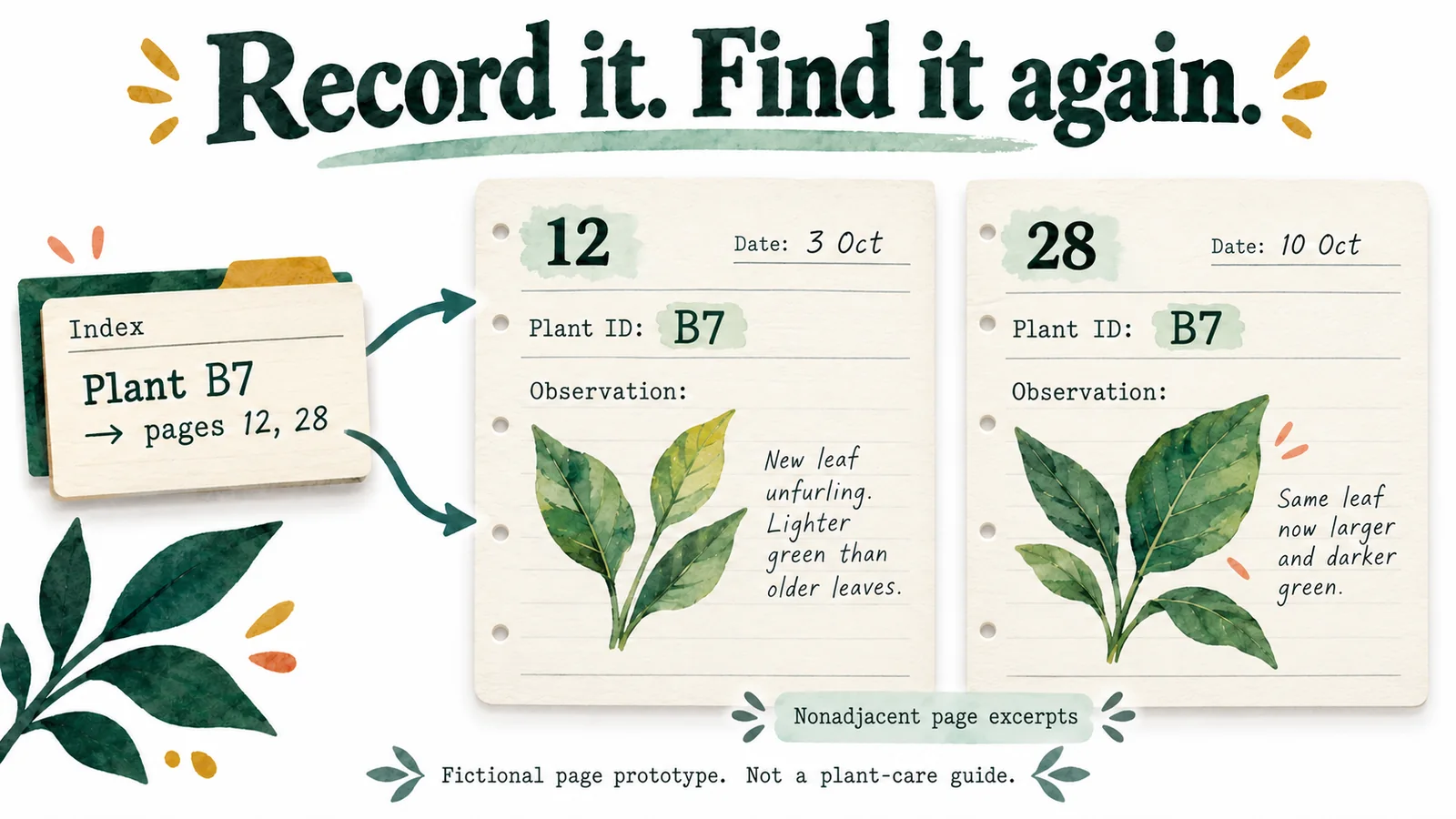
Consider page numbering, a simple index, repeated identifiers or another usable retrieval method. A log that is easy to fill but impossible to revisit may fail the task. Test the system with entries on nonadjacent pages, not just one attractive spread.
For a fictional retrieval test, index plant B7 to pages 12 and 28. The first entry is dated 3 October and the later one 10 October. Ask the user to find both without remembering the dates. Those are nonadjacent page excerpts, not one physical spread; a repeated identifier connects them without prescribing treatment or proving the page design works.
What should remain flexible?
A notebook and a rigid tracker solve different problems. Give the user room for unexpected notes where the use case needs them. More fields can reduce usability rather than increase value. Record why each structural element exists before repeating it across the book.
Test a representative spread with realistic entries
Print a sample at the intended size and use it with the kind of writing the book expects. Inspect the inner margin, field widths, line spacing and contrast. Do not infer comfortable handwriting space from a full-screen mockup.
For the fictional log, test a short plant name, a longer identifier and an observation that needs several lines. Then try retrieving an earlier entry. If the layout fails, revise the template before generating the entire interior.
| Check | Representative attempt | Repair if it fails |
|---|---|---|
| Writing space | Enter realistic short and long responses at actual print size. | Change field dimensions or reduce unnecessary structure. |
| Prompt clarity | Ask an intended user what belongs in each field without coaching. | Clarify labels or remove ambiguous prompts. |
| Retrieval | Locate a previous record after adding several entries. | Improve identifiers, numbering or the index. |
| Physical page | Inspect contrast, inner margin and the intended writing instrument on a proof. | Revise layout and claims before release. |
This is a usability check, not an accessibility certification or a universal paper-performance guarantee. Record the proof and method you actually tested. Do not promise compatibility with every pen or marker from one successful attempt.
Check the publishing constraints before choosing an identifier
Under the current KDP guidance, low-content books can use an owned ISBN or publish without one, but are not eligible for KDP's free ISBN. Expanded Distribution and KDP series are unavailable. Without an ISBN, Read Sample and the back-cover thumbnail are unsupported; the guidance identifies A+ Content as an alternative for showing interior images.
That is a decision to make before relying on a particular presentation plan. Do not choose an identifier only because it seems like the quickest setup path, then assume every feature will be identical.
The same official guidance says Release Date is not currently offered for low-content books. ISBN selection cannot be changed after publication; changing that option requires unpublishing and republishing. Check these constraints before planning identifiers or a launch schedule.
Kindle suitability is a separate issue. The Kindle quality guidance flags books primarily intended for writing on pages as unsuitable. Uploading a print template as page images does not solve that reader-interaction problem.
Show the actual page structure and state its limits
The title and description should identify the recording task, intended format and important layout characteristics accurately. If the interior is undated, do not imply that it contains a dated calendar. If it supplies a logging template, do not sell it as an instructional gardening course.
Choose representative interior images that show what the user receives. A decorative cover mockup cannot communicate field sizes or page sequence. Any filled example should be clearly an example, with invented entries rather than someone's private information.
Use the metadata guidelines for public claims and the content guidelines for rights and content responsibilities. Confirm appropriate rights to artwork and templates; owning a downloaded file is not itself a review of its publishing license.
The strongest product description explains what the user can do with the pages, not how little work the publisher spent making them.
Research the task, not only a popular cover theme
Use the reader-task process and product comparison to inspect relevant alternatives. Distinguish a free-form notebook, guided journal and specialist log even when they share plant artwork.
Record what comparable interiors actually show. An unavailable sample is missing evidence, not proof of poor design. Public query suggestions and a small comparison set do not establish verified demand. Use keyword research to collect accurate language without turning a theme into an unsupported outcome.
Check production effort and distribution assumptions separately with the economics guide. Repeating a template can make file assembly faster, but it does not remove proofing, rights review or the need for a useful product.
Release only when the interior and promise agree
- Define the input and retrieval task.
- Test a representative page at actual size.
- Inspect the final interior for classification and format decisions.
- Check identifier and presentation implications.
- Keep rights, costs and unresolved claims visible.
A successful prototype supports the next production decision, not a forecast of sales. Choose whether to revise the page, inspect more relevant products, prepare a complete proof or stop. For broader visibility questions after publication, use the discoverability hub.
Explore the KDP niche research guides to compare reader needs, competition and publishing formats.
Sources and scope
Official primary guidance rechecked on 17 October 2026. Page layouts, counts and use cases are fictional; no physical product or reader trial was tested.
Official KDP references were checked on 17 October 2026. The logbook, interior briefs and usability checks are original fictional examples. No live niche demand, actual paper test, reader study or income outcome was audited. The illustration is conceptual, not a product preview.
Frequently asked questions
What should define a low-content niche?
The recording or planning task, intended user and interior structure. A cover theme alone does not establish a useful product or verified demand.
How should I assess low-content classification?
Review the actual interior against current KDP guidance rather than the title, word count or a template seller's label.
Can a low-content book use KDP's free ISBN?
No. Current guidance allows an owned ISBN or publication without one, but not the free KDP ISBN. Check presentation implications before choosing.
What preview issue should I check when publishing without an ISBN?
KDP's current low-content guidance says Read Sample and the back-cover thumbnail are unsupported without an ISBN. Review the guidance's interior-presentation alternatives.
Does a comfortable digital mockup prove handwriting usability?
No. Test realistic entries and retrieval at actual size, then inspect a physical proof. Avoid universal claims about writing instruments or accessibility.
Does simple file assembly make the niche profitable?
No. Rights, design, proofing, costs, reach and actual buyer response remain separate tasks. Repetition does not remove the need for a useful book.