

Profitable KDP Niches
Profit depends on the book you produce, its costs and actual sales, not a topic label or a competitor's rank.
Compare conditional niche directions, verify the edition's royalty and work through a clearly labeled cash-recovery model before committing.
A profitable KDP niche is not a label you can verify from a bestseller list
Profit belongs to a particular publishing project, with particular costs and results. A topic can attract buyers while an individual book loses money. Another author may have an audience, production assets or experience that you do not share. Their visible listing does not reveal your likely outcome.
Use niche research to identify a reader task worth investigating, then build a separate economic scenario for the book you can actually produce. Keep demand evidence, cost assumptions and calculation results in different records. A mathematically positive scenario is not proof that enough readers will buy.
Choose the accounting question
This guide uses a simple cash-recovery model: how much remains per sale after specified variable costs, and how many such sales would recover specified project costs? That is narrower than full economic profit. Author time, recurring overhead, taxes, refunds or other adjustments need their own treatment rather than disappearing into an attractive headline.
Start with a reader-task hypothesis and relevant product comparisons. The economics should test that concept, not invent a profitable market from an arbitrary spreadsheet target.
Compare niche directions by what they require you to deliver
These are conditional project ideas, not a measured ranking of profitable niches. Each can be worth investigating for an author with the relevant capability; none comes with verified demand, a sales forecast or an earnings promise.
| Direction | Reader value to demonstrate | Economic question to resolve |
|---|---|---|
| Everyday hand-mending instruction | Complete repair steps, usable photographs and clear prerequisites. | Can the author create and check the lessons without an uncontrolled photography and editing bill? |
| A tightly scoped illustrated cookbook | Tested recipes, consistent yields and readable cooking instructions. | What do testing, images and the chosen color edition require before any sales occur? |
| A focused adult puzzle collection | Valid distinct puzzles, correct solutions and comfortable print layout. | What validation and proofing work remains even if generation is inexpensive? |
A short production workflow is not automatically cheap, and a low file-generation cost is not a complete budget. Compare the actual work needed to make the reader promise reliable. Use the first-project guide for delivery scope and the competition guide for entry assumptions.
Separate project costs from costs attached to sales
Project costs
Record editing, original illustration or photography, permissions, layout, proof copies and any other spending required to release the proposed edition. Mark amounts as quotations, actual spending or assumptions. Keep a date and scope beside a supplier quote so a later revision does not quietly use the wrong price.
Per-sale costs
Start from the royalty estimate for the correct edition and channel, then subtract any additional variable cost included in your scenario. If printing has already been deducted in that royalty estimate, do not subtract it again. Keep advertising assumptions separate from observed campaign results.
Your time and ongoing work
A cash budget can be small while the labor requirement is large. Record your expected production and maintenance effort even if you are not paying yourself an hourly rate in the simple calculation. A revised edition, fact-checking pass or replacement asset may change the project burden later.
Do not present sales revenue, royalties, contribution and profit as interchangeable numbers. Use explicit labels so the next person reading the worksheet knows what has and has not been deducted.
Verify the royalty for the actual edition before calculating
The current paperback royalty guidance uses a 50% or 60% rate for supported Amazon paperback sales, depending on price and marketplace, with printing costs deducted. Do not assume a universal 60% rate or copy a result from a different channel.
Use the printing-cost guidance and the current KDP estimate for the intended specification. Recheck after changing page count, ink choice, format, price or marketplace. The figures below are planning assumptions, not a quoted KDP price or royalty for a real book.
An eBook, paperback and hardcover need separate calculations. Do not carry a paperback contribution assumption into another format just because the manuscript title is the same.
Four scenarios for one fictional repair manual
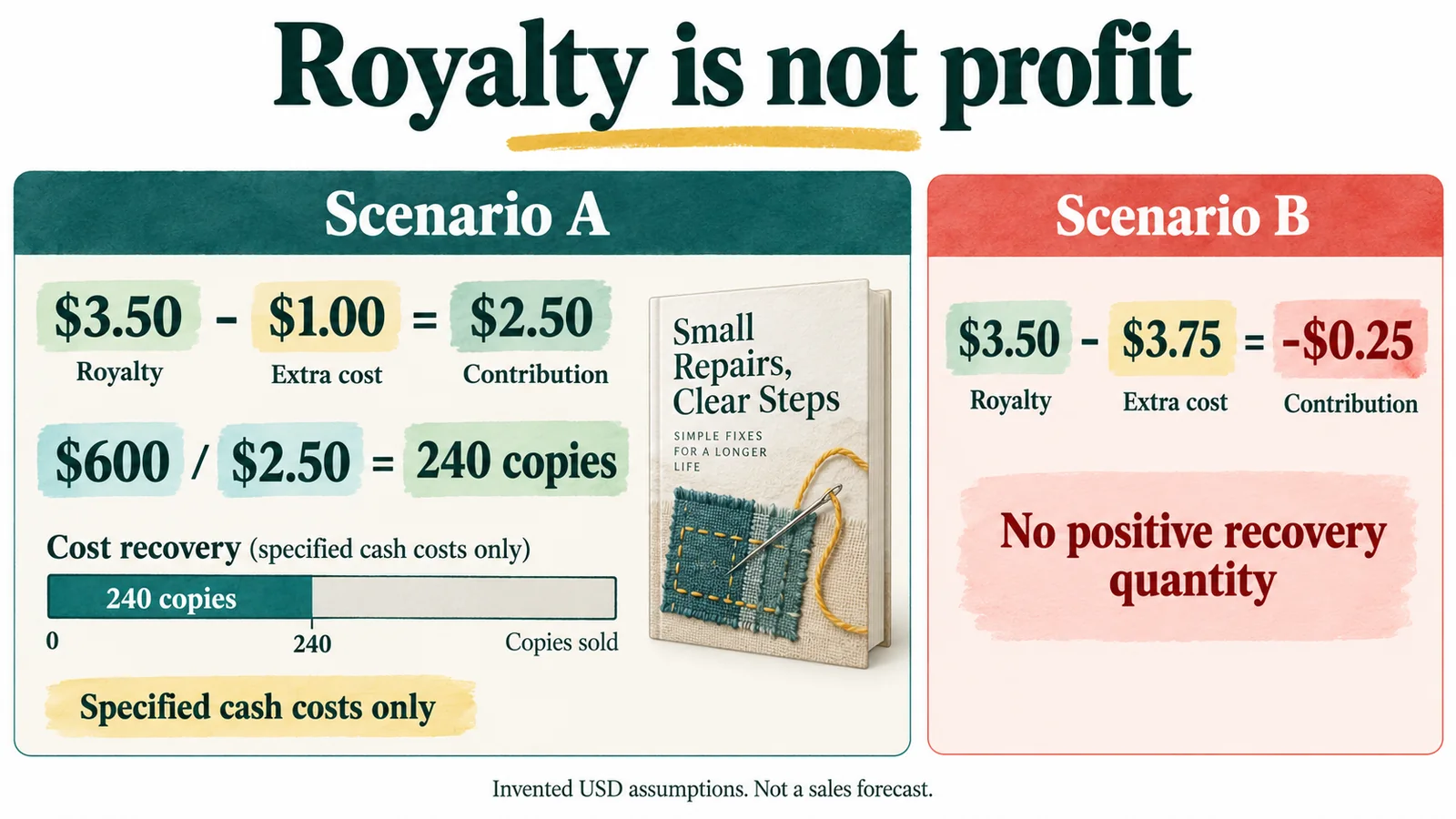
Assume a fictional manual called Small Repairs, Clear Steps. All amounts are invented US-dollar inputs. The assumed royalty already has platform printing deductions included. Additional variable cost is an assumed average per sale across the modeled sales mix, not measured advertising cost per acquisition.
Contribution per copy = assumed royalty minus additional variable cost. If contribution is positive, cash-recovery copies = specified project cost divided by contribution, rounded up. Neither formula predicts whether those copies will sell or when.
| Scenario and assumptions | Contribution per copy | Specified cost recovery |
|---|---|---|
| A: royalty $3.50; additional variable cost $1.00; project cost $600. | $2.50 | 240 copies to recover the specified $600. |
| B: royalty $3.50; additional variable cost $3.75; project cost $600. | -$0.25 | No positive recovery count under these assumptions. |
| C: royalty $3.50; additional variable cost $1.00; project cost $1,200. | $2.50 | 480 copies to recover the specified $1,200. |
| D: royalty $3.50; additional variable cost $1.50; project cost $600. | $2.00 | 300 copies to recover the specified $600. |
In scenario A, 100 modeled sales produce $250 of contribution, leaving $350 of the specified project cost unrecovered. That is not $250 of project profit. In B, selling more at the same negative contribution does not solve the problem. In C, a larger production bill doubles the recovery quantity without proving a larger audience exists.
The recovery boundary in A is also specific: 239 modeled copies contribute $597.50, leaving $2.50 unrecovered; 240 contribute $600 and recover exactly the specified cash cost; 241 contribute $602.50, leaving $2.50 after that cost. Even the last amount is not full economic profit when labor, overhead and tax are excluded. These quantities are calculation checks, not expected sales.
This simplified calculation excludes tax, author labor, ongoing overhead and any adjustments not explicitly included. It is planning arithmetic, not financial or tax advice.
Check how readers could find and choose the book
A positive contribution assumption is only one condition. Write a separate plan for reaching relevant readers and showing the value of the book. Name the channels, the sample or description they will see, and what evidence would justify continuing.
Do not assume that organic traffic is free in effort, or that paid traffic will remain at the cost chosen in the worksheet. A hypothetical average variable cost is not a campaign result. Use the Ads budget guide when designing an advertising test, not the royalty calculation as an instruction to spend.
A competitor's BSR does not establish your reachable sales. Use the contextual BSR log instead of converting rank into an exact forecast. Public visibility can identify questions worth researching; it cannot supply the missing economics of your own project.
Stress-test the assumptions before expanding
Change one important assumption at a time: production spending, additional variable cost or the royalty estimate for a changed edition. Record which change makes the scenario unacceptable to you. Use that finding to choose the next fact to establish.
If color images are essential to the instruction, do not remove them only to improve the spreadsheet. Test whether a different layout or narrower scope can preserve usability. If a cheaper version no longer delivers the reader task, it is a different product, not the same book with a better margin.
The useful conclusion is not "this niche is profitable." It is "these assumptions make this project worth a bounded next test, and these unknowns could reverse that decision."
A proposed series also needs a new content case for each title. Do not multiply one fictional book's contribution by ten and call it a validated catalog plan. Shared assets may reduce some work, but they do not establish repeat purchases or justify repetitive products.
Write a bounded publishing decision
For a separate calculation using your own stated assumptions, use the royalty calculator for the edition estimate, then the publishing ROI calculator for specified project costs. Neither tool verifies a niche, supplier quotation or reachable sales.
Before relying on a per-copy estimate, check the current royalty rates and eligibility. Use royalty reconciliation for actual reported results and author income scenarios to keep project recovery separate from a recurring income goal.
- Identify the book, edition, channel and reader task.
- Separate actual costs, quotations and hypothetical inputs.
- Check that printing is not deducted twice.
- Keep labor, overhead and other exclusions visible.
- Name the next test and the condition for stopping.
Before publishing, check the metadata guidelines and align the title, description and sample with the actual book. A business scenario does not justify unsupported promises. Use keyword research and the discoverability hub for the separate presentation and visibility decisions.
Explore the KDP niche research guides to compare reader needs, competition and publishing formats.
Sources and scope
Official KDP sources were checked on 17 October 2026. The niche directions, repair manual and dollar scenarios are original fictional examples. No production quotations, actual campaign costs, sales, tax position or profitable market were audited. The illustration is conceptual.
Frequently asked questions
Does a profitable-looking niche guarantee a profitable book?
No. An individual project's costs, audience, execution and results can differ from those of existing authors. Visible listings do not reveal your likely outcome.
Is a royalty the same as project profit?
No. Additional variable costs and project spending may remain. Keep author time, recurring overhead, tax and other exclusions explicit rather than calling every royalty profit.
Should I deduct printing costs twice?
No. If the royalty estimate already includes the printing deduction, do not subtract printing again. Check the correct edition, channel and current KDP calculation.
What does the example's recovery quantity mean?
It is the number of modeled copies needed to recover specified project costs at the assumed positive contribution. It does not predict that those copies will sell or when.
What if contribution per copy is negative?
Under unchanged assumptions, selling more does not recover the specified project cost. Revisit the cost structure, edition or test plan instead of assuming volume fixes the problem.
Are the dollar scenarios actual KDP quotes?
No. They are fictional planning inputs, not measured demand, actual provider quotes or a financial forecast. Verify current specifications and your own costs separately.