

Kids Sudoku Books on KDP: Design the First Solving Experience
A children's puzzle book needs clear teaching and comfortable practice, not just smaller grids and an age label.
Define the starting reader, check every puzzle and hint, and test the printed experience before expanding the collection.
Kids Sudoku starts with a learner, not an age sticker
A children's Sudoku book has two audiences: the child doing the puzzles and the adult choosing the book. The child needs understandable rules and manageable steps. The buyer needs to know what prior skills are assumed, how much help is expected and what the book actually contains. An adult easy collection with a cartoon cover does not answer those questions.
Write a short starting-reader description before choosing a puzzle count. Can the reader recognize and write the symbols? Follow a row across the page? Distinguish a column from a region? Read the instructions independently, or use them with a caregiver? These are design questions, not a clinical assessment or a claim that every child of a particular age has the same ability.
Separate three kinds of support
Instructional support explains the rule. Puzzle support provides an appropriate next move or checked hint. Physical support makes the page comfortable to read and write on. Increasing the font size cannot repair unclear rules, and adding more clues cannot repair a cramped writing area. Use the easy Sudoku guide for logical progression and the large-print guide for page-level readability.
Choose a grid progression and state each rule set
Nikoli's classic Sudoku rules use a 9 by 9 grid: digits 1 through 9 appear once in each row, column and 3 by 3 block. Smaller grids can introduce the same no-repeat idea, but they are variants with their own digit sets and region shapes. Label the transition rather than expecting a child to infer it.
| Format | Explicit rule set | Teaching purpose and check |
|---|---|---|
| 4 by 4 mini-grid | Digits 1-4; four 2 by 2 regions | Introduce rows, columns and regions; check that the reader considers all three. |
| 6 by 6 bridge | Digits 1-6; six 2-row by 3-column regions | Increase scanning demands; explain the rectangular regions again. |
| 9 by 9 classic | Digits 1-9; nine 3 by 3 regions | Use after the reader understands the rule and can navigate a larger page. |
| Symbol-based variant | A fixed distinct symbol set and clearly specified regions | Test symbol recognition and reproduction; decorative similarity must not create ambiguity. |
This is an editorial format menu, not evidence that children must complete every stage. Some readers can begin with classic grids; others need more mini-grid practice. A mixed-size collection should make its contents obvious on the cover description and sample pages. Do not advertise a classic-only count if it includes several variants.
Teach a repeatable action before asking for independence
One explained move is better than a finished grid
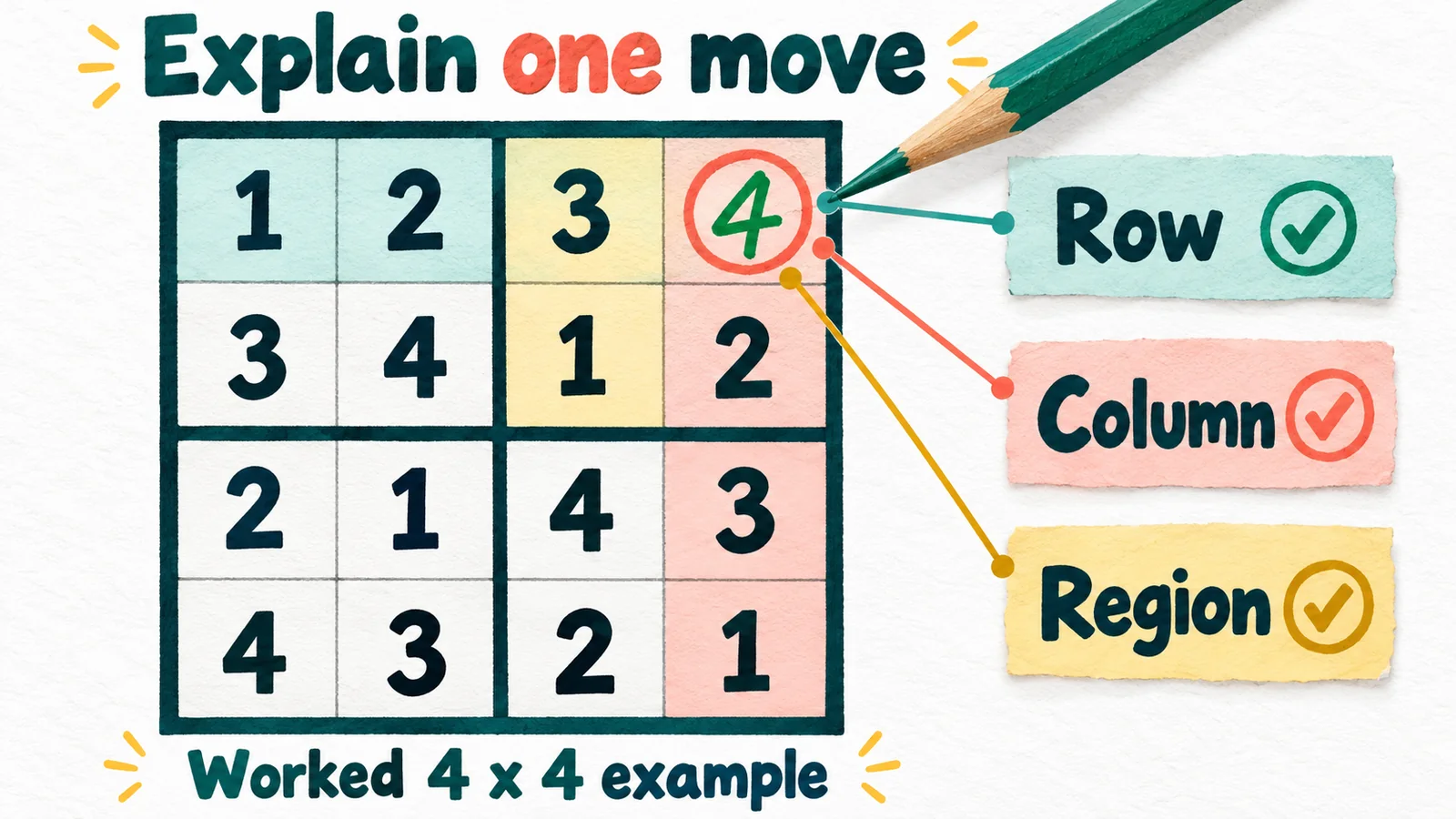
Start with a small worked example. Identify the target cell, show which digits are ruled out by its row, column and region, then explain why the remaining digit fits. The explanation must match that exact starting position. A completed answer grid shows the destination but not the reasoning that gets the reader there.
For an original 4 by 4 teaching example using digits 1-4 and 2 by 2 regions, the first row before the move is 1, 2, 3, blank. The other rows are 3, 4, 1, 2; then 2, 1, 4, 3; then 4, 3, 2, 1. The target is the top-right cell. Its row already has 1, 2 and 3; its column has 2, 3 and 1; its upper-right region has 3, 1 and 2. All three constraints allow 4. The header illustration marks that newly entered 4 in pencil. This deliberately simple worked position is not an age standard or a practice-puzzle difficulty claim.
Use the same vocabulary and visual markers throughout. If a region has a heavier border on the teaching page, preserve that convention in practice. Avoid instructions that depend only on color: the paperback may be printed in black ink, and readers should still identify the relevant cell or region.
Make help optional and easy to find
Place hints in a separately labeled section, keyed to the puzzle number. A first hint can point to a promising row without revealing the whole answer. Explain that a hint describes one valid route from a recorded state; a child who has already made different valid moves may need a different explanation. Keep encouragement specific to the task, such as checking all three constraints, rather than scoring intelligence or speed.
Turn the idea into a countable collection brief
Consider a fictional proposal called First Logic Steps: 48 distinct practice puzzles, comprising 16 mini-grids, 16 bridge grids and 16 classic grids. Four teaching examples are additional and excluded from the practice count. This is a planning example, not a generated, validated or reader-tested collection.
For each section, record the permitted techniques, expected level of adult help, hint policy and answer layout. A grid's size and number of clues are not sufficient difficulty specifications. Keep a separate reserve pool so rejected puzzles can be replaced without padding the book with duplicates or making the final section unexpectedly difficult.
- Identify the assumed starting skills and who reads the instructions.
- Separate teaching examples, practice puzzles and answers in the count.
- Record rules and region geometry for each grid family.
- Define a progression that can be checked, not just labels such as fun and challenging.
- Budget space for guidance, hints, solutions and comfortable writing.
Validate the mathematics separately from the teaching
Every included puzzle needs a reliable uniqueness check under its own rules. A solver producing one answer does not prove that a second answer is impossible. Reject invalid or multiply solvable puzzles and hold unresolved validation results out of the collection. A checker configured only for 9 by 9 Sudoku cannot establish the validity of a 6 by 6 variant.
Keep the puzzle, explanation and answer together
Assign a stable identifier such as K-018. Link its givens, rule set, solution, logical trace and any hint positions to that identifier. Generate the printed puzzle and answer from the same checked record, then verify their printed numbers after pagination. Test the exact hint state, including any extra entries pictured in the explanation.
Check duplicate starting grids and conspicuous equivalent layouts across the collection. A digit relabeling may look new while repeating the same challenge. The Sudoku production workflow explains uniqueness, duplicate checks and answer traceability in more detail; these requirements still apply to a children's edition.
Observe a sample without coaching every next move
Use a short representative sample with a caregiver's agreement and supervision. Explain that you are testing the book, not the child. Let the reader attempt the instructions and first puzzle before offering help. Record where the page causes confusion: a forgotten region rule, an unclear instruction, an unreadable symbol or insufficient room to erase and rewrite.
Ask the accompanying adult whether the advertised support level matches the session. If every move requires an explanation, a promise of independent practice is not supported. Change the teaching sequence or narrow the promise, then try the revised sample. Do not collect identifying information or photographs simply to document a layout observation.
A small usability session can reveal a confusing page. It does not establish learning gains, cognitive benefits, suitability for every child or commercial demand.
Proof the printed experience, not just the source file
Check the exported PDF at actual size, then inspect a physical proof. Children need room for their own pencil marks, not merely legible printed givens. Decorative characters should stay outside the solving area. Test left and right pages, because a usable outside edge does not guarantee comfortable access near the binding.
| Gate | Evidence to retain | Reason to stop and revise |
|---|---|---|
| Rule clarity | Reviewed instructions and observations from a representative sample | Readers cannot distinguish row, column and region constraints. |
| Puzzle integrity | Rule-specific uniqueness results and stable answer IDs | Unknown validation, wrong answer mapping or repeated challenges. |
| Writing comfort | Physical proof marked with an ordinary pencil and eraser | Digits collide with borders or the binding obstructs the grid. |
| Promise accuracy | Final count, format mix and documented support level | The listing implies independent use or extra practice not actually supplied. |
Use KDP's current trim, bleed and margin specifications for the selected format and page count. Minimum manufacturing margins are a starting constraint, not proof of comfortable use. Leave extra space when the solving task needs it.
Describe the real contents and choose the next step
State the grid sizes, practice count, included answers and expected adult involvement. Choose an age range based on the actual content and reviewed experience, not a popular competing subtitle. KDP's metadata guidance explains reading age and accurate book details; it does not certify an educational outcome.
The reading-age field is optional, but KDP warns that omitting an appropriate age can affect eligibility for children's categories and age-specific search visibility. An invented age label is not a substitute for checking the content and support level. Keep the cover, description and chosen audience consistent with the final collection.
KDP lists puzzle books as not generally low-content, with exceptions. Classify the actual interior rather than treating every repeatable page template as a blank notebook. Also, write-on-page puzzle books are unsuited to Kindle; a static digital copy is not the same solving product.
Once the sample works, use puzzle-book keyword research to describe those verified features. If the audience or competing alternatives remain uncertain, return to the niche research hub and select the evidence you still need before expanding the manuscript.
Sources and next steps
The linked Nikoli and KDP pages support the rule and platform statements. Collection briefs, testing steps and release gates here are original editorial recommendations, not official age standards or completed experiments. Recheck platform guidance before publishing and retain the validation records for the exact file you release.
Primary references rechecked on 17 October 2026. The worked mini-grid has been checked as an explanatory example; no reader trial, completed puzzle collection or physical book proof was conducted for this guide.
Frequently asked questions
What age should a kids Sudoku book target?
Choose the range from the actual content, assumed skills and reviewed use, not a competing cover. Number recognition, reading support and prior Sudoku experience differ within an age group.
Are 4 by 4 and 6 by 6 puzzles classic Sudoku?
They are variants. Specify their digit sets and region shapes. Classic Sudoku uses a 9 by 9 grid with 3 by 3 blocks; a mixed-format book should explain each transition.
Can I make a children's book from an adult easy collection?
An easy difficulty label does not establish child suitability. Review vocabulary, instructions, puzzle progression, help and physical writing space for the intended learner.
Do small Sudoku grids still need uniqueness checks?
Yes. Check each puzzle under its own rule set and exclude invalid, multiply solvable or unresolved results. A checker must support the actual grid and region dimensions.
Should teaching examples count as practice puzzles?
Keep the count explicit. Separating worked examples from distinct practice puzzles lets buyers understand what the collection actually provides.
Does a successful sample prove educational benefits?
No. Observing a sample can reveal usability problems and support design changes. It does not prove learning gains, cognitive benefits or suitability for every child.