

Amazon Book Niche Research
Build a comparison set that answers a specific publishing question. Similar subjects do not necessarily mean the same reader task or competing product.
Inspect promises, visible interiors and evidence limits, then write a positioning hypothesis and a short decision memo.
Amazon book niche research compares products serving a reader task
A niche research session should answer a defined publishing question. For example: "How do current books help adult beginners make a first travel watercolor sketch with a small kit?" That is more useful than collecting everything returned for art books or assuming all books sharing a keyword compete in the same way.
This guide focuses on the comparison stage. If you still need a book concept, start with how to find KDP niches. Once you have a reader-task hypothesis, inspect a bounded set of books and record both their visible promises and the limits of what you can observe.
Fix the marketplace, format and question
Record the Amazon marketplace, language, intended edition format, date and search department. Decide whether you are comparing instructional paperbacks, eBooks or another product. Do not mix a blank notebook, advanced reference work and beginner manual into one undifferentiated competition count.
A short session can support a useful decision if the scope is explicit. It cannot claim to be a complete census of Amazon or a measured demand forecast.
Build a sample you can explain and reproduce
Use more than one entry point
Begin with a few supported reader-task queries, then inspect relevant category shelves and clearly related books. Record how each candidate entered the sample. Include an item because it helps answer the question, not merely because its cover looks attractive or its rank is prominent.
Preserve the query and whether a search result is sponsored. The official search guidance explains that results are dynamic. Your captured selection is a session sample, not a stable universal ordering of the niche.
Deduplicate at the right level
Keep a work identifier and an edition identifier. Two formats of one work may provide useful format comparisons, but they are not two independent manuscripts. Conversely, distinct books by the same author can have different promises and should not automatically collapse into one record.
KDP notes in its search troubleshooting guidance that search generally shows one format of a book. Open the detail page and inspect available editions rather than assuming the first visible format is the only one.
Separate direct competitors, adjacent books and substitutes
The following products are invented for an editorial exercise. They are not real listings, audited ranks or a claim about current availability. The proposed book is a beginner travel-watercolor manual with portable materials and worked first-sketch lessons.
| Fictional product | Reader task and visible contents | Comparison role |
|---|---|---|
| Pocket Watercolor Starts | A compact beginner manual with material choices and complete first-sketch steps. | Direct comparison: close reader task and instructional level. |
| Studio Watercolor Structures | Large-format demonstrations assuming existing drawing and painting skills. | Adjacent: same medium, different prerequisites and use setting. |
| The Travel Sketch Journal | Mostly blank drawing pages with brief prompts. | Substitute: supports recording sketches, not learning the full method. |
| Field Lines and Washes | Outdoor sketching instruction with some watercolor and substantial ink technique. | Partial overlap: useful for comparing scope and equipment assumptions. |
Do not discard adjacent products entirely. They can reveal alternative reader expectations and production choices. Keep them in separate groups so they do not inflate your count of direct competitors or distort a comparison of teaching depth.
Inspect the promise, evidence and friction
Promise
Record what the title, cover and description say the reader will achieve or experience. Translate vague adjectives into a testable claim. Beginner might require explained prerequisites; portable might require a realistic materials list; step by step should show the intermediate work, not only finished paintings.
Evidence
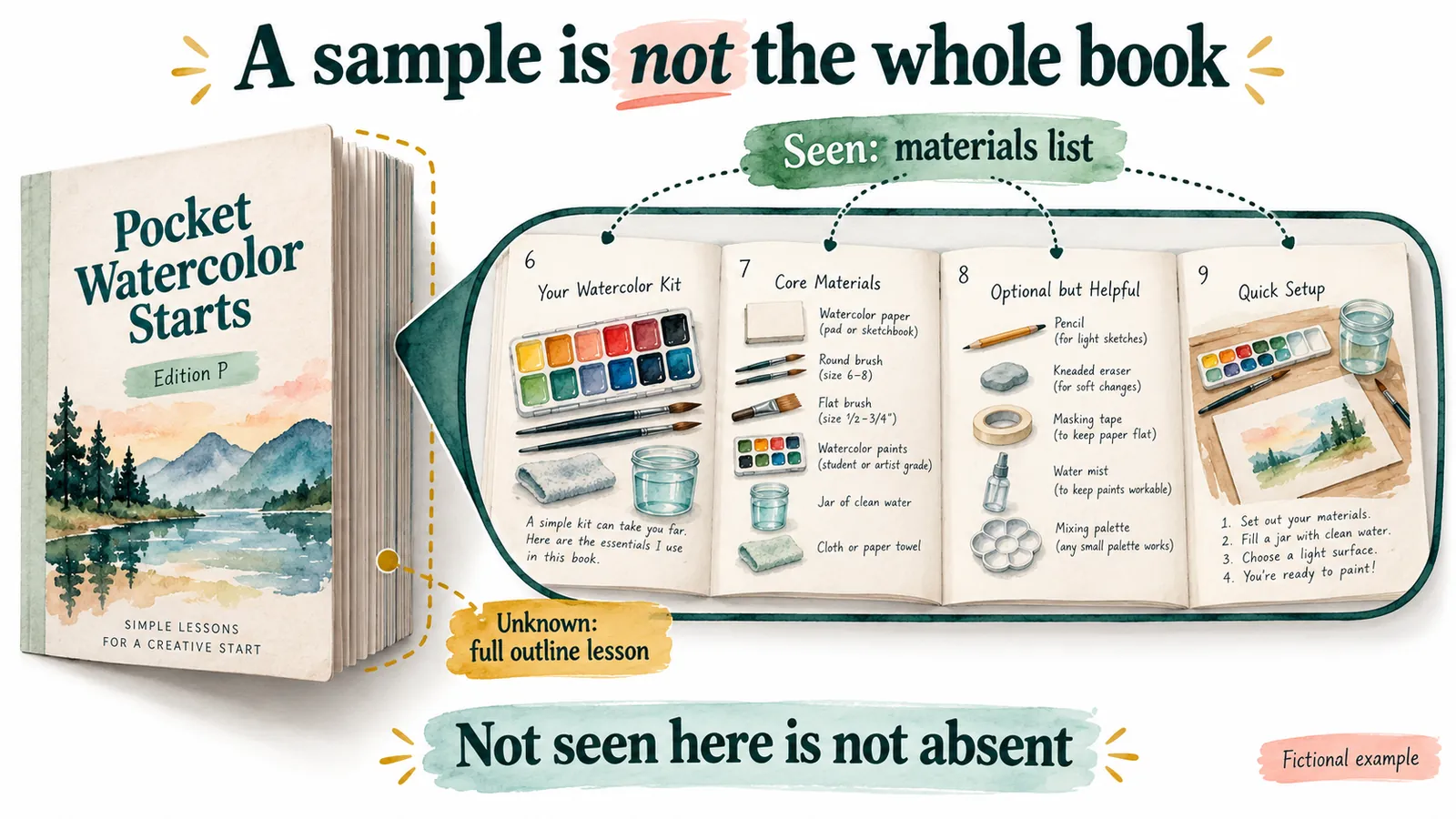
Inspect the contents and available sample for the relevant lesson. Note exactly which pages you saw. A sample can support a positive observation about those pages, but its silence does not prove a feature is absent from the full book.
The Read Sample guidance describes availability limits. If a sample is unavailable, record "not inspected" rather than "no instruction." A missing preview is an evidence limitation, not a negative quality score.
A fictional inspection note could read: "Pocket Watercolor Starts, edition P, sample pages 6-9 inspected; materials list visible; first-outline demonstration not seen on these pages." That records four pages, not a judgment on the entire book. Mark full-book coverage unknown and plan the next inspection. Do not rewrite the note as "the book has no outline lesson" or enter a zero quality score.
Friction
Look for observable barriers to the intended task: unexplained materials, unreadable step images, prerequisites not mentioned in the description or a format that changes usability. Avoid scoring artwork solely by personal taste. State what the reader needs to do and where the visible instruction helps or leaves a question.
Keep current price, page count and format as context, not quality proxies. A longer book is not automatically more complete; a shorter one may serve a tightly defined task well.
Use reader reviews to form questions, not to measure the market
Read a bounded set of relevant comments and preserve the date and context. Look for specific task statements: difficulty starting a first sketch, confusion about materials or appreciation for a complete demonstration. Distinguish content criticism from delivery complaints or a reader's preference for another style.
Reviews are self-selected responses, not a representative survey of all buyers. Several similar comments can justify checking a potential problem; they do not establish what percentage of the market has it. A high rating count also does not tell you current sales or the cost of acquiring those readers.
Observation: "Two inspected comments mention missing intermediate steps." Research question: "Would a clearly shown first lesson resolve a problem for my intended readers?"
Paraphrase research notes rather than copying reviewers' words into your marketing. Do not claim an endorsement, permission or relationship that does not exist. The task is to improve your own content brief, not to assemble a competitor's review collage.
Write a specific positioning hypothesis you can test
Combine the reader task, your delivery capability and the questions raised by the sample. For the example: "A compact manual that demonstrates one complete first travel sketch, including a limited materials list and intermediate images." That is a content plan, not a claim that no other book offers those features.
A genuine comparison may reveal that direct competitors already do this well. That is useful information. Revise the hypothesis, identify a different supported task or stop. Do not call a niche empty because you ignored the closest books.
KDP categories provide shelf context, while keyword guidance helps with accurate wording. Neither authorizes copying a competitor's identity or choosing unrelated placement. Use the keyword hub and the category guide for those separate decisions.
Keep commercial unknowns out of the comparison score
| What you can record | What it does not establish | Next action |
|---|---|---|
| A relevant visible sample | The complete book's quality or every feature it contains. | Record inspected pages and resolve missing content questions. |
| Price and presentation | Author profit, production cost or reader acquisition cost. | Prepare your own production and pricing assumptions separately. |
| A rank observation | Exact units, niche-wide demand or sales available to a new entrant. | Use a contextual BSR log, not a profit forecast. |
| A proposed content distinction | That readers value it enough to purchase your book. | Test a representative lesson and the clarity of its promise. |
Do not turn missing information into a numerical score just because a spreadsheet has an empty column. A score of zero can falsely imply that you measured absence. "Unknown" often leads to the more honest next action.
- Keep direct, adjacent and substitute products separate.
- Link every observation to a work, edition and source context.
- Record unavailable samples without inventing a quality judgment.
- Separate observed presentation from inferred commercial results.
Finish with a short decision memo
Summarize the question, scope, selection method, closest comparable books, observed content patterns, important unknowns and the next test. Include which evidence would change your decision. A collaborator should be able to understand the conclusion without reconstructing it from a folder of screenshots.
Use the discovery guide to turn the memo into a prototype gate. Before publishing a title or description, check metadata guidelines for accurate presentation. For a broader visibility question, use the discoverability hub.
The successful outcome is a defensible decision: build a small test, inspect more relevant evidence, revise the concept or stop. It is not necessarily a promise that this niche is profitable.
Explore the KDP niche research guides to compare reader needs, competition and publishing formats.
Sources and scope
Official primary guidance rechecked on 17 October 2026. The examples are fictional; no live marketplace audit or reader trial was conducted.
Official KDP references were checked on 17 October 2026. The four products, comparison roles and memo framework are original fictional examples. No live competitor census, review sample, purchase data, production costs or market-size calculation was audited. The illustration depicts conceptual products rather than actual Amazon listings.
Frequently asked questions
Is niche research the same as collecting keywords?
No. This comparison stage also examines reader tasks, products, formats, visible instruction and your proposed distinction. Keywords are one source of language, not the whole decision.
What is a direct competitor in this workflow?
A book serving a closely similar reader task with comparable instructional level and use context. Adjacent books and substitutes can be informative but should be grouped separately.
Should two editions count as two competing books?
Not automatically. Keep both work and edition identifiers. Different formats may deserve comparison, but they are not two independent manuscripts.
What if a book has no available sample?
Record that the content was not inspected. Do not convert an unavailable preview into a claim that the book lacks instruction or is low quality.
Can review comments measure market demand?
No. They are self-selected responses. Specific comments can suggest questions to investigate, but they are not a representative buyer survey or current sales report.
What should a comparison memo conclude?
State the question, sample method, relevant products, observations, unknowns and next test. The outcome can be to proceed, revise, investigate further or stop, not necessarily to declare a profitable niche.