

Journal Niches: Create Prompts Readers Can Actually Use
A journal should make it easier to record or reflect on a specific experience, without prescribing how the reader must feel.
Choose between open writing, repeatable prompts and guided sequences. Then test an adult creative-project journal for clarity, writing burden and honest positioning.
Journal niches begin with a reflection or recording task
A journal niche connects a reader, an experience and a reason to return to the page. "A journal for creative people" is broad. "A place to record what changed during an informal creative project and what to try next" defines a usable task. It still needs research and testing; a precise description is not proof of demand.
Distinguish reflection from instruction. A journal invites the reader's account; a workbook may teach a method, set exercises or evaluate answers. If you promise a structured learning program, a few repeated prompts will not deliver it. If you promise open reflection, compulsory scoring and extensive instructions may interfere with that purpose.
Choose the main kind of entry
A notebook emphasizes free capture; a journal can organize experiences or reflection; a planner helps arrange future actions. A single product may use elements of all three. Decide which action dominates and make the cover, description and first usable spread agree.
Compare four journal directions
These examples show design choices, not rankings of popular or profitable niches. Their value depends on whether the proposed reader wants this particular structure. Avoid assuming that an identity, hobby or occasion automatically creates a buying audience.
| Possible direction | Entry structure to test | Important boundary |
|---|---|---|
| Creative-project reflection | What changed, what was noticed, optional next experiment | Reflection, not instruction in a craft or guaranteed improvement. |
| Reading response | Book reference, open response, optional discussion question | Personal response, not reproduced copyrighted passages or a study course. |
| Local outing memories | Place, observation, sketch or short recollection | A record, not a destination guide with verified travel information. |
| Personal everyday observations | Optional date and one open observation | No claim to treat anxiety, improve health or provide therapy. |
Select the response before the decorative theme
Imagine the actual answer someone would write. Does it need a sentence, several paragraphs or a drawing? If every proposed direction uses exactly the same response space and prompts, the distinction may exist only in the packaging. That can be a design choice, but do not present it as functional specialization.
Investigate expectations in the intended marketplace
Use niche research to form a specific candidate, then inspect relevant listings in one marketplace. Record the query and date. Compare blank journals, lightly prompted journals and substantive guided books separately. They may share words in their titles while meeting different expectations.
For visible interiors, note prompt length, frequency, response area, entry order and whether dates are required. If a preview is unavailable, mark the structure unknown. Review comments may reveal questions to investigate, such as repeated prompts feeling restrictive; isolated comments do not establish a general preference or give you a license to reuse proprietary wording.
Maintain an evidence record that separates observation from interpretation. Test your own alternative prompt before deciding that it solves a problem. Do not infer sales volume from a search result count, a handful of reviews or the presence of many cover variations.
Write prompts that leave room for the reader
One question, one understandable response
Use plain questions about the intended experience. "What changed in this version?" is easier to answer than "How did your creative journey transform your perspective and unlock your potential?" Avoid double questions hidden in a single line. When a prompt asks for an observation and an explanation, provide separate space or choose the more useful action.
Do not assume every experience was positive. "What did you notice?" permits a neutral or disappointing entry; "What amazing success are you celebrating?" pressures the reader toward a particular response. Include an explicit option to skip a prompt or write freely when that matches the product's promise.
Repeated questions can make entries comparable, while varied prompts can introduce new angles. Neither is automatically superior. Decide what stays consistent and why. If a sequence depends on earlier entries, explain that dependency; if entries are independent, do not force a daily streak merely to fill pages.
Prototype an adult creative-project journal
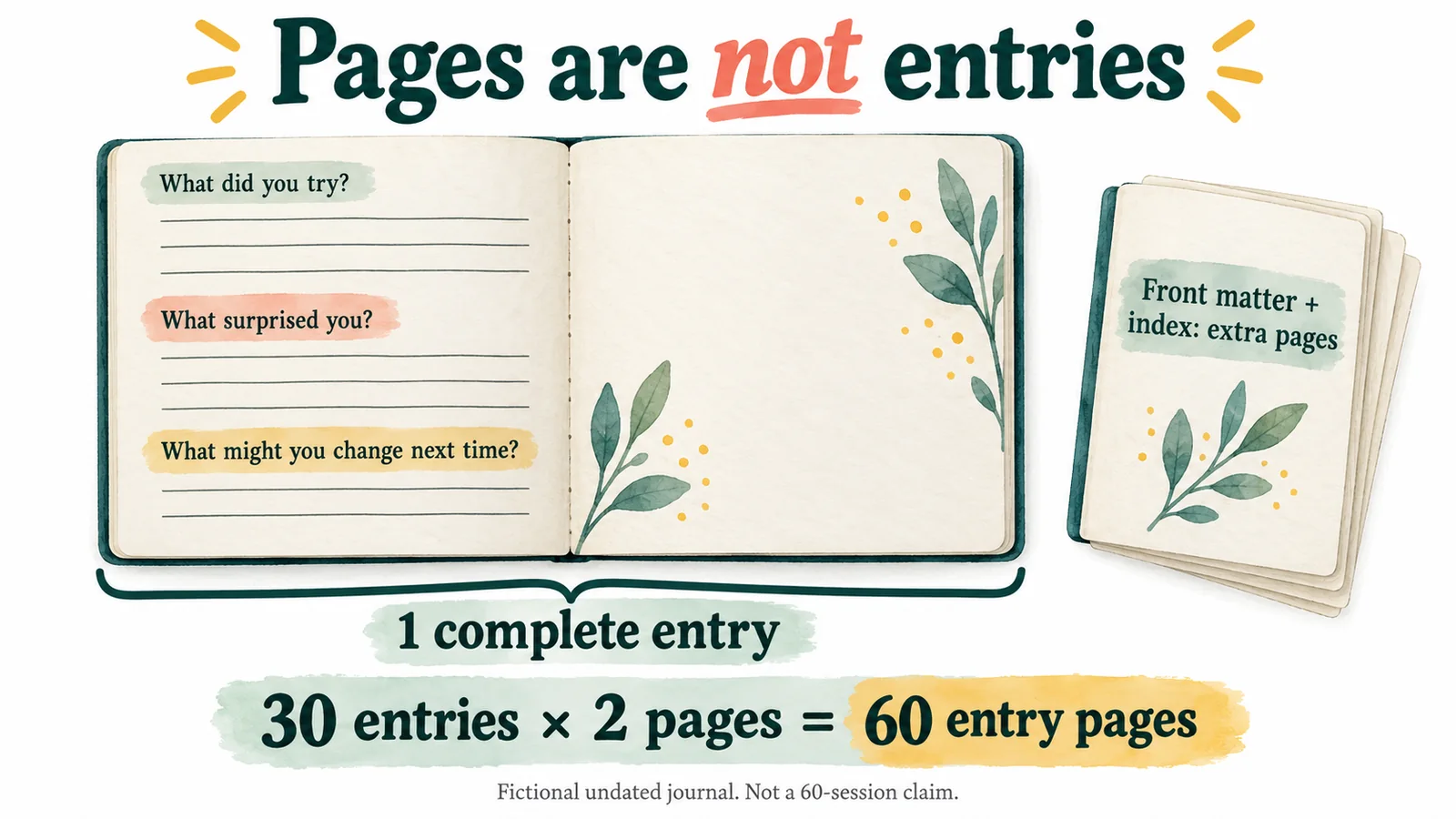
The fictional "After the Project" concept helps adults record informal creative attempts. It is not a therapeutic program, professional development course or tested product. Each entry starts with an optional project reference and offers three short prompts: "What did you try?", "What surprised you?" and "What might you change next time?" An open page accommodates longer responses or a sketch.
Check three different experiences
Draft a sample entry about arranging a handmade paper collage. Then test an unfinished attempt and a session where nothing notable happened. The unfinished entry should not require a completed result; the ordinary entry should not force an invented insight. Rewrite any question that fails these cases.
Decide how readers find a previous project: an index, a topic line, or chronological order with optional dates. Avoid collecting unnecessary personal details on introductory pages. If you need feedback from testers, ask about clarity and space rather than asking them to share private entries.
Test whether the prompt is usable, not whether the reader reveals something meaningful to the publisher. A private response can remain private.
Evaluate writing burden and repeat use
A journal can look spacious until someone writes a realistic answer. Print candidate spreads at final size and invite intended users to try representative entries. They may use invented responses. Observe misunderstandings, skipped fields and requests for more space; do not interpret personal answers or assess psychological outcomes.
| Test | Question to observe | Revision signal |
|---|---|---|
| First entry | Can someone explain the prompt without your help? | Replace ambiguous language or a hidden second question. |
| Short response | Does a brief answer feel acceptable? | Remove pressure to fill every line or rate every experience. |
| Long response | Is there an obvious continuation space? | Increase writable area or add a clear continuation method. |
| Return after a break | Can someone resume without reconstructing missing days? | Use optional dates or clarify independent entries. |
After revising the paper prototype, inspect a printed proof of the actual configuration. Check legibility, binding-side writing space, repeated-page consistency and blank-page placement. Record the version tested. One successful response does not prove broad usability, pen compatibility or an accessibility certification.
Calculate the real entry capacity. Thirty two-page entries are not sixty separate sessions; introductory pages and indexes also occupy space. State the count of complete entries only when the finished file supports it. A promise of daily use for a year requires enough usable entries, not merely a calendar-themed cover.
For an explicit fictional file budget, 30 complete entries at two pages each require 60 entry pages. If front matter occupies four pages and the index another four, the modeled total is 68 pages, still only 30 complete entries. Verify final page order, continuation and print requirements separately; this arithmetic is not a universal trim or page-count recommendation.
Publish with accurate classification and restrained claims
KDP's low-content guidance includes journals and prompt journals as common examples, with exceptions. Judge the finished interior, especially if it contains substantial instruction. The broader low-content guide explains setup implications without assuming every journal is identical.
Apply the metadata guidelines to a concrete description: who the journal is intended for, what prompts it includes, and how entries work. Do not claim therapy, treatment, guaranteed confidence or measurable wellness benefits without an appropriate basis. This guide provides no clinical recommendations.
For a write-in journal, choose a suitable physical product rather than assuming an eBook will be equivalent. KDP identifies writing-on-page products as unsuited to Kindle. Describe actual features, not features visible only in an illustrative mockup.
Use a clear publish-or-revise checklist
- The journal's recording or reflection task is specific.
- Prompts allow neutral, unfinished and brief experiences.
- Entry capacity and continuation space match the listing.
- Testers can keep their responses private.
- The printed proof and classification match the final file.
Check costs with the profitability framework. Build relevant phrases with keyword research, then connect accurate positioning to discoverability. Stop adding prompts when they increase effort without serving the core task. A narrower, coherent journal is preferable to a collection of unrelated exercises presented as a complete solution.
Explore the KDP niche research guides to compare reader needs, competition and publishing formats.
Sources and scope
Official primary guidance rechecked on 17 October 2026. Page layouts, counts and use cases are fictional; no physical product or reader trial was tested.
Official KDP low-content, metadata and Kindle-quality sources linked above were checked on 17 October 2026. Niche directions and the creative-project example are fictional editorial proposals, not live demand findings or clinical guidance. The generated illustration is conceptual; no reader study or physical product test is claimed.
Frequently asked questions
How does a journal niche differ from a notebook niche?
A journal usually organizes recording or reflection around an experience. A notebook mainly supports free capture, while a planner focuses on future actions; the formats can overlap.
Are prompt journals automatically substantial guided workbooks?
No. Repeated fill-in prompts do not by themselves provide a teaching method or course. Classify and describe the actual interior.
Should a journal use repeated or varied prompts?
Repeated prompts can support comparison; varied prompts can introduce new angles. Choose the structure that serves the intended task and test it rather than assuming one is superior.
How do I test a journal without collecting private responses?
Allow invented entries and ask about prompt clarity, writing space and navigation. Testers do not need to share personal writing or have their responses interpreted.
Can I market an ordinary journal as therapy?
Do not make unsupported treatment or wellness-outcome claims. Describe the actual reflection or recording features; this guide offers no clinical recommendations.
How should I count the journal's usable entries?
Count complete entry units in the finished file, excluding introductions and indexes. A two-page entry is one entry, not two sessions.