

Notebook Niches: Design Around a Real Note-Taking Task
A useful notebook niche starts with what someone needs to capture, not a slogan on the cover.
Compare ruled, dotted, grid and blank interiors, test a small project-notes prototype, and separate practical differentiation from unverified market demand.
Notebook niches begin with a capture task
A notebook niche is a specific reason to choose one writing surface over another. "For gardeners" names an audience; "ruled pages with generous margins for recording observations during short garden visits" explains a use. The second description gives you design decisions to test. It does not establish that customers will buy it.
Start with one sentence: "This reader captures this information in this setting and needs to find it again this way." Note whether the reader writes sentences, draws, calculates, or mixes them. Include where the notebook travels and whether entries are chronological. A decorative theme can support that purpose, but changing a cover does not demonstrate a new functional niche.
Keep the format boundary clear
Notebooks primarily support free capture. A journal can support reflection or a record of experiences; a planner organizes future commitments. These can overlap, but a page crowded with mandatory tracking fields is no longer a straightforward open notebook. Define the main job before borrowing features.
Compare four notebook directions
The following are conditional product ideas, not a list of profitable niches. For each direction, identify the practical reason its interior differs from ordinary lined paper. If the only difference is an audience label, research whether buyers actually want that positioning before producing variations.
| Possible direction | Interior decision | What would weaken the idea? |
|---|---|---|
| Small creative-project notes | Room for sketches beside written observations | Forced project fields interrupt quick capture. |
| Reading discussion notes | Open ruled space with room for page references | Fixed review questions turn it into a different journal product. |
| Informal language-study notes | Flexible paired columns for personally chosen words | Columns are too narrow for examples or different scripts. |
| Sketch-and-caption notes | Blank area with a modest ruled caption space | Decoration consumes drawing room or implies specialist art-paper performance. |
Reject an unsupported specialization
Do not market ordinary pages as a professional record system, certified accessibility aid, or specialist technical workbook. A relevant cover does not supply missing instructions, standards or testing. Narrow the promise to what the printed pages actually help someone do.
Research the buying situation, not just the keyword
Use a repeatable niche-research process to define candidate phrases. Examine the intended Amazon marketplace and record the search date, query, format and relevant products. Separate notebooks from planners, journals and unrelated gifts. A small set of relevant listings is more informative than an undifferentiated result count.
Where interiors are visible, note ruling, usable area, page organization and what the description promises. Where they are not visible, record "interior unknown" rather than guessing from the cover. Comments about writing space can suggest a design question; they are not permission to copy another publisher's layout or proof that the same problem affects every buyer.
Follow the evidence-sheet approach: observation, interpretation, proposed test. "Three inspected interiors have small caption boxes" is an observation. "Readers need larger boxes" is a hypothesis. Ask intended users to complete a representative entry before treating it as a requirement.
Choose ruling by the actual writing task
Ruled, dotted, grid or blank?
Ruled pages guide lines of prose; grid pages support alignment; dots offer light structure; blank pages leave placement open. None is universally better. Test the reader's own handwriting, diagrams and usual amount of text. A grid that looks elegant on screen can be distracting when printed darkly.
Print sample spreads at the proposed final size without automatic scaling. Measure line spacing and the remaining writable area after margins and headings. Try a long entry, a short entry and a mixed sketch-and-text entry. Compare left and right pages, especially writing near the binding. Do not shrink labels merely to make every idea fit.
Portability also creates a trade-off: a smaller page can travel conveniently but leave less room for long notes. A thicker notebook offers more pages but changes handling. Choose dimensions and page count together, then check the current KDP setup requirements for that configuration before finalizing files.
Develop a small project-notes prototype
Consider the fictional "Small Project Notes" concept for adults recording informal creative projects. It is not an instruction manual and provides no safety advice. The initial prototype uses mostly open pages, a small optional date-and-topic area, page numbers and a few index pages. These are proposed features, not a tested commercial product.
Make the example entry do the work
Write one sample entry about testing paper shapes for a handmade greeting card: a sketch, a material note, an observation and a possible next attempt. Then write an entry consisting only of two sentences. Both should feel natural without requiring irrelevant fields. If the structure works only for the publisher's imagined perfect entry, simplify it.
Now return to the sample a week later in the test scenario. Can the reader locate it using their own index wording? Numbered pages help only if there is an understandable retrieval method. A topic line may be enough; elaborate indexing can introduce unnecessary maintenance.
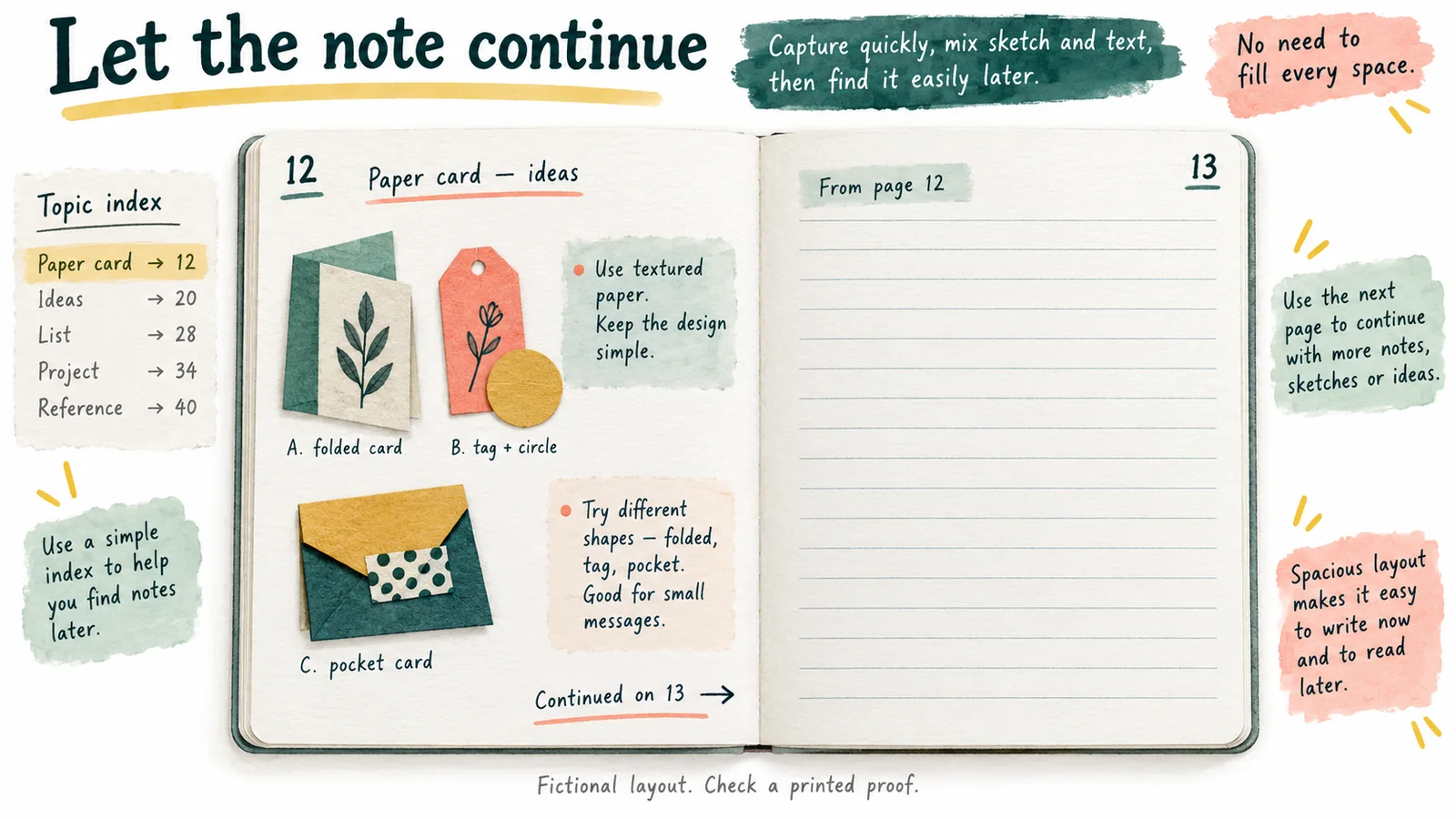
In the fictional paper-card entry, the topic index points to page 12. A note at the foot of that page says "Continued on 13"; page 13 starts "From page 12". Test whether someone can follow that link after a break without mandatory project fields. The cross-reference supports retrieval, not a claim that the finished binding lies flat.
Keep a field only when it supports capture or retrieval. Empty space is useful when the reader controls what belongs there.
Test the notebook in four ordinary situations
Use an inexpensive paper prototype for early layout decisions, then inspect an actual printed proof before publication. A home printout cannot establish the binding, paper or reproduction quality of the finished KDP configuration. Record the file version, print settings and changes so that observations remain attributable.
| Test situation | Observe | Possible revision |
|---|---|---|
| Quick note | Can the reader start without interpreting fields? | Remove mandatory headings that delay capture. |
| Long entry | Does writing continue comfortably onto another page? | Reduce decoration or clarify continuation. |
| Later lookup | Can an earlier note be found without remembering its date? | Test a simpler topic index and visible numbering. |
| Printed spread | Are rules readable and binding-side spaces usable? | Adjust contrast or margins and inspect another proof. |
Try the writing tools your description intends to mention, but do not generalize one sample into "marker-proof," universal fountain-pen compatibility or guaranteed lay-flat binding. Report only substantiated features. User feedback on this prototype tests usability, not total market size or accessibility certification.
Describe and classify the actual interior
KDP lists notebooks among common low-content examples, with exceptions. Classify the finished interior rather than relying on its name. The low-content guide covers the associated identifier and preview decisions.
Keep the listing concrete: ruling, trim size, page count and any real navigation feature. Under KDP's metadata guidelines, the title should match the cover and avoid repetitive generic keyword stuffing. Show representative interior pages through an available, permitted presentation method; do not imply illustrated sample entries are included if they are not.
KDP treats books mainly intended for writing on their pages as unsuited to Kindle. Do not turn a blank notebook into an eBook merely to add a format. A separate substantive writing guide would be a different product.
Decide whether to publish, revise or stop
- The reader, capture task and retrieval method are explicit.
- A representative entry fits without unexplained workarounds.
- The proof supports every physical feature claimed in the listing.
- Research notes distinguish observed listings from inferred demand.
- The planned price and production costs have been checked for this configuration.
Use a cost-and-risk assessment before committing to multiple covers. For search positioning, follow keyword research and discoverability guidance: relevant language cannot rescue an interior that fails its purpose. Publish one coherent, checked product; revise weak pages or stop when the proposed distinction has no practical value.
Explore the KDP niche research guides to compare reader needs, competition and publishing formats.
Sources and scope
Official primary guidance rechecked on 17 October 2026. Page layouts, counts and use cases are fictional; no physical product or reader trial was tested.
Official KDP low-content, metadata and Kindle-quality guidance linked above was checked on 17 October 2026. Product directions, the project-notes example and testing framework are editorial proposals, not verified sales opportunities. The illustration is conceptual and does not establish a product's construction or print quality.
Frequently asked questions
What makes a notebook niche more specific than a cover theme?
A defined capture task, setting and retrieval method give you interior decisions to test. An audience slogan alone does not demonstrate functional differentiation or customer demand.
Should I choose ruled, dotted, grid or blank pages?
Choose according to the intended writing and drawing task. Test realistic entries at final print size; no ruling is universally best.
Are notebooks low-content books on KDP?
KDP lists notebooks as common low-content examples, with exceptions. Classify the actual finished interior, not just the product name.
How can I validate a notebook idea without inventing sales figures?
Record relevant listings and visible interior features, separate observations from assumptions, and test a prototype with intended users. Usability feedback does not establish market size.
Can I publish a write-in notebook as a Kindle eBook?
KDP identifies products mainly intended for writing on their pages as unsuited to Kindle. A substantive separate guide is not equivalent to a blank notebook.
What should I check in a printed notebook proof?
Check rule contrast, usable margins, writing near the binding, page order and retrieval features. Do not extrapolate one sample into universal pen or binding guarantees.