

KDP Risks and Bans: Choose the Right Prevention or Response Task
Start with the observed record and the decision you need to make, not an imagined account-health score.
Choose a specialist workflow for release checks, reader reviews, rights questions or an actual account notice.
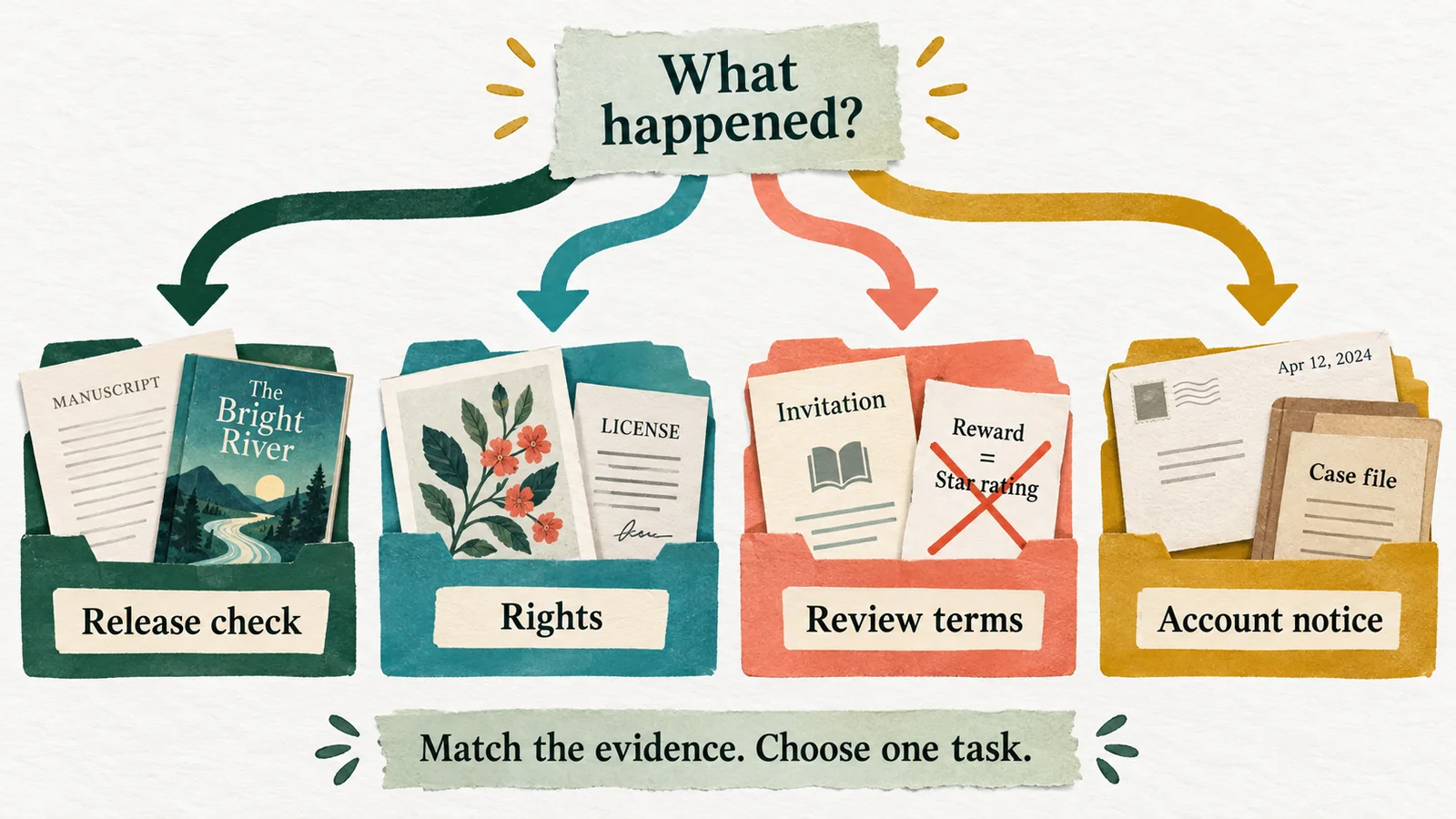
Choose the current task instead of guessing your KDP ban risk
Start with one of three jobs: check a release before publishing, inspect an existing practice, or respond to an actual notice. This hub directs you to the relevant workflow; it does not score your account or predict enforcement.
A quiet launch, changed rank or missing review is not, by itself, an enforcement notice. Use the KDP troubleshooting hub for listing and sales symptoms. For rights, review conditions or account messages, choose a guide below.
Keep a minimum record before making changes
Record the affected book or function, format, marketplace, date, file version and exact message. Retain originals privately. If a campaign is involved, save participant terms and benefit conditions; for a rights question, locate the specific asset and agreement. Mark missing facts unknown.
A successful login does not prove every publishing function works. A document upload does not prove acceptance. Keep passwords, identity documents, payment information and readers' account details out of public discussions.
Select the guide that matches your decision
| Your task | Start here | Useful outcome |
|---|---|---|
| Audit the publishing process | KDP policy audit | A correction register for the release |
| Check asset permissions | Rights and provenance inventory | Supported uses and unresolved rights questions |
| Understand review boundaries | Amazon review rules | Eligibility, independence and display distinctions |
| Invite suitable readers | Optional review outreach | A neutral invitation and genuine decline path |
| Inspect a review service | Review-incentive audit | Benefit conditions and the no-review outcome |
| Investigate a missing contribution | Missing-review investigation | Observed records, not a guessed moderation cause |
| Identify an account restriction | Restriction triage | The affected function and response task |
| Respond to termination | Termination response | A factual case and the stated appeal route |
| Recover a failing access layer | Account recovery | The login, security-code or identity workflow |
Run a release check around the actual deliverables
Compare the final interior, cover, metadata and permissions, including newly introduced material. Use the rights inventory for asset-level checks rather than repeating that work here. The KDP Content Guidelines apply to book content, cover and product description.
Inspect invitations, participant rules, reminders and completion conditions together. For a service or group offer, compare exchange models, apply the exchange-policy checks and examine what a paid service actually delivers. Give each unresolved finding an owner and next action; do not mark it cleared because a deadline is near.
Classify the actual notice before choosing a response
| Observed message | Record to preserve | First response task |
|---|---|---|
| Title request or Blocked status | Edition and complete related email | Address the stated book concern |
| Identity request | Correct-account banner and due date | Use the genuine verification process |
| Authentication or code error | Failing screen and exact error | Recover the affected access layer |
| Explicit termination notice | Decision and response instructions | Prepare the case-specific response |
KDP's Book Status reference identifies Blocked as a title status and directs you to the related email. A requested identity check is a separate process. Do not silently rename either observation account termination.
Protect access while resolving the publishing question
Use trusted KDP routes and the official account-security guidance to check doubtful contacts. Do not send credentials to someone promising to unlock an account. Section 4.2 of the KDP Terms prohibits opening a new account after termination; a replacement identity is not a recovery procedure.
Prepare a factual case someone else can follow
Organize the stated concern, identifiers, chronology, relevant evidence and unresolved question. Distinguish completed corrections from proposed changes. Do not fabricate an admission, backdate permission or upload unrelated private records.
Use the response channel in the actual notice. Section 3 of the KDP Terms describes appeal instructions for a termination believed erroneous, not guaranteed reinstatement. KDP's review help directs customer-review matters to Amazon Community; do not combine a reader's posting restriction with your publisher-account case.
Verify the original task and record the limit
Recheck the named function, edition or process and retain the reply and verification date. If a question remains, name it. One successful action is not an account-wide safety certificate. Return to reader-facing marketing work after the relevant task is resolved; an ordinary sales fluctuation does not require a new enforcement theory.
Sources and scope
Official KDP references checked on 16 October 2026. The directory and prioritization method are original organization aids. No private account, agreement or notice was inspected. This hub is not legal advice, a ban-risk model or a guarantee of compliance, restoration or sales.
Frequently asked questions
Does this hub calculate my probability of a KDP ban?
No. It connects scoped evidence and response workflows, not a ban-risk model or private account assessment.
Where should I start before publishing a new edition?
Use the policy audit and rights inventory, then inspect any review campaign's actual conditions. Record concrete checks and unresolved questions.
Where should I start after an account message?
Preserve the complete message and classify its scope: title, identity, authentication, restriction or explicit termination.
Does a Blocked title mean the publishing account is terminated?
No. A title status and an account termination are different records. Follow the actual associated message.
Which guide explains rewards tied to public reviews?
Use the review-incentive audit. For neutral invitations and reminders, use the optional outreach guide; for definitions, use the review-rules reference.
Can any guide guarantee restoration or a ban-proof account?
No. Current rules, actual notices and the evidence of the case determine the relevant action. Verify the specific result rather than making a universal safety claim.