

How to Get Amazon Reviews Safely: Keep Reader Choice Genuine
A safer process depends on the actual conditions, not on making a campaign look natural or slowing down submissions.
Invite suitable readers, deliver the right edition and respect their decision whether to comment publicly.
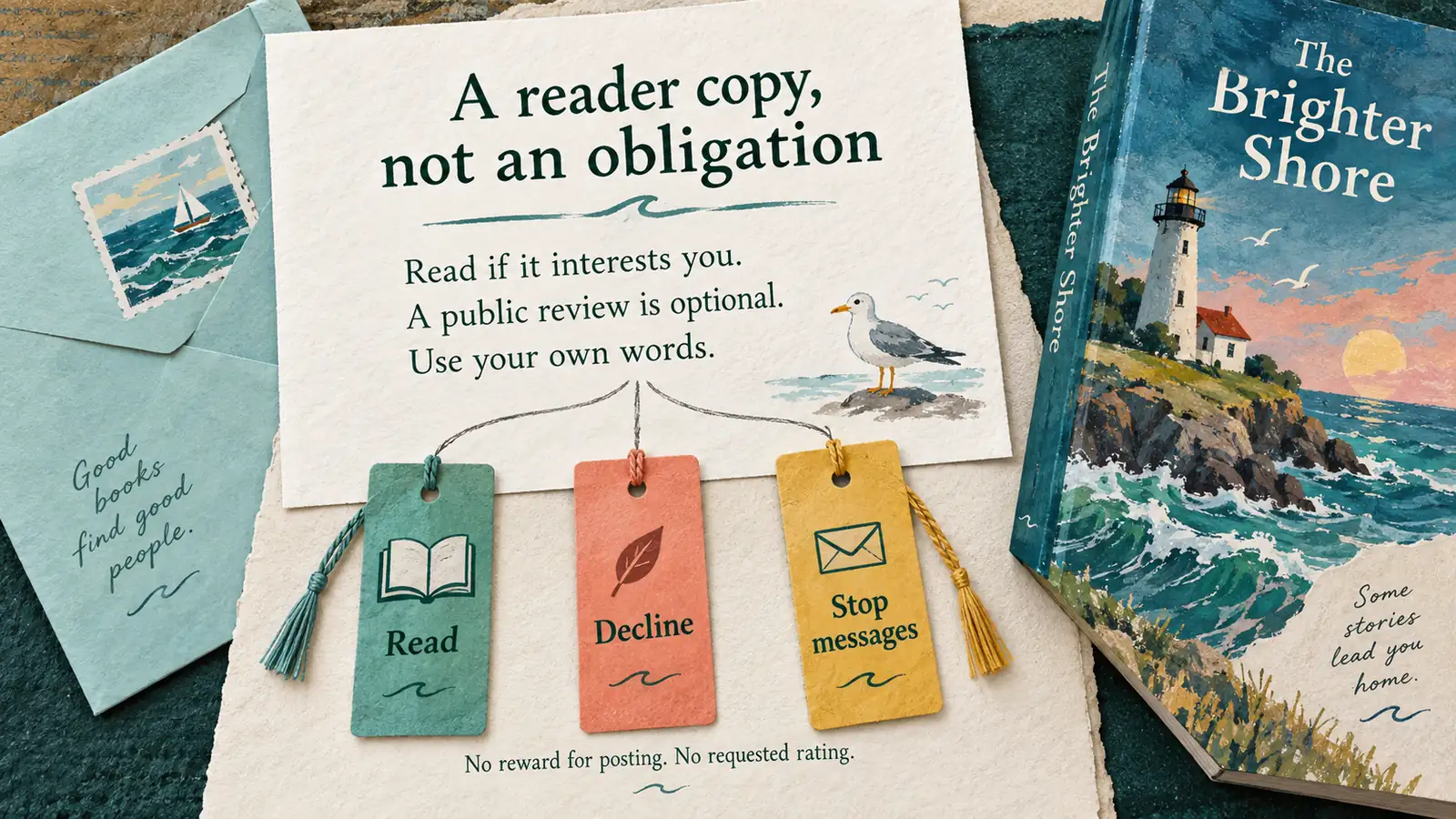
Define an optional invitation, not a public-review assignment
Getting Amazon reviews safely is not a technique for making a campaign look natural. It is a question of what you ask readers to do and what happens if they choose not to do it. Start with a book that fits the reader, an accurate invitation and a genuine choice about public participation. No outreach process can guarantee acceptance by Amazon or immunity from moderation.
KDP's Customer Reviews guidance distinguishes a free or discounted book copy without a required or influenced review from additional compensation. Build the invitation around that boundary. Do not promise a refund, points or another benefit for submitting a rating, even if you describe the requested opinion as honest.
Write down what is optional
State whether you are offering a reader copy, requesting private editorial notes or inviting a public opinion. Do not combine them into one mandatory completion task. Use the review-rules reference for the different systems involved and the incentive audit for reward conditions. This guide focuses on day-to-day outreach and communication.
Choose readers for subject fit rather than an expected rating
Describe the genre, topic, length, edition and potentially relevant content accurately before someone accepts a copy. Invite people through channels where contact is appropriate and permissioned. Do not scrape profiles, buy a list of reviewers or assume that joining your newsletter authorizes repeated personal requests.
Use interest, not predicted praise
A reader who regularly chooses your kind of book is a sensible audience match. Selecting only people who promise five stars is a different condition. Do not screen a private survey to send the public-review link only to enthusiastic respondents while diverting dissatisfied readers away from public feedback.
Check relationships and conflicts before recruiting a launch team. A colleague, contractor or close relative is not automatically an independent customer-review prospect. Consult the rules reference rather than treating a change of reviewer name as a solution. Keep private encouragement from your personal circle separate from public-review recruitment.
Give people enough information to decline
Explain the reading experience honestly. If the subject or format does not suit someone, let them pass without persuasion. A clean decline saves both parties time and avoids turning reader discovery into a negotiation over a promised public contribution.
Write a neutral message with a visible no-review path
The invitation should identify the book and what you are offering, then make the public decision optional. Do not include sample praise for readers to copy, a target star count or instructions about what an acceptable review must say. A friendly tone cannot cancel contradictory completion rules elsewhere.
Original invitation example: "I am offering a reader copy of this book to people interested in its subject. There is no obligation to post a public rating or review. If you independently choose to share your experience, use your own words and follow the destination's current rules. You can decline this invitation or stop receiving these messages."
| Draft wording | Problem to inspect | Better operational choice |
|---|---|---|
| Please support us with five stars | Requested opinion is predetermined | Leave sentiment and wording to the reader |
| Submit a link to keep your credit | Benefit depends on public posting | Remove the review-contingent benefit condition |
| Happy readers review; others contact me | Public invitation is filtered by sentiment | Do not route feedback according to praise |
| A review is appreciated but optional | Later rules may contradict the invitation | Test the actual decline and completion paths |
The example is not an Amazon-approved template. Adapt it truthfully to your offer and check every related message. If an external service controls the participant workflow, inspect those terms too; you cannot make its hidden obligation optional merely by editing your email.
Make the offer specific before sending: for example, a 240-page cozy mystery, an EPUB reader copy and a stated publication date. Those details help readers assess fit; they are not a deadline for a public contribution. Confirm that you may distribute the file using the rights and permissions inventory.
Deliver the correct edition and separate support from reviewing
Confirm the file opens, the edition matches the invitation and the reader can access the promised material. Provide a suitable contact route for file problems. An unreadable attachment is a delivery task, not a reason to press for a review before the problem is resolved.
Keep the book and destination clear
If you provide a retail destination, check that it identifies the correct book and format. Do not send people to unrelated editions to concentrate ratings. Do not request login credentials, screenshots of private account settings or a different Amazon identity when a contribution is unavailable.
For advance copies, distinguish access before release from the availability of a public-review destination. Use the ARC team guide for coordination and the prelaunch review guide for timing limits. Do not promise a public Amazon review by launch day because a copy was delivered earlier.
Use reminders for clarity, not escalating pressure
Decide the communication plan before starting and honor a decline or opt-out. A reminder can clarify access or correct a destination; it should not create a debt for the copy. There is no universal number of reminders that makes every campaign compliant. A single coercive message is not improved by spacing it out.
An optional follow-up example
Original follow-up example: "Checking that you could open the reader copy. No public review is required. If the file failed, you can reply for help. If you no longer want these messages, you can stop them here."
Do not add a countdown to lost points, demand proof of posting or suggest a reader owes you favorable visibility. If the reading schedule changes, adjust your communications rather than turning a suggested date into a penalty. A slow campaign is not automatically a safe campaign; the conditions still matter.
Respect declines, unfinished reading and unfavorable opinions
A reader may decline, stop reading or form an opinion you dislike. Make these ordinary outcomes in the process. Do not ask for a public rating from someone who tells you they have not engaged with the book, and do not bargain over a negative opinion.
Keep support independent of sentiment
Resolve a genuine file or service problem without tying the resolution to editing or deleting a review. If you believe a contribution violates a rule, use the relevant reporting route with the actual evidence; criticism alone is not the same as abuse. Use the missing-review investigation when the issue is display or moderation rather than reader outreach.
Do not promise that an optional-copy statement overrides every eligibility or relationship rule. Reader choice is necessary to this workflow, but it is not a blanket authorization for every person to publish on every Amazon marketplace.
Measure outreach without creating a review quota
Track invitations, accepted copies, delivery problems, opt-outs and genuinely private feedback if that was separately requested. Public-review observations should not determine a participant's entitlement to a promised benefit. Keep only the records needed for the campaign, not a surveillance file on reader accounts.
| Stage | Useful record | Do not turn it into |
|---|---|---|
| Invitation | Offer version and appropriate contact source | A promise of positive sentiment |
| Delivery | Edition, file and access issue | A purchase of a public opinion |
| Follow-up | Message version and opt-out status | A penalty deadline for review proof |
| Close | Resolved support and remaining private tasks | A guaranteed review count |
Check the whole workflow before sending the next batch
Test the invitation, delivery, reminder and decline paths together. Have another person read them as a participant. Ask whether anything implies that silence, criticism or a decision not to review causes a loss. Fix the actual condition, not only the most visible sentence.
Close with a bounded result
Record the offer checked and the changes made. Do not describe the campaign as ban-proof or guaranteed to produce reviews. Return to the KDP risks guide map for separate rights, policy or account questions. Reader outreach is one publishing workflow, not a substitute for those checks.
Sources and scope
KDP Customer Reviews was rechecked on 16 October 2026. Invitation text, examples and process records are original practical aids, not approved Amazon forms. Direct Community Guidelines retrieval was unavailable; the accessible KDP guidance supports the book-copy boundary stated here. No private account, campaign or moderation outcome was tested.
Frequently asked questions
Does a slow review campaign automatically comply with Amazon's rules?
No. Timing does not remove a reward condition, rating demand or other problematic arrangement. Inspect what participants are actually required to do.
Can I require a review link after sending a reader copy?
Do not make public reviewing a completion obligation for the copy. The invitation and the later workflow must preserve a genuine choice.
What should an optional invitation say?
Identify the book and offer, make public participation optional and leave wording and sentiment to the reader. The sample message is an original aid, not an Amazon-approved template.
Should I send the public-review link only to happy readers?
Do not use private sentiment screening to route only praise into public feedback while steering criticism away.
How many reminders are safe?
There is no universal count that makes every workflow acceptable. Honor declines and opt-outs, and do not add penalties or pressure to publish.
Does this process guarantee review acceptance?
No. Reader eligibility, actual account messages and moderation remain separate from an author's outreach process.