

Are Paid Amazon Reviews Safe? Inspect the Purchased Deliverable
Do not purchase Amazon customer-review posts or star ratings as a marketing shortcut, even when a provider promises honest opinions.
Identify the actual output, inspect participant conditions and keep private critique, editorial coverage and promotion distinct from customer reviews.
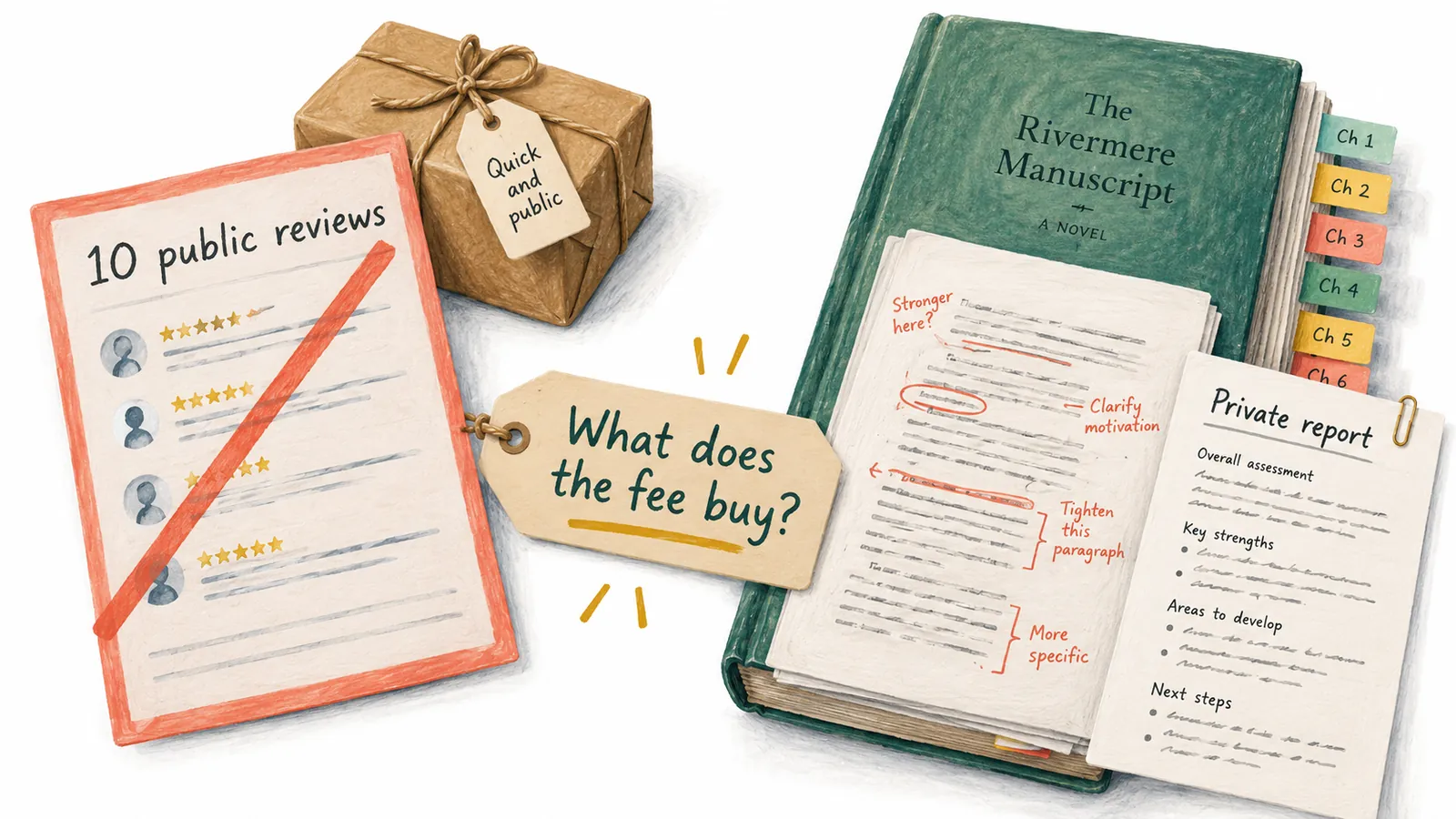
Do not buy customer-review delivery as a shortcut to credibility
Are paid Amazon reviews safe? Do not treat a purchase of customer-review posts or star ratings as an acceptable marketing shortcut. Amazon's public review explanation prohibits compensated review arrangements. A promise that reviewers are real or opinions are honest does not remove the payment condition.
However, not every paid publishing service sells Amazon customer reviews. Editing, private reading reports, promotional placements and commissioned editorial coverage have different deliverables. Identify the exact output before paying. Those services still require appropriate terms, permissions and applicable disclosures; they are not automatically approved because they use a different label.
Write the invoice in plain language
Replace vague terms such as visibility boost with a description of what must be delivered and where it appears. Is the fee buying an advertisement, a private report or a specified number of public Amazon contributions? If the provider will not answer, do not treat the ambiguity as favorable.
Separate public reviews, private critique and promotion
The destination matters as much as the text. A private manuscript assessment is not an Amazon customer review. A paid editorial piece should not be copied into a customer-review account as if it were an independent shopper's contribution. A promotion package should describe the exposure being purchased rather than guarantee reader opinions.
| Offer | Deliverable to establish | Boundary to preserve |
|---|---|---|
| Amazon review package | Public customer-review posts or ratings | Do not purchase public opinions |
| Private reading assessment | Notes delivered privately to the author | No hidden public-posting requirement |
| Editorial coverage | Specified publication and usage rights | Not automatic permission for customer-review posting |
| Advertising or reader introduction | Defined placement or distribution service | No guaranteed review count or sentiment |
This is a procurement classification, not a recommendation of any provider. For reciprocal or credit-based models, use the exchange-model comparison and the policy-application guide. A membership fee does not tell you what participants are required to do.
Request the actual participant terms before buying
Ask for the author contract and the reader-facing instructions. Read the completion, validation, cancellation and refund conditions together. A polished publisher sales page may omit what readers receive or what happens when they do not post.
Ask questions that can be answered with records
| Question | Record to request | Decision implication |
|---|---|---|
| What exactly closes the order? | Delivery and acceptance criteria | Reject a public-review count as the purchased output |
| What happens if a reader declines? | Participant cancellation and reward rules | Inspect loss of benefits tied to posting |
| Can readers choose an unfavorable opinion? | Validation and revision instructions | Identify sentiment control separately |
| Who writes the contribution? | Authorship and editing workflow | Reject scripted shopper impersonation |
| Where may supplied coverage be reused? | License and disclosure terms | Do not assume unlimited advertising rights |
Keep a dated copy of the answers. If the provider changes the offer during a sales call, ask for the revised scope in writing. Do not pay for a small trial of a prohibited deliverable simply to see whether the first reviews remain visible.
Trace both the publisher's fee and the reader's benefit
Two payment flows may exist: your fee to the organizer and a reward supplied to participants. Trace both. Ask whether a public review releases money, preserves credits, unlocks another assignment or triggers reimbursement. A provider charging for administration can still operate a review-contingent participant system.
Early credits can remain conditional
If a reader receives credits at acceptance but loses them without public proof, inspect that clawback. It is not resolved by describing the reward as payment for reading. Use the incentive audit to follow the no-review outcome through timeout and cancellation, not only the first grant.
KDP's review-copy guidance describes an optional free or discounted book copy, not a general permission for extra rewards. Do not assume that reimbursing a genuine purchase creates an independent customer opinion. The transaction and the incentive arrangement answer different questions.
Check what a refund promises
A package that replaces missing reviews until a target count is reached is promising a different deliverable from an advertisement with a documented placement. Identify the exact promise rather than treating every refund clause as proof of reliability. Contract questions may require advice; no refund promise authorizes the underlying review arrangement.
Check claims about approval, visibility and technical safety
Ask for the basis of claims such as approved by Amazon, guaranteed to stay live or impossible to detect. Do not accept a provider logo or a screenshot of existing reviews as proof of applicable authorization. A review visible today does not reveal its future status or every condition behind its creation.
Reject concealment as a selling point
Changing referrers, account names or posting intervals cannot turn a purchased public-review deliverable into a different service. Do not request evasion instructions or a safe daily quantity. Assess what the provider promises, not how effectively it claims to hide the arrangement.
KDP's account-security guidance explains how to verify doubtful contacts and protect credentials. Do not give a vendor your Amazon password or a reader's login. A legitimate-looking sales conversation is not a reason to surrender account control.
Separate advertising disclosure from Amazon posting permission
For U.S. advertising contexts, the FTC Endorsement Guides Q&A addresses disclosure of material connections. Its consumer-review rule Q&A distinguishes incentives from sentiment-conditioned incentives. Those are legal questions, not an Amazon exception.
Do not use one disclosure as a universal clearance
A paid endorsement labeled as advertising may still be unsuitable for a customer-review surface. Evaluate the intended use, the destination's rules and the applicable law separately. This guide does not give legal approval to a proposed campaign or decide disclosure requirements across jurisdictions.
If you buy editorial coverage, establish whether you may quote it, where it may appear and what context is required. Keep the publication and the rights record with the invoice. Do not strip a sponsored statement of its context to make it resemble an unsolicited shopper recommendation.
Choose a budget for a verifiable publishing task
Define the job before comparing prices. A manuscript that needs diagnosis may benefit from a clearly scoped private assessment. A book ready for readers may need a relevant introduction or a working audience channel. Neither objective requires buying a public-review count.
A fictional purchase decision
Fictional example: one proposal guarantees customer reviews; another specifies a private report on confusing chapters. The author rejects the first deliverable and evaluates the second against the manuscript's actual need, reader qualifications, scope, price and permitted use of the report. The comparison does not assume that every private-report vendor is suitable.
For optional early reading, use the ARC team guide and the outreach workflow. For promotion, use the marketing guide map. Set a bounded spending allowance and measure the purchased work rather than retrofitting a review quota to justify the fee.
Write a purchase brief that can be verified
- Output: name the exact private report, editorial publication or advertising placement. State explicitly whether any public customer-review contribution is required.
- Scope: identify the manuscript version, destination, reader qualifications where relevant, deadline, total fee and any separate distribution costs.
- Acceptance evidence: define the document or placement record that demonstrates delivery. Do not substitute shopper-review screenshots for a private assignment.
- Stop rule: specify how to pause if the provider introduces public-posting requirements, unexpected rewards or requests for account access.
Fictional brief: a report identifies confusing passages in chapters one through three, with page references and suggested questions for revision. The author evaluates those notes against the agreed scope; no Amazon post closes the order. That makes the purchased task inspectable, not automatically useful or legally cleared. For actual advertised options and prerequisites, consult the service comparison rather than treating a low entry price as evidence of fit.
Handle an existing order without buying a cover-up
Preserve the offer, invoice, participant conditions and correspondence privately. Stop new review-delivery commitments while clarifying the scope and legitimate cancellation options. Do not pay for edits or deletions to conceal the transaction, threaten readers or demand replacement contributions from new accounts.
Respond to actual records, not imagined outcomes
If a genuine notice arrives, follow its instructions and describe the facts truthfully. If a contribution disappears, use the missing-review investigation without declaring the private reason known. A correction to your process does not guarantee reinstatement or erase earlier conduct.
Record the final procurement decision, the scope declined or accepted and any unresolved question. Use the risk guide map for a separate account or rights issue. This page is a service-purchase workflow, not a list of vendors certified safe.
Use the Amazon book review guides to find the next step for reader recruitment, review rules or visibility problems.
Sources and scope
Official Amazon, KDP and U.S. FTC references checked on 16 October 2026. Direct Community Guidelines retrieval returned an error; accessible official explanations were used. Procurement tables and the example are original aids. No provider was purchased, tested or endorsed, and no private account or legal dispute was assessed.
Frequently asked questions
Can I buy Amazon customer reviews if the opinions are honest?
Do not treat honesty as an exemption for a purchased public-review deliverable. Inspect the compensation and the actual platform requirements.
Are all paid publishing services the same as paid Amazon reviews?
No. Editing, private reading reports, editorial coverage and advertising have different outputs. Assess their actual scope, permissions and conditions separately.
Is paying an organizer rather than a reader enough to resolve the issue?
No. Trace both the publisher fee and the participant benefits. An administration label does not remove a review-contingent reward.
Should I test a small review package before buying more?
Do not purchase a trial of a prohibited deliverable to see whether it remains visible. Visibility is not policy authorization.
Does advertising disclosure authorize a paid Amazon review?
No. Legal disclosure and destination rules are separate checks; one does not automatically satisfy the other.
What should I retain if I already placed an order?
Keep the offer, invoice, participant terms and correspondence privately. Stop new review-delivery commitments while clarifying legitimate cancellation options and any actual notice.