

KDP Niche Research With BSR
Record the context before interpreting the rank. BSR observations can support follow-up questions, but they are not exact sales or a profitable-niche certificate.
Work through a fictional log covering repeated observations, different formats, category ranks and a missing value.
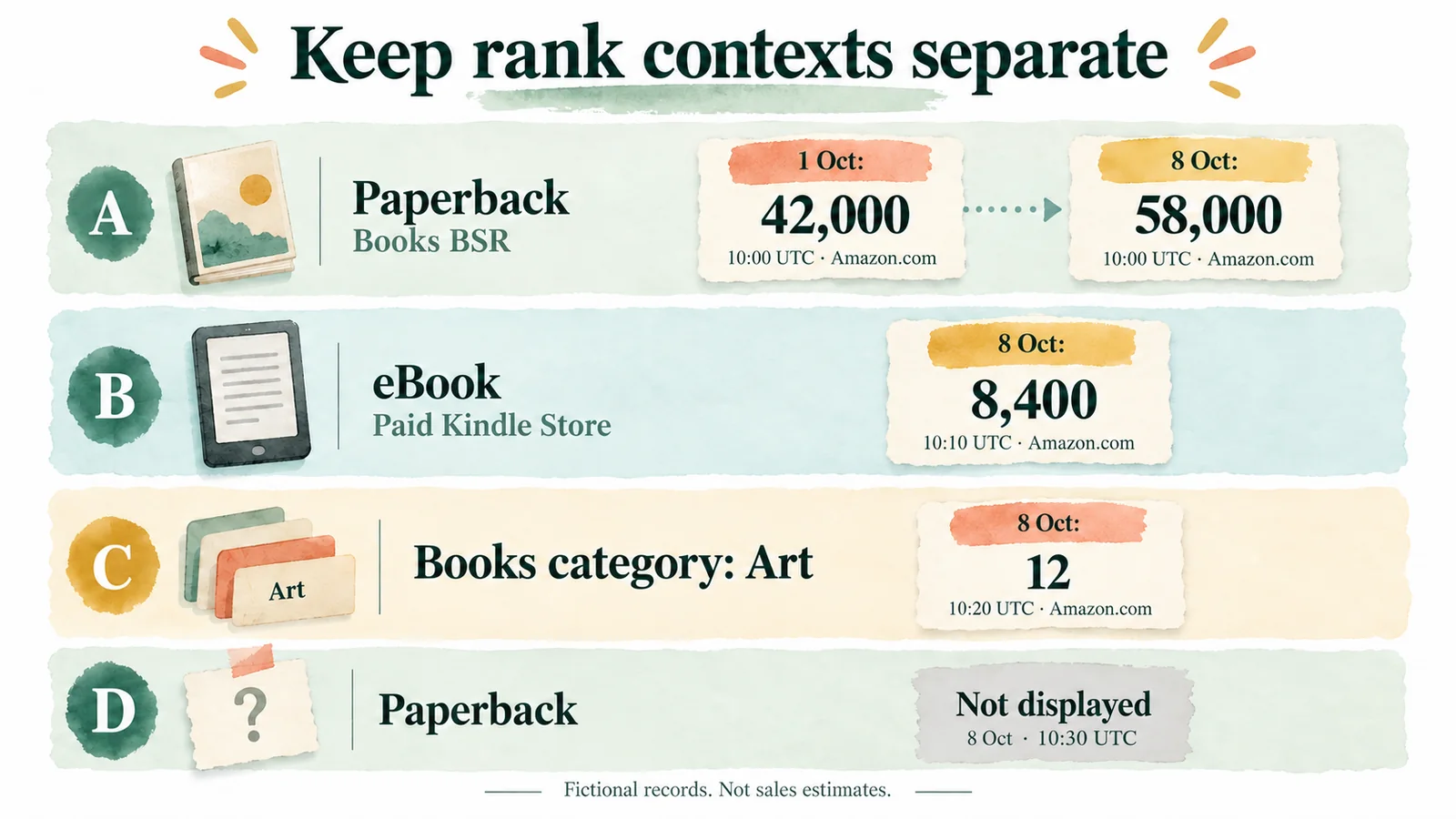
BSR is contextual evidence, not a niche approval score
Use Amazon Best Sellers Rank in niche research only after defining the reader task and relevant books. Starting with a rank threshold and searching for a topic that fits it reverses the decision: you may select a book you cannot produce or compare products that solve different problems.
KDP's Sales Ranking guidance describes relative customer activity, incorporating recent and historical activity. A number can therefore change without a matching change in the book's own activity. It is not an exact unit-sales report.
The practical use here is narrow: identify records worth following up, keep contextual observations and avoid conclusions the data cannot support. For a new concept, begin with niche discovery; for the comparison set, use book market research.
Write the question first
"What context should I investigate around these relevant editions?" is answerable from a careful log. "How much will my unwritten book earn?" is not answered by a competitor's rank. Keep those questions separate before opening a calculator or spreadsheet.
Record what the number actually describes
Save the exact displayed ranking label, marketplace, work, edition format, identifier, date and time. Include the query or route used to reach the page, along with visible offer or availability notes. A bare number pasted into a spreadsheet is not a complete observation.
KDP distinguishes format-specific BSR from category rankings; Books category rankings can aggregate formats. The Kindle Store also separates Free and Paid lists. These are different comparison contexts, so keep the original label rather than renaming every field simply "BSR."
Do not silently repair incomplete records
If the format, list label or timestamp is missing, mark the observation incomplete. If a rank is not displayed, record that fact. Do not replace it with zero, an estimated value or a conclusion that the book has never sold.
Your research log is not an account ledger. Leave sales, royalties and advertising spend blank or explicitly unavailable unless you have an appropriate independent source for them. A tool's estimate should remain labeled as an estimate, with its method and limits.
Read five fictional records without combining unlike ranks
This table is an original teaching example. The products, dates and values are invented; no live Amazon pages or sales were audited. The research subject is a beginner travel-watercolor instructional paperback. Identifiers A through D are internal example IDs, not real ASINs.
| Record | Recorded context and value | Allowed next step |
|---|---|---|
| A, observation 1 | 1 October 2026, 10:00 UTC. Amazon.com, paperback, Books BSR: 42,000. | Retain as a dated record for this exact example edition. |
| A, observation 2 | 8 October 2026, 10:00 UTC. Same marketplace, edition and label. Books BSR: 58,000. | Record the changed value; investigate context without calculating units lost. |
| B, different format | 8 October 2026, 10:10 UTC. Amazon.com, eBook, Paid Kindle Store BSR: 8,400. | Keep a separate format group, not a direct arithmetic comparison with A. |
| C, category record | 8 October 2026, 10:20 UTC. Amazon.com, Books category label recorded as Art: 12. | Preserve the category context; do not treat 12 as an overall Books BSR. |
| D, incomplete record | 8 October 2026, 10:30 UTC. Paperback detail page, rank not displayed. | Mark unavailable and inspect the edition; do not enter zero sales. |
Group comparable observations by marketplace, edition identifier and exact displayed list label. Only the two A records share that key here. Keep B and C in separate contexts; D is incomplete because its marketplace and list label are not recorded and its rank is unavailable. This grouping checks comparability, not demand. Preserve an unknown value rather than filling it with zero.
The table does not show five independent competitors: A appears twice. It also does not establish a market average. There are different formats, different labels and one missing value. Keeping those differences visible is the point of the exercise.
Repeat observations to improve the record, not to manufacture certainty
Choose a bounded observation plan
Decide which relevant editions you will revisit, what context you will record and which question the next visit should resolve. Use a manageable schedule that fits the project. There is no universal number of observations that certifies a niche or converts a log into a sales forecast.
Revisit the exact edition rather than a search result that may point somewhere else. Record changes to visible price, availability or presentation, and note what you could not inspect. If the title has been replaced by a different edition, start a new record rather than pretending the old series continued unchanged.
Preserve the original observations
Do not overwrite last week's value with today's. Keep timestamps, labels and any evidence references. If an earlier entry was a transcription error, correct it with a note. This makes the reasoning reviewable without turning your notebook into an undocumented graph.
Rank movement can justify another question, but it does not tell you its cause. A visible discount may be relevant context; you still do not know the author's full promotion history or account results.
Avoid arithmetic across incompatible records
A category position and an overall store rank answer different questions. The A and C records should not be averaged. A paperback record and a Kindle record should not be ranked as if they came from one shared unit-sales scale. A free offer should not be silently mixed into a paid comparison.
Work-level and edition-level analysis also need different grouping. If your question is how many distinct books serve a reader task, duplicate editions can inflate the count. If your question is how a particular physical product is presented, merging its records with another format can hide important differences.
First ask whether the records are comparable. Only then ask whether a summary would help answer the research question.
A minimum value can hide the weakest observations; an average can create false precision. Keep the underlying rows inspectable, especially in a small convenience sample. Use BSR versus discoverability for the difference between rank and being found through a query.
Reject universal profitable-niche thresholds
A rule such as "publish whenever several books are below rank X" leaves out the book's task, the author's capability, production burden, relevant competitors and route to readers. It can sound decisive while answering a different question from the one your project faces.
Similarly, multiplying a rank-to-sales estimate by a competitor's list price does not establish that author's profit or your opportunity. List price is not net earnings, and the estimate has not supplied production, distribution or reader-acquisition costs. Keep any scenario calculation separate from observed marketplace facts.
For a separate, assumption-based cost model, use the niche economics guide. Keep its scenario inputs distinct from observed ranks; neither provides expected sales.
Nor is a small result count proof that a niche is easy. It may reflect query wording, format display or an unclear reader task. The search results guidance is a reminder that the query view is another contextual observation, not a full inventory.
Accurate wording and shelf fit still matter. Use the keyword hub and the category guide rather than treating a rank number as permission for unrelated placement.
Use rank to choose a next investigation
| Observation | Unsupported conclusion | Better next action |
|---|---|---|
| A changed between two visits | The author lost a specific number of sales because demand collapsed. | Check the exact edition and visible context; keep the cause unknown. |
| B shows a smaller number | The eBook sells more units than the paperback in this sample. | Maintain separate format records and inspect the actual reading task. |
| C has a prominent category position | The whole niche is profitable for a new author. | Inspect relevant books and your own delivery feasibility. |
| D has no displayed rank | Zero buyers and no competition. | Record missing evidence and investigate availability or page context. |
- Keep exact labels, formats, timestamps and identifiers.
- Do not treat repeated observations as extra competitors.
- Keep missing data missing rather than entering zero.
- Separate observed values, estimated scenarios and conclusions.
Write a conclusion that fits the evidence
A defensible memo could say: "We inspected a bounded set of relevant editions. The log contains two contextual observations of A, a separate Kindle example, a category record and one unavailable value. These records identify follow-up questions; they do not establish sales totals or niche-wide demand."
Then name the next action: inspect the lesson sample, test your prototype, resolve the comparison set or stop the project. Return to the discovery gates and the market comparison memo. For broader visibility diagnosis, use the discoverability hub.
Research is useful when it reduces a specific uncertainty. It does not need to manufacture a profitable-niche label to justify the work.
Explore the KDP niche research guides to compare reader needs, competition and publishing formats.
Sources and scope
Official primary guidance rechecked on 17 October 2026. The examples are fictional; no live marketplace audit or reader trial was conducted.
Official KDP ranking and search guidance were checked on 17 October 2026. The observation protocol, records, values and decision examples are original fictional teaching material. No live rank collection, sales conversion model, profitability analysis or causal effect was audited. The illustration is conceptual.
Frequently asked questions
Can BSR tell me exact book sales?
No. Treat the displayed rank as contextual evidence, not an exact unit-sales report. A competitor's number also does not forecast your unwritten book's results.
What should I record beside a rank?
Save the marketplace, exact label, work and edition identifier, format, timestamp and relevant visible context. A bare number is not a complete research observation.
Can I average overall BSR and category positions?
No. They describe different comparison contexts. Preserve the original labels and decide whether the records answer the same question before summarizing them.
Does an absent rank mean zero sales?
No. Record the value as unavailable and investigate the edition or page context. Do not replace missing evidence with a zero or a lifetime sales claim.
Do repeated visits count as additional competitors?
No. They are repeated observations of the same edition. Distinguish the number of records from the number of distinct works or products.
Is there a universal BSR threshold for profitable niches?
No threshold is established here. Reader task, comparable products, author capability, production burden and unresolved commercial questions still require separate assessment.