

How Much Do Authors Make on Amazon? Build a Realistic Model
Your result depends on the royalties you earn, the readers you reach and the costs of producing and promoting the books.
Replace vague income claims with clearly labeled scenarios, required-volume calculations and actual records when available.
Author income depends on royalties, volume and costs
There is no responsible single-dollar answer for what you will make from publishing on Amazon. A book can earn no royalties during a period, and a project can lose money after expenses. Higher sales can support higher earnings, but neither publishing a title nor choosing a high royalty percentage establishes that those sales will happen.
This guide does not have a representative author-earnings dataset from which to estimate a typical person's take-home pay. Instead, it provides a practical way to calculate scenarios from explicit assumptions, then replace those assumptions with your own records. The examples are not average earnings, testimonials or forecasts.
Define the income measure first
Separate customer spending, platform royalties, operating surplus and cash received. A screenshot showing $2,000 of royalties does not reveal editing costs, advertising, tax, unpaid work or the earning period. Before comparing two authors or two months, make sure the numbers describe the same thing.
Use the royalty rate reference to check format-specific rules and the royalty reconciliation guide to connect estimates, statements and payments. Income planning starts after those definitions are clear, not with multiplying retail price by a desired number of readers.
Build a per-unit model for each earning stream
For each edition, record a supportable royalty per net paid copy using the actual price, eligible transaction conditions and production inputs. Do not assume paperback, hardcover and eBook buyers produce identical amounts. If you already have reliable statements, use the matching historical results and preserve their period and marketplace context.
The per-copy royalty calculator can apply a confirmed formula, but it cannot supply demand or verify eligibility. Carry only a compatible royalty amount into the income model, then subtract external variable costs once to obtain contribution per copy.
Keep reading units separate from paid copies
Kindle Unlimited earnings use eligible normalized pages read and the fund allocation, not a fixed retail-price percentage. Keep that stream in its own row with an explicit period and rate assumption. A borrow, a paid copy and a normalized page are different units.
Start with a conservative model that you can explain. If one format has not launched or a reading stream has no evidence, label its volume unknown rather than giving it an optimistic default. Zero contribution from an unproven stream is a useful downside scenario, not a claim that the stream can never work.
Compare monthly outcomes without calling them typical
The following fictional planning cases assume an average royalty of $3 per net paid copy, no KU earnings and no other publishing revenue. Monthly operating spend includes the period's promotion and recurring tools. A separate $100 planning allowance represents recovering a hypothetical $1,200 production budget over twelve months; it is not an accounting depreciation rule or an additional cash bill each month.
| Net paid copies | Royalties at assumed $3 each | Monthly operating spend | Remaining after spend and $100 recovery allowance |
|---|---|---|---|
| 0 | $0 | $120 | -$220 |
| 60 | $180 | $120 | -$40 |
| 300 | $900 | $300 | $500 |
| 900 | $2,700 | $900 | $1,700 |
The cases are independent assumptions, not stages you should expect to progress through. Spending $900 does not establish that 900 copies will sell. The final column is before personal taxes and does not price the author's labor. It is a defined planning remainder, not take-home salary.
Change one uncertain input at a time
Recalculate with a lower per-copy royalty, higher acquisition costs and a slower month. If the project only works at the highest volume in the table, the decision depends heavily on demand that may not exist. Keep the low-volume case visible when deciding what you can afford to spend.
Include production, promotion and your own time
| Cost category | Examples | How to model it |
|---|---|---|
| One-off production | Editing, cover, illustrations, formatting and proofs | Track actual cash outlay and a separate recovery goal; do not hide it in a monthly royalty figure. |
| Promotion | Ads, qualified promotional placements and creative production | Use actual period spend; attributable sales are not automatically incremental sales. |
| Recurring operations | Relevant software, mailing tools and subscriptions | Allocate a documented share to the project without counting a catalog-wide bill repeatedly. |
| Author time | Writing, production checks, research, reader communication and reporting | Record hours separately and test whether the result justifies the workload. |
Do not subtract print manufacturing or digital delivery again if the royalty figure already includes those deductions. Conversely, starting from retail sales revenue requires the full platform calculation before you reach royalties. Name the starting basis in the model so another person can follow the arithmetic.
In the fictional 300-copy case, the $500 planning remainder divided by 20 hours of ongoing work would be $25 per hour before personal taxes. That still excludes the initial writing and production time unless you explicitly include it. Changing the labor definition changes the result; neither version is a universal author wage.
Translate an income goal into required volume
Use contribution, not retail price
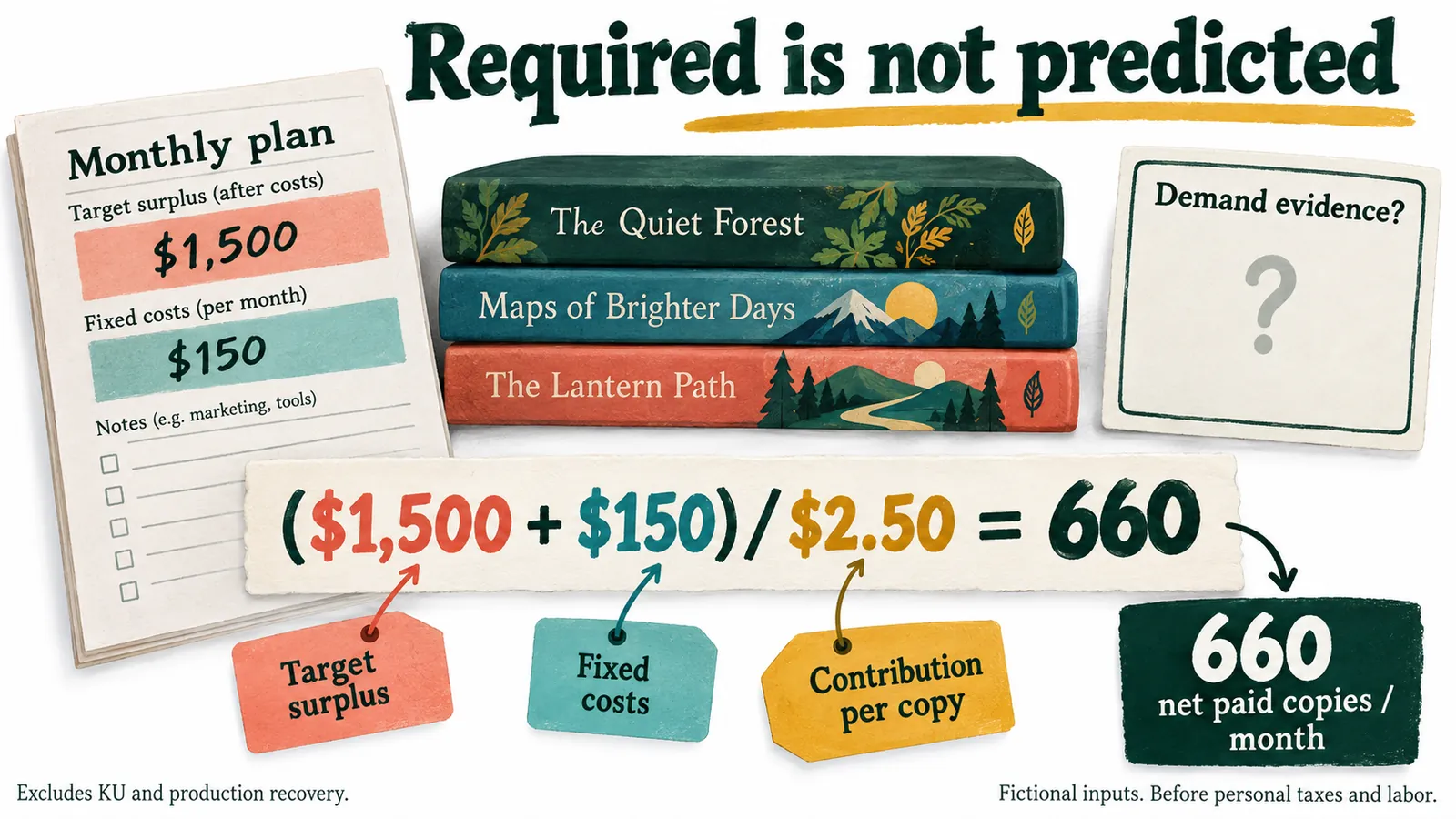
In a separate hypothetical model, assume each net paid copy contributes $2.50 from royalties less modeled variable promotion costs. Suppose fixed monthly operating costs are $150 and the desired pre-tax operating surplus is $1,500. The required volume is ($1,500 + $150) / $2.50 = 660 net paid copies per month. This model excludes KU and one-off production recovery.
The result states what would be required, not what the market will deliver. Check whether you have evidence for reaching that volume at the assumed variable cost. If acquisition becomes more expensive as volume grows, the $2.50 contribution is no longer a valid constant and the required volume must be recalculated.
Separate break-even from a recurring living
With an upfront budget of $1,200 and a contribution of $2.50 per copy, recovering that budget alone requires 480 net paid copies, before fixed costs, personal taxes and labor. That is cumulative production recovery, not a monthly salary target. Use project profitability planning to keep those questions separate before expanding a catalog.
Judge income claims by their scope and denominator
For a published benchmark, check the cohort, year and statistic behind average income claims. For your own demand evidence, reconcile Amazon paid-copy counts. When researching another title, audit a BSR-to-sales estimate before using it as a model input. These are three different evidence checks.
Before using an earnings claim, ask who is included, what period is covered and whether it describes royalties, book income or a broader business. A successful author's selected launch month cannot establish what a new publisher should expect. A survey of full-time authors cannot automatically describe all first-time account holders.
- Identify the sample, selection method and publication date.
- Distinguish mean, median and a selected individual example.
- Check whether zero earners and inactive publishers are included.
- Separate book royalties from courses, services, speaking and other work.
- Look for expenses, author hours and the size and age of the catalog.
- Do not transfer a result between genres or formats without supporting evidence.
KDP's sales rank guidance describes relative sales activity, not an author's profit. A rank screenshot cannot provide the missing advertising budget, production cost or portfolio history. Use the BSR research workflow for the limited question that rank evidence can address.
Plan for payment lag and uneven catalog performance
KDP's payment schedule separates the earning month from the later payment period. Track upcoming production and promotion bills against available cash, not just estimated current royalties. Leave personal taxes and obligations as separate planning items to discuss with a qualified local adviser.
More titles can add earning opportunities and workload, but title count alone is not an income multiplier. Track contribution by book and format, shared costs, revision needs and how much revenue depends on one successful title. Do not assume a new book reproduces the best existing title's performance.
Use scenarios instead of annualizing one strong month
Keep a quieter month, a planned campaign month and a delayed-release case. If an annual plan depends on twelve launch-level months, record that as an unsupported assumption unless you have evidence for it. Also keep a stop rule: when will you revise the offer, limit spend or pause further production?
Improve the weak part of the model
When several titles are involved, use the catalog income workflow to separate title contribution from shared costs. Before expanding a new commitment, use the scenario review to test sensitive assumptions rather than multiplying a favorable result.
Choose a focused next step: compare worked project cases, calculate the net copies required for a defined goal, or review whether the income and cash pattern could support household commitments. Those are different decisions, not interchangeable ways to predict a salary.
If per-copy economics are weak, inspect format, cost and pricing before buying more exposure. If the offer does not match a clear reader task, return to niche research. If discovery is weak, use the discoverability guides; if you need a measured campaign, use the marketing hub.
For advertising decisions, the ACOS guide helps distinguish attributed retail sales from the royalty available to pay for ads. Choose a bounded test with an observation window and spending limit. Changing the model with better evidence is more useful than adding another optimistic earnings scenario.
For another earnings task, return to the KDP earnings guide hub and choose the relevant royalty, measurement, planning or catalog workflow.
Sources and scope
Primary KDP references were checked on 16 October 2026. All financial scenarios, volumes, costs and hourly figures on this page are explicitly fictional arithmetic examples, not measured author outcomes or personalized financial advice. Use actual statements and cost records for your own decisions and keep uncertainty visible.
Frequently asked questions
Is there a guaranteed income from publishing on Amazon?
No. Publishing a book does not establish sales or profit. A period can produce zero royalties, while production and operating costs can create a loss.
Does this guide report average author earnings?
No. It does not have a representative earnings dataset. All numerical examples are explicitly fictional planning scenarios, not survey results or typical outcomes.
How do I estimate a monthly income goal?
State whether the target is after fixed costs and includes production recovery. For a target after fixed period costs, add those costs and any required recovery allowance before dividing by contribution per net paid copy. Required volume is not predicted demand.
Can I count Kindle Unlimited pages as book sales?
No. Eligible normalized pages are a separate earning stream. Model them independently and do not assume a permanent page rate.
Does publishing more books guarantee more income?
No. A new title has its own reader fit, production work, costs and sales uncertainty. Track contribution and workload rather than multiplying the best title's performance by catalog size.
What is missing from a royalty screenshot?
Often the costs, time, earning period, catalog context, other revenue streams and cash timing. A screenshot alone is not a complete author profit statement.