

Amazon KDP Royalty Calculator
Estimate one qualifying paid copy using a confirmed method and compatible cost inputs.
Example values are fictional. Confirm rate eligibility, the applicable price and edition-specific costs in KDP before relying on the estimate.
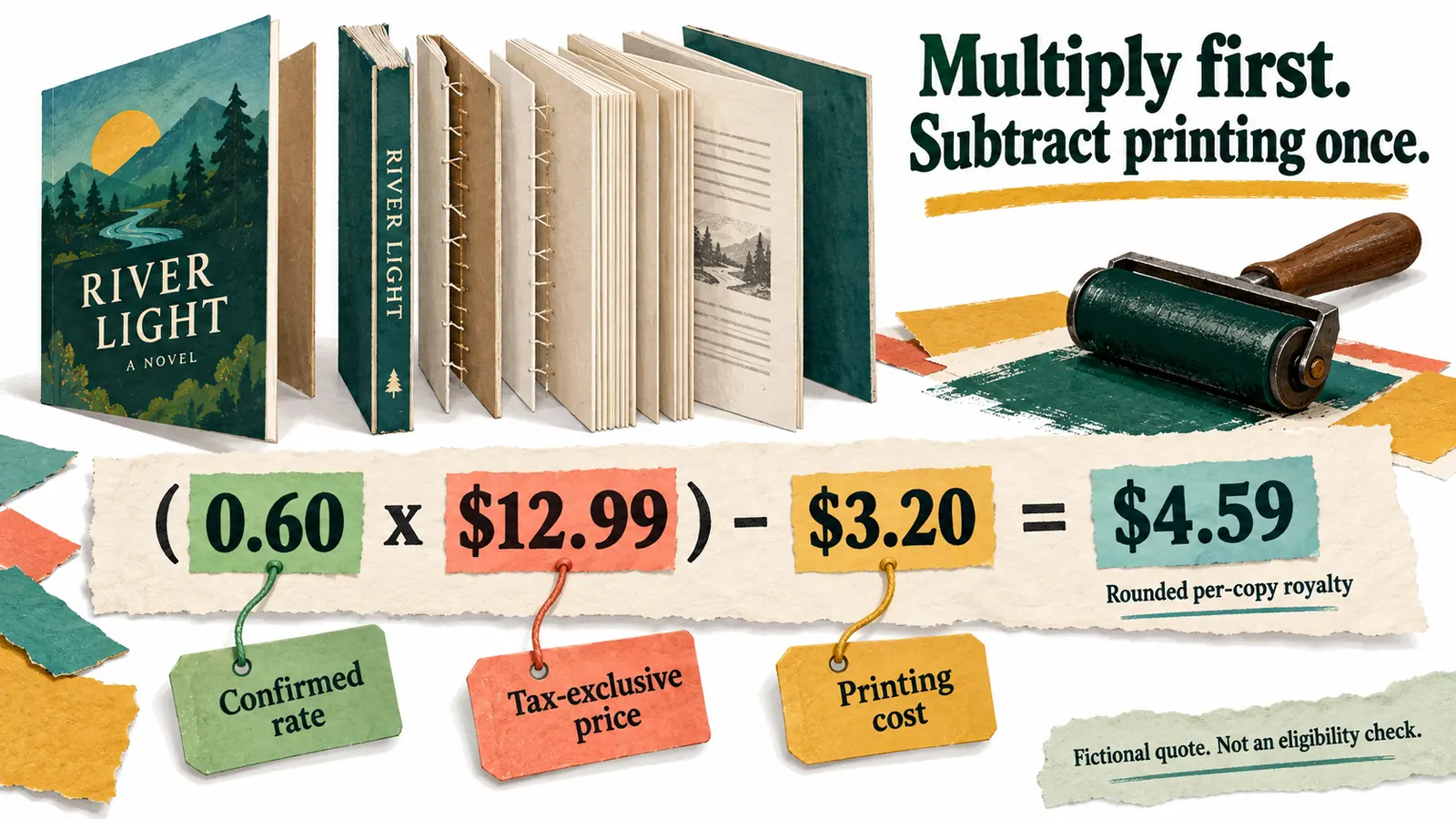
A royalty calculator estimates one qualifying paid copy
The calculator above applies a confirmed royalty method to an applicable tax-exclusive price and a delivery or printing cost. The starting numbers are fictional examples, not recommended prices or a verified production quote. The result is a conditional per-copy estimate, before external promotion, editing, software, personal taxes and author labor.
It does not determine whether a book, price or customer territory qualifies for a rate. Confirm those conditions in KDP first. Nor does selecting a display currency convert an amount or choose a marketplace. All inputs must already use the same currency. For the broader rate rules, use the royalty reference guide.
Keep the calculation separate from demand
A stronger per-copy result says nothing by itself about sales volume. A higher price may change reader response, and a cheaper production setup may affect the book's usefulness. Save the estimate as one input to a defined project rather than treating it as expected monthly income.
Confirm price, method and deduction before entering them
| Input | What it represents | Check before using it |
|---|---|---|
| Applicable price excluding tax | The price basis for the qualifying sale | Remove applicable VAT correctly; check whether price matching changes the basis. |
| Confirmed method | Ebook option or print channel and rate | Check eligibility and the relevant market; a selection here does not certify it. |
| Delivery cost | The charge used for the ebook's eligible 70% calculation | Use the relevant file and territory cost, not an assumed universal fee. |
| Printing cost | Manufacturing cost for the specific print edition | Use a current quote for its setup and marketplace. |
When an input price includes VAT, remove the tax using the correct base before entering it. For a fictional price of 6.00 with an assumed 20% VAT rate, 6.00 / 1.20 = 5.00 excluding VAT. Subtracting 20% of the gross price would incorrectly give 4.80. This arithmetic does not supply the applicable tax rate for any country.
Do not estimate production cost from the cover
Use the official printing cost calculator guidance to obtain an edition-specific quote. Its linked tool covers paperback and hardcover estimates, not Expanded Distribution estimates. Copy the relevant cost into this worksheet only after checking the actual format and channel.
Keep the quote date, edition settings and currency with the calculation. If the interior or setup changes, obtain a new quote before reusing the old number. This worksheet intentionally does not maintain a printing-cost lookup table or infer a quote from page count.
Apply the ebook deduction in the correct order
KDP's ebook royalty guidance distinguishes the 35% and eligible 70% options. This worksheet uses 0.35 x tax-exclusive applicable price for 35%, and 0.70 x (tax-exclusive applicable price - delivery cost) for 70%. Delivery is not subtracted again in the 35% method.
Work through a fictional example
With an assumed applicable price of $4.99 and delivery cost of $0.30, the 70% calculation is 0.70 x ($4.99 - $0.30) = $3.283, displayed as $3.28. Subtracting $0.30 after multiplying the price would instead produce $3.193, which is a different formula.
At 35%, the same fictional price gives 0.35 x $4.99 = $1.7465, displayed as $1.75. These cases do not establish that both options are available for every sale. Check the customer territory and applicable conditions rather than assuming that the store domain alone guarantees the selected percentage.
Subtract printing cost after applying the confirmed print rate
The checked print pricing guidance specifies 50% or 60% for standard distribution according to list price, and 40% for eligible Expanded Distribution. Expanded Distribution is not available for hardcover. The worksheet therefore offers its 40% method only as paperback Expanded Distribution.
Use a quote, not a permanent assumed cost
For a fictional standard-distribution case, assume the confirmed rate is 60%, tax-exclusive list price $12.99 and printing cost $3.20. Royalty is (0.60 x $12.99) - $3.20 = $4.594, displayed as $4.59. The $3.20 cost is an assumption, not a current quote for every paperback.
Do not subtract printing from price before multiplying by the rate. That would assign part of the manufacturing deduction to the platform percentage and overstate the result. Also do not deduct the same printing cost again when the calculated royalty is transferred into a business-income worksheet.
Compare cases without implying equal eligibility
Keep an unchanged reference case when testing a deduction. At a fixed confirmed print rate and price, increasing printing cost by an assumed $0.50 reduces royalty by $0.50. In an otherwise unchanged 70% ebook case, increasing delivery by $0.50 reduces royalty by $0.35. Those are different sensitivities because the deductions occupy different positions in the formulas. Neither comparison predicts how an altered book or price affects purchases. Retain the old input, new input and changed assumption alongside the result.
| Confirmed method assumed | Tax-exclusive price | Delivery or print cost | Displayed royalty |
|---|---|---|---|
| Ebook 70% | $4.99 | $0.30 delivery | $3.28 |
| Ebook 35% | $4.99 | Not deducted | $1.75 |
| Standard print 60% | $12.99 | $3.20 printing | $4.59 |
| Eligible paperback Expanded Distribution 40% | $12.99 | $3.20 printing | $2.00 |
The cases isolate formula differences. They do not recommend a distribution channel or prove that a price satisfies current minimum and maximum requirements. A nonnegative answer here is not a publishability check. Use the KDP setup screen and current channel rules to confirm what can actually be offered.
Investigate a mismatch before changing the inputs to fit
- Check the exact edition, marketplace and customer territory.
- Confirm the applicable price and tax-exclusive basis.
- Verify whether delivery or printing belongs in the selected method.
- Retain the quote date and any price-matching context.
- Compare an estimate with a matching record, not unrelated bank cash.
- Keep unresolved differences visible instead of changing a cost without evidence.
Compare the same record state
A conditional estimate is not an official earnings statement. The KDP Royalties Estimator explains why estimates and actual earnings can differ. Follow the reconciliation guide when the question concerns a posted earning or payment rather than a hypothetical qualifying sale.
Understand display rounding and validation boundaries
The worksheet calculates with a six-decimal money scale and displays monetary results to two decimals, including JPY for consistency in this planning view. It does not claim to reproduce every platform statement-rounding convention. If a rounded per-copy amount is copied into another worksheet, its total can differ from a calculation using more precise values.
Rejected inputs do not become estimates
Blank, negative, non-finite and out-of-range amounts are not silently converted to zero. A negative royalty result is rejected with a request to review the inputs. Positive price is required. The supported upper bound is 1,000,000 per numerical input; it is an implementation limit, not a market or policy limit.
Connect per-copy economics to the right next calculation
Use the income calculator to combine confirmed per-copy amounts with net paid-copy assumptions and a separate KU stream for one period. Use the ROI calculator when the question is production recovery and included-cost return. Neither tool supplies demand evidence.
For a measured sales input, use the sales reconciliation workflow. For other tasks, return to the earnings hub. Retain your source inputs and exclusions with the result so another reader can understand what was calculated.
Sources and scope
Primary KDP references checked on 16 October 2026. All worked prices and costs are explicitly fictional teaching inputs. This is an independent planning worksheet, not an Amazon eligibility engine, production quote or official earnings statement. No author account or private financial records were accessed.
Frequently asked questions
Does this calculator determine which royalty rate my book qualifies for?
No. Choose a method only after confirming the price, territory, format and channel conditions in KDP. A nonnegative result does not certify publishability or eligibility.
Where does delivery cost go in the 70% ebook calculation?
The worksheet uses 70% of the applicable tax-exclusive price after subtracting delivery. It does not subtract that fee again under the 35% method.
Does the calculator quote a printing cost from page count?
No. Enter a current cost for the exact edition and marketplace. The guide links to Amazon's official printing calculator guidance; the local worksheet does not maintain cost tables.
Does changing currency convert my inputs?
No. It changes the display label only. All amounts must already use the selected currency and a consistent price basis.
Why can the estimate differ from a statement?
Eligibility, applicable sale price, taxes, costs, record state and rounding may differ. This conditional worksheet is not an official earnings statement or a replica of every platform convention.
Are the default prices and deductions recommendations?
No. They are fictional teaching values. Replace them with verified compatible inputs before using the calculation in a plan.