

Low Competition KDP Niches
A sparse result page is a starting question, not proof of an easy market. Define the reader task and inspect the products that actually serve it.
Use fictional repair-book examples to examine alternative explanations, test a distinction and make a bounded publishing decision.
Low competition is a claim to investigate, not an easy-entry certificate
A book competes for a particular reader's attention and purchase decision. The useful question is whether you can deliver a recognizable task or experience that relevant existing books do not already serve equally well. Counting all books about sewing, then calling a narrower phrase low competition, does not answer that question.
Competition, demand and your ability to produce the book are separate issues. A sparse result page can reflect an awkward query or an unclear task. A busy result page can include adjacent books and substitutes rather than only direct competitors. Neither observation proves a profitable opening.
Define the proposed reader task
Our fictional project helps adults make a few everyday clothing repairs by hand, without assuming a sewing machine or tailoring experience. It promises complete worked repairs, not an advanced garment-construction course. Those boundaries determine which books deserve direct comparison.
Use niche discovery to write that brief, and the comparison method to build the relevant sample. This guide adds a decision about entry feasibility; it does not provide a verified list of currently underserved markets.
Set boundaries before inspecting the results
Marketplace and format
Record the marketplace, language, edition format, date and search department. A physical manual with step photographs may have different use constraints from a blank sewing journal or an eBook reference. Preserve work and edition identifiers so multiple formats do not inflate the count of independent books.
Queries and selection
Use several plain descriptions of the supported task, not only a highly specific phrase invented to return fewer matches. Record how each candidate entered the sample and whether a result was sponsored. Inspect the actual product page before assigning a role.
The KDP search guidance describes dynamic results. A captured session is not a complete marketplace census or a permanent ordering of competitors. Keep your sample method visible so another researcher can understand its limits.
Direct, adjacent and substitute
A beginner hand-repair manual is a closer comparison than a specialist tailoring reference. A journal may substitute for recording projects but not for learning a repair. Keep those roles separate instead of treating all neighboring products as equally strong or equally irrelevant.
Count works before counting direct matches
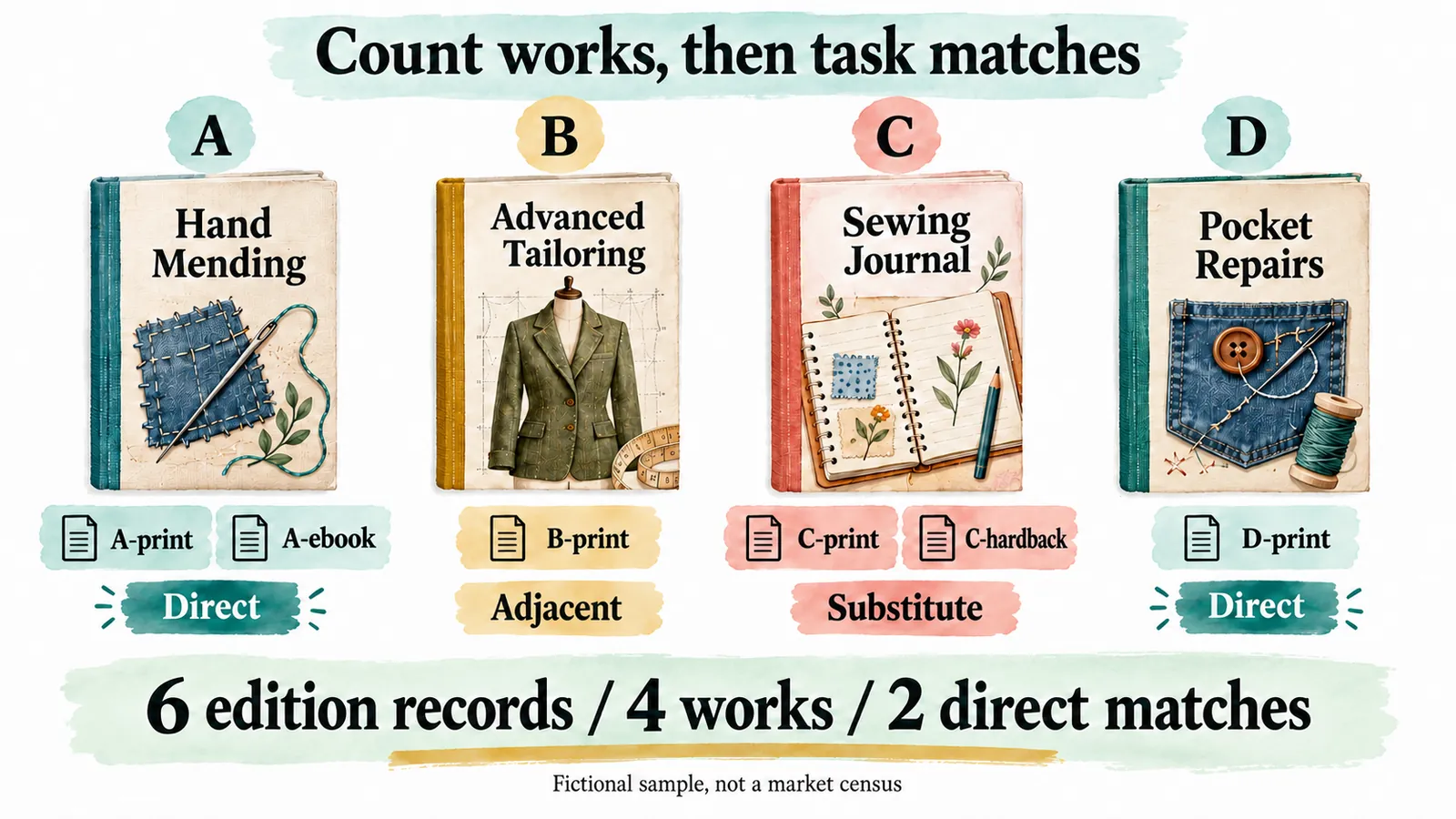
In an invented six-record ledger, A-print and A-ebook are two formats of Hand Mending; B-print is Advanced Tailoring; C-print and C-hardback are paperback and hardcover records of Sewing Journal; D-print is Pocket Repairs. Preserve all six records and their edition details, then group them into four works. For the stated hand-repair task, A and D are direct comparisons, B is adjacent and C is a recording substitute: two direct matches in this sample, not six independent competitors.
This grouping is an editorial exercise, not a live inventory or proof of weak competition. A duplicate appearance can still matter as an exposure observation; keep its query and sponsored/organic status separately. The journal example uses two physical editions, not an endorsed fill-in Kindle edition.
Interpret observations without turning them into a competition score
The following observations are invented teaching cases. No live search results, review counts or competitor contents were audited. Each row suggests a follow-up question, not an approved niche.
| Possible observation | What it might also mean | Proportionate next action |
|---|---|---|
| Few matches for one exact phrase | The wording is unusual, the format is displayed differently or the task is not recognized. | Try plain task language and inspect relevant shelves before calling the market empty. |
| Several books show modest review counts | The sample mixes editions, publication histories or products serving different tasks. | Inspect relevance and contents; do not apply a universal review cutoff. |
| Inspected lessons assume a sewing machine | The books intentionally teach a different method or prerequisites. | Investigate a hand-repair lesson as a distinct hypothesis, not proof of absent competition. |
| Several direct manuals show clear complete repairs | The proposed distinction may already be well served. | Revise the concept or stop; do not ignore the closest comparisons. |
| A prominent series appears repeatedly | One publisher has several relevant works, rather than each appearance being an independent competitor. | Deduplicate records and inspect the series' actual coverage. |
The strongest-looking signal can disappear once the comparison set is corrected. Preserve the original observations and the reason for revising a judgment. A change of conclusion is useful research, not a failure to discover a winning niche.
Review count is context, not a universal entry barrier
A low review count does not prove weak sales or an easy market. A large count does not establish that every potential reader is satisfied, or that no new book can offer a useful distinction. Treat counts as descriptive fields, not an automatic go or stop rule.
If you read reviews, look for specific task statements and inspect the relevant content where possible. A comment about missing intermediate steps raises a question about instruction. A delivery complaint raises a different question. Do not combine them into one quality score.
Reviewers are self-selected, and the comments you inspect may be a convenience sample. Record scope and dates. Several similar remarks are a reason to check a potential problem, not a measured share of buyers who would purchase your alternative.
BSR needs separate context too. Use the rank observation guide rather than combining rank and review count into a private formula for easy niches. The public fields do not reveal a competitor's full acquisition costs, audience or production economics.
Turn a proposed gap into a specific content test
State the difference without a monopoly claim
For the example, propose: "A compact hand-mending guide showing one complete button replacement and one simple patch, with materials and intermediate steps." Do not add "the only guide" or "no competition" unless you could actually substantiate those claims; this research has not done so.
Check whether the distinction changes the reader's ability to complete the task. A new cover color or a longer subtitle is not evidence of a new instructional experience. More pages may add value, or they may add repetition and production burden.
Build the smallest representative lesson
Create the actual intermediate images and instructions, then ask intended readers to attempt the lesson. Record where they need help, what the description led them to expect and whether the method suits the stated constraints. That tests usability, not willingness to buy at scale.
A defensible entry hypothesis names the reader task, the content difference and the evidence that would make you abandon the idea.
For first-project scope, use the beginner guide. For the economic implications of photography, editing and the chosen edition, use the project-economics guide.
Do not manufacture lower competition through inaccurate placement
The official category guidance calls for relevant placement. An unrelated small shelf does not become a valid strategy because a chart there looks easier. Categories organize browsing; they do not replace a complete reader-task definition.
Likewise, the keyword guidance requires accurate wording. A longer phrase can be precisely wrong. Do not attach absent methods, age groups or outcomes simply to find a less crowded query.
Use keyword research and the category guide for those decisions. Check metadata consistency before turning a research hypothesis into a public title or description.
Use an entry-feasibility gate instead of a universal score
| Question | Evidence to inspect | If unresolved |
|---|---|---|
| Is the task recognizable? | Plain reader language and a clear product promise. | Reframe the hypothesis rather than celebrate sparse results. |
| Are comparisons relevant? | Actual samples, product roles and work/edition grouping. | Repair the sample before describing competition. |
| Does the distinction matter? | A representative lesson and intended-reader feedback. | Test or revise; do not infer demand from difference alone. |
| Can you deliver and reach readers? | Capability, production burden and a bounded distribution test. | Hold or stop without an easy-entry label. |
- Retain alternative explanations for sparse results.
- Avoid universal rank and review thresholds.
- Keep direct comparisons visible, even when they weaken the idea.
- Separate a usable prototype from demonstrated market demand.
Finish with a bounded conclusion
A useful memo might say: "The inspected sample suggests a hand-method distinction worth testing. We have not established the full competitor inventory or enough buyers. The next step is a representative lesson and a clearer route to intended readers."
Name what would change that conclusion: direct books already solving the task well, a failed prototype, an unmanageable production requirement or no workable way to reach relevant readers. For broader visibility questions, use the discoverability hub. Low competition should remain a research question, not a promise of easy sales.
Explore the KDP niche research guides to compare reader needs, competition and publishing formats.
Sources and scope
Official KDP references were checked on 17 October 2026. The repair concept, observations and decision gate are original fictional examples. No live competition census, review sample, demand measurement or entry-success rate was audited. The illustration is conceptual.
Frequently asked questions
Do few search results prove low competition?
No. Query wording, format display and an unclear reader task can all affect what you see. Inspect relevant products through more than one entry point.
Can I use a universal review-count cutoff?
No cutoff is established here. Review counts are context, not automatic proof of weak sales, easy entry or a barrier no new book can overcome.
What is a useful content distinction?
A difference that changes the intended reader's ability to complete the task or enjoy the experience, supported by representative content rather than only a new cover or subtitle.
Does a usable prototype prove demand?
No. It can test instruction and promise alignment. Buyers, reach and the project's economics remain separate questions.
Should I choose an unrelated small category?
No. Placement and wording should match the actual book. A seemingly quieter shelf does not justify misleading categorization or unsupported claims.
What should an entry-feasibility memo say?
State the reader task, sample, proposed distinction, alternative explanations, unknowns and next test. Include what would make you revise or stop.