

Best KDP Niches for Beginners
The best first project is one you can deliver and check. Being new to publishing is different from being new to the subject.
Compare conditional book directions, map the production work and test a representative lesson before expanding into a full release.
The best first KDP niche fits your delivery capability, not a universal list
A beginner-friendly publishing project has a clear reader task, a manageable production scope and a credible way for you to check the result. That does not mean the shortest manuscript, the fewest competing books or a format that software can generate quickly.
Choose a project where you can distinguish a usable book from a plausible-looking file. If you cannot assess the instruction, puzzles, recipes or factual claims, you need appropriate help before promising them to readers. Being new to publishing is not permission to skip subject expertise.
Define the first project's purpose
You may want to learn editing, layout, proofing, metadata and reader communication through one complete project. Make that learning objective explicit. It is different from a promise to earn a living immediately or to build a large catalog at once.
Use the niche discovery process to define the concept, and the comparison method to inspect relevant existing products. This page helps judge whether the project is a sensible first production experience for a particular author.
A first-time publisher can already be an experienced teacher
Inventory your existing strengths
List the tasks you can demonstrate, explain and check without guessing. Add original examples or materials you can legally use, people who can review the work and intended readers you can reach for feedback. Keep aspirations separate from demonstrated capability.
In our fictional example, an experienced sewing tutor is publishing a book for the first time. A tightly scoped hand-mending guide may use their existing lesson knowledge and original repair photographs. A beginner in sewing as well as publishing would face a different project and should not borrow that conclusion.
Identify the unfamiliar publishing work
The tutor still needs editing, layout, image preparation, proofing and an accurate description. Existing expertise reduces one risk; it does not remove the rest of the production chain. Mark which steps you will learn, outsource or have reviewed.
Do not choose a topic solely because an AI tool can produce an outline for it. An outline does not establish that you can recognize errors, secure appropriate assets or support the book's claims.
Compare four conditional first-project directions
These are original example directions, not a live ranking of easy or profitable niches. None has audited demand or a guaranteed sales outcome. Use the table to expose the work each option requires.
| Direction | Capability and checking needed | First-project judgment |
|---|---|---|
| Focused everyday hand-mending guide | Competent instruction, original intermediate images and review of a complete repair. | Plausible for the experienced tutor; prototype the lesson before expanding. |
| Adult Sudoku collection | Reliable puzzle validation, distinct items, correct solutions and comfortable print layout. | Not automatically easy because generation is fast; resolve checking and format first. |
| Small recipe collection for a defined cooking task | Recipe testing, measured yields, usable instructions and suitable image production. | Consider only with relevant cooking and testing capability. |
| Sewing-project journal | Useful page design, prompt clarity, physical usability and actual interior classification. | A different product from instruction; blank pages do not establish reader value. |
The strongest choice is not the row with the fewest visible steps. It is the one whose important risks you can understand and resolve. A tutor may make a better first manual than a puzzle publisher, while a competent puzzle editor may reach the opposite conclusion.
For content-specific checks, use the puzzle-book guide and the cookbook guide. Their examples explain evidence requirements, not a list of niches guaranteed to sell.
Map the whole production chain before committing
Content and assets
List the explanations, demonstrations, photographs, illustrations or validated puzzles the reader needs. Record who creates and reviews them. Permission and originality questions belong here, not after the cover is finished.
Editing and layout
Check whether your chosen layout makes the task easier. A repair photograph may need a close view of the thread path; a puzzle needs usable cells and an answer section; a recipe needs readable ingredients and steps. Do not remove essential information just to hit a short page target.
Proof and revision
Inspect a representative proof in the intended format and reserve time for corrections. Source files that look good on your screen can still produce a poor reader experience. A manageable first project has room for revision instead of relying on a perfect first export.
Keep the budget and your time visible. Use the economics guide to distinguish project costs from per-sale contribution. An inexpensive file is not a complete publishing budget.
Low-content classification and Kindle suitability are not shortcuts
KDP's low-content guidance distinguishes repetitive, minimal-content interiors from other books, with exceptions. Notebooks and journals are common examples; puzzle books are not generally low-content. Inspect the actual interior rather than choosing a classification because it sounds simpler.
The Kindle quality guidance separately identifies books primarily intended for writing or coloring on the pages as unsuitable for Kindle. A fill-in journal does not become a suitable eBook merely because uploading a second format looks convenient.
A mostly blank project journal, a guided instructional workbook and a read-and-apply manual can require different decisions. Adding a brief introduction does not automatically settle classification. Describe the product accurately and resolve the intended reader interaction before publishing.
Test a representative piece, not only the introduction
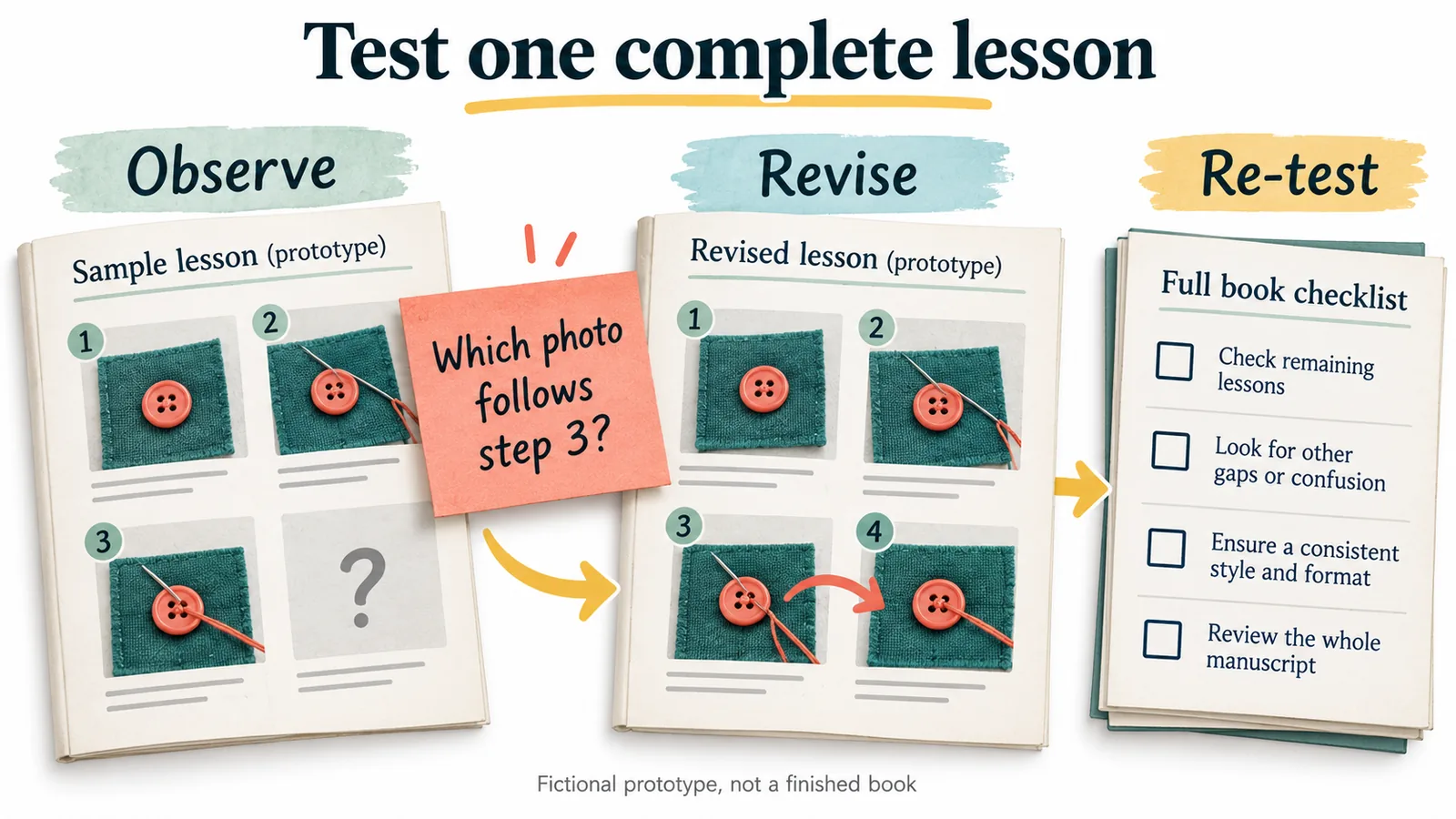
For the fictional tutor, build one complete repair lesson with prerequisites, materials, intermediate images and a check of the finished result. Ask intended readers to attempt it without extra coaching. Record where the pages fail to supply what they need.
Ask: "What did you do from these instructions, and where did you need help?" Also ask what the description led the reader to expect. Their answers can improve usability and positioning. They do not establish a representative market or predict purchases.
For a concrete fictional observation, a test reader locates the materials but asks, "Which photo follows step 3?" Record the exact gap, link the next image to that step and re-test the revised lesson without extra coaching. A full-book checklist stays open: one corrected sequence does not validate the remaining repairs, establish demand or complete the manuscript.
A prototype is evidence about a task. It is not automatically a complete publishable book or proof of demand.
Do not release a thin fragment simply because the test lesson worked. The final book needs enough coherent content to deliver its stated purpose. There is no universal page count that makes an incomplete product complete.
Use the reader-feedback workflow when organizing a small review group. Keep feedback separate from any obligation to buy or post a public review.
Plan how relevant readers could encounter the book
Identify a bounded route to readers: an existing permission-based audience, appropriate community participation or another realistic distribution test. Record what you will show them and what you need to learn. Do not assume that publishing the file creates its own audience.
Use the competition guide to inspect relevant alternatives rather than choosing a topic from sparse results. Low competition and beginner-friendly production are different claims. A production task you can handle may still need substantial positioning and distribution work.
Keep the initial test small enough that you can learn from it and stop. Do not interpret a handful of compliments or signups as a forecast of sales at scale. For broader planning, use the marketing hub.
Use a readiness gate for the first full project
| Condition | Evidence | If missing |
|---|---|---|
| You can check the content | Relevant capability, usable examples and qualified review where needed. | Narrow the subject or find appropriate help. |
| The prototype delivers the task | Representative instructions tested with intended readers. | Repair the lesson before expanding it. |
| Production and format are feasible | Asset plan, layout, proof, revision time and correct classification. | Resolve the specification rather than select a shortcut. |
| The next release test is bounded | Budget, route to readers, questions and stopping condition. | Hold without a guaranteed easy-niche label. |
- Distinguish subject expertise from publishing experience.
- Keep the first project focused but complete.
- Resolve validation and format rather than assuming a template solves them.
- Record time, costs and unresolved questions.
Before publication, align the title, description and sample with the actual book using metadata guidelines. Continue with keyword research and discoverability as separate tasks. A sensible first project is one you can deliver and evaluate, not one someone calls effortless.
Explore the KDP niche research guides to compare reader needs, competition and publishing formats.
Sources and scope
Official KDP references were checked on 17 October 2026. The author, niche directions and readiness gate are original fictional teaching examples. No live niche ranking, income study, reader survey or publishing-success rate was audited. The illustration is conceptual.
Frequently asked questions
What makes a niche beginner-friendly for a particular author?
A clear reader task, manageable production scope and a credible way to check the result. Existing subject expertise matters separately from publishing experience.
Are low-content books automatically the best first choice?
No. The actual product still needs useful design, correct classification and physical usability. Fewer written pages do not establish reader value or sales.
Are puzzle books automatically simple or low-content?
No. They need appropriate validation, correct solutions and usable layout. KDP says puzzle books are not generally low-content, with exceptions.
Can a fill-in journal simply be released as a Kindle edition?
Do not assume so. KDP's Kindle guidance flags books primarily intended for writing on the pages. Resolve the actual reader interaction and format.
Can I publish the prototype as the finished book?
Not automatically. A test lesson is evidence about a task. The final product needs enough coherent content to deliver its stated purpose, without relying on an arbitrary page target.
Does a sensible first project guarantee income?
No. It reduces particular production uncertainties, not all market risks. Reach, positioning, costs and actual buyer response still require separate assessment.