

How Much Money Can You Make on KDP? A Scenario Review
Possible earnings are conditional on the assumptions, not guaranteed by a favorable spreadsheet result.
Compare complete scenarios, identify the inputs that matter and define a bounded test before committing more.
How much you can make is a scenario question, not a promised amount
The amount you could make on KDP depends on paid volume, royalties, reading income where applicable, external costs and the period you mean. A credible plan states those inputs and tests what happens when they change. It does not turn an attractive spreadsheet result into evidence that readers will buy the book.
This guide helps evaluate an uncertain project before increasing the commitment. For historical research, read the average-income evidence guide. For worked accounting cases, read KDP income examples. Here the distinct task is deciding which assumptions must be tested before a possible outcome is useful.
Name the outcome before choosing the number
Choose between royalties earned, a period operating remainder, cumulative production recovery and available cash. Specify whether the result is before personal taxes and unpaid author labor. A positive monthly remainder can coexist with an unrecovered production budget, and a positive earning period can precede the associated cash receipt.
Separate observed records, estimates and chosen assumptions
Use three labels in your planning sheet. An observed value comes from matching records, such as a finalized royalty statement or paid invoice. An estimate is provisional, such as a current royalty calculation. An assumption is a value selected to explore an outcome, such as the volume for a book that has not launched.
- Record the format, marketplace, currency and observation window.
- Attach a source and date to every observed input.
- State how each estimate was constructed and when it will be revised.
- Mark chosen volumes and costs as assumptions, not measured averages.
- Keep missing evidence visible rather than substituting a favorable value.
A precise output does not improve a weak input
The KDP Royalties Estimator distinguishes estimates from official earnings records and notes that rates and exchange effects can change results. A projection with two decimal places still inherits uncertainty from its inputs. Use the royalty-rate guide to check the edition economics; do not assume the retail price is the royalty.
Compare full scenarios instead of changing only the sales total
These three scenarios are fictional and use the same invented one-month window. Each assumes a single paid-copy stream, $120 fixed period costs and a $900 upfront production outlay. There is no KU income. Per-copy royalty and variable promotion cost are deliberately chosen teaching values, not current platform rates or observed acquisition costs.
| Case | Net copies | Royalty per copy | Variable promotion per copy | Period operating remainder | Result after upfront production |
|---|---|---|---|---|---|
| Lower volume | 120 | $2.50 | $0.90 | $72 | -$828 |
| Reference case | 240 | $3.00 | $1.20 | $312 | -$588 |
| Higher volume, costlier acquisition | 480 | $3.50 | $1.80 | $696 | -$204 |
The reference remainder is 240 x ($3.00 - $1.20) - $120 = $312. Deducting the separate $900 production outlay gives -$588 for this defined project view. Production is counted once, not included in fixed costs and then deducted again. None of the three cases recovers that outlay within the modeled month.
Do not read the rows as a growth path
The cases are independent combinations, not stages an author normally progresses through. No probability is assigned to any row. Higher volume does not establish that a higher royalty or a particular advertising cost is achievable at the same time. The third case explicitly illustrates why acquisition assumptions should not remain artificially favorable as a plan expands.
Find the assumptions that can change the decision
Start from the reference case and change one input at a time while holding the others fixed. This isolates arithmetic sensitivity, not a real-world causal effect. The comparison asks what would happen under a specified change; it does not claim that an author can make the change without affecting demand or workload.
| Changed assumption | Recalculation | New period remainder | Difference from reference |
|---|---|---|---|
| Net copies fall to 120 | 120 x ($3.00 - $1.20) - $120 | $96 | -$216 |
| Royalty falls to $2.50 | 240 x ($2.50 - $1.20) - $120 | $192 | -$120 |
| Variable promotion rises to $1.70 | 240 x ($3.00 - $1.70) - $120 | $192 | -$120 |
| Fixed period costs rise to $220 | 240 x ($3.00 - $1.20) - $220 | $212 | -$100 |
These checks identify inputs worth investigating. They do not constitute a probability distribution or confidence interval. Combining several adverse changes would create a separate scenario, and choosing the worst row does not establish the maximum possible loss. Contracted bills and other commitments may still matter when sales disappoint.
Keep unknown demand unknown, including a zero-sales case
A new title may lack defensible volume evidence. Do not fill that gap with a survey median, a competitor's rank or a target copied from a course. Record the assumption and identify the smallest useful test. For your existing titles, reconcile complete sales windows before projecting from them.
Test the downside of the defined model
At zero net copies, the reference formula gives -$120 of operating remainder and -$1,020 after the stated $900 production outlay. That is only this model's defined downside: variable promotion is assumed to arise per net copy and therefore falls to zero. Real advertising can spend money without producing purchases. If you commit a nonrefundable campaign budget, model it as a separate expense instead.
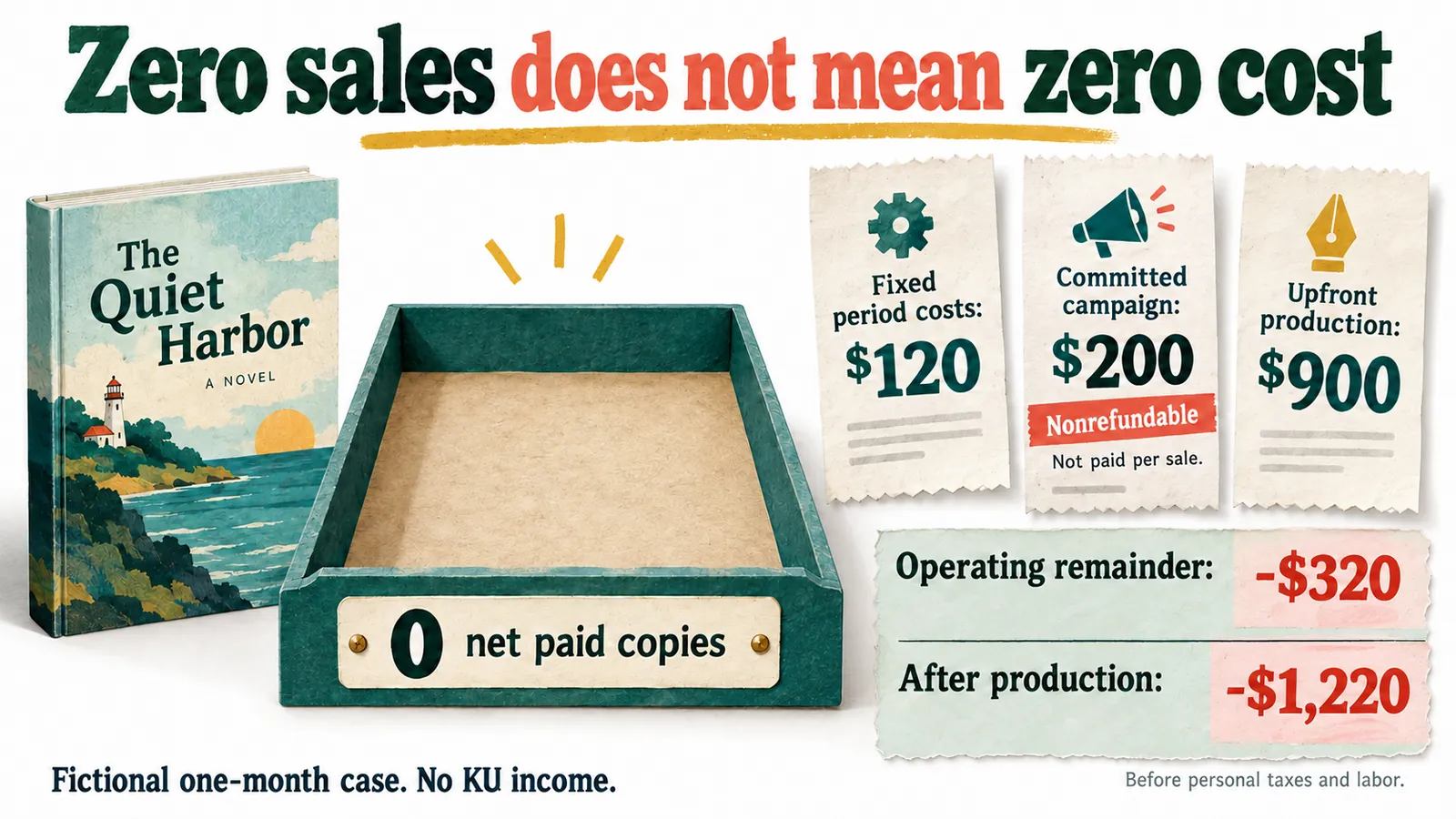
A separate fictional case adds a committed, nonrefundable $200 campaign to that no-KU zero-copy model. Operating remainder is 0 - $120 - $200 = -$320; after the separate $900 production outlay, the defined project result is -$1,220. The campaign is not also included in per-copy promotion or the $120 fixed cost. Other commitments could still increase the loss.
A BSR-derived volume needs its own validation. Use the estimate-audit guide rather than treating an unsupported count as an observed input. Not knowing the probability of the modeled outcomes is a limitation to retain, not a reason to invent an expected income.
Check price and volume together
A higher royalty per copy can help the calculation while a reduction in purchases offsets that benefit. In another fictional comparison, changing the reference royalty from $3.00 to $3.30 but reducing volume from 240 to 200 copies gives 200 x ($3.30 - $1.20) - $120 = $300, below the original $312.
Do not confuse a counterfactual with a tested price response
Those numbers do not estimate demand elasticity or recommend a price. They demonstrate why changing a royalty input alone cannot establish improved earnings. A real price test needs matching edition economics, a planned observation window and a record of other changes. Keep availability, promotion and release timing visible when interpreting the outcome.
If the project includes subscription reading, model that stream separately using a stated assumption and later reconcile actual royalties. KU's normalized reading mechanism is not a paid-copy count or a permanent assumed page rate. Do not add pages directly to copies to increase the apparent demand input.
Include your capacity and cash commitments
Copying the best scenario across ten future titles ignores writing, editing, revision and reader-support time. Identify the tasks you must perform and whether the schedule can support them. For a multi-title operation, use the catalog income workflow to distinguish direct costs, shared operations and unresolved earning streams.
The KDP payment schedule also separates earnings from later payments. A positive modeled remainder cannot fund a bill due before the money arrives. Keep a dated cash plan alongside the scenario; the project-result column is not a promise about your bank balance.
Set a review rule before committing more
I will fund only the defined test, retain the actual costs and review matching sales records after the window. If the contribution or workload does not meet my documented requirement, I will revise or pause before expanding the commitment.
Use required-sales calculations when you have a specific target, and the livelihood review when considering recurring household commitments. Those decisions need more than a favorable scenario. Return to the earnings hub to choose the next evidence check instead of increasing every assumption at once.
Sources and scope
Primary KDP references checked on 16 October 2026. All volumes, royalties per copy, costs and scenario outcomes here are fictional educational calculations. No personal outcome probability, author account, price experiment or advertising campaign was audited. The models do not establish typical earnings, a maximum possible loss or individualized financial advice.
Frequently asked questions
Does the reference scenario predict what I will earn?
No. Every amount and volume is fictional. The scenarios show conditional arithmetic, not observed outcomes, typical earnings or the probability of reaching an income target.
What does the operating remainder mean here?
It is net copies times the assumed royalty minus assumed variable promotion per copy, less fixed period costs. Upfront production, personal taxes and author labor are shown separately or excluded as stated.
Why does a positive month still show unrecovered production?
A period's operating remainder can be smaller than the upfront production outlay. The example deducts that outlay once in its separate project-result view, not again inside fixed costs.
Is the zero-sales example my maximum possible loss?
No. The simplified variable cost disappears at zero copies. Real campaigns may spend without generating purchases, and contracted bills or other commitments can make the downside larger.
Does a higher royalty guarantee more income?
No. Volume and costs may change too. Check them together; the fictional price-response comparison is arithmetic, not a tested demand curve or pricing recommendation.
What should I do when the sales assumption has no supporting data?
Keep it labeled as an assumption, consider a smaller commitment and define the evidence needed from a bounded test. Do not replace missing data with a survey median or unsupported rank estimate.