

Can You Make a Living With KDP? Review the Sustainability
A strong royalty month is not enough to establish that publishing can reliably support a household.
Separate operating surplus from available cash, inspect weak periods and dependencies, and document a decision that fits the actual circumstances.
Making a living with KDP is a sustainability decision
A publishing project can contribute to household income, but a strong royalty month does not establish that it can reliably replace another source of earnings. The relevant questions are what remains after business costs, when the money arrives, how uncertain the next period is and what work is required to maintain the result.
This guide provides a readiness review, not a recommendation to leave employment or a claim about how many authors live from KDP. It has no representative career-outcome dataset. Use the income model for definitions, worked project cases for examples and required-sales calculations for volume arithmetic.
Separate a possible target from a supported decision
You can calculate the sales required to support a monthly goal without having evidence that those sales will occur. You can also have several profitable books without cash available on the day a household bill is due. Treat demand, operating surplus, liquidity and personal obligations as separate findings.
Define what publishing would need to support
List necessary household outgoings, irregular commitments, debt payments where relevant, and amounts reserved for taxes and other personal obligations. Keep household and business costs in separate records. A business software subscription belongs in the publishing calculation; household rent belongs in the personal requirement unless you have a professionally established allocation.
Do not compare royalties with a salary headline
A job and a publishing business may have different costs, benefits, leave arrangements and tax treatment. Those details depend on your circumstances and location. Identify what would need replacing and obtain qualified local advice for consequential tax, accounting or benefits decisions rather than assuming a dollar of royalties equals a dollar of spendable salary.
Write the resulting goal with its exclusions. For example, $1,800 per month available before personal taxes is not the same target as $1,800 of household spending after taxes. The fictional example below deliberately uses the first definition and does not establish that it would be sufficient for any particular household.
Review several periods, not the best screenshot
The following six-month record is entirely fictional. It assumes $500 of business costs in each period, excludes new production budgets and personal taxes, and compares the remaining operating amount with a $1,800 pre-tax planning target. Six months is an illustration length, not a universal minimum observation window or a career-readiness certificate.
| Period | Royalties | Business costs | Operating remainder | Gap versus $1,800 |
|---|---|---|---|---|
| Month 1 | $1,600 | $500 | $1,100 | -$700 |
| Month 2 | $2,600 | $500 | $2,100 | +$300 |
| Month 3 | $2,100 | $500 | $1,600 | -$200 |
| Month 4 | $3,200 | $500 | $2,700 | +$900 |
| Month 5 | $1,800 | $500 | $1,300 | -$500 |
| Month 6 | $2,500 | $500 | $2,000 | +$200 |
Total royalties are $13,800; after $3,000 of business costs, the average operating remainder is $1,800. Yet three months fall below that target, before personal taxes or a new production bill. The average alone does not explain how the lower months would be funded.
Preserve the source and scope of actual records
For your own review, save matching earning-period, marketplace and currency records. KDP Reports distinguishes dashboard estimates, royalty statements and payments. Do not mix a converted current estimate with a historical bank deposit or annualize one selected launch month as if it were a stable baseline.
Map the payment calendar before increasing commitments
KDP's ordinary payment schedule is approximately 60 days after the end of the month in which sales were reported, or 90 for Expanded Distribution, subject to applicable requirements and method timing. These are not guaranteed bank dates or immediate payments when a reader orders.
Maintain a cash calendar with opening accessible funds, expected receipts, known business payments and household commitments. Use actual payment records as they become available. Exclude money that is already reserved for taxes, contracted production or another obligation from the amount available to bridge a shortfall.
Use a delay case, not only an earning decline
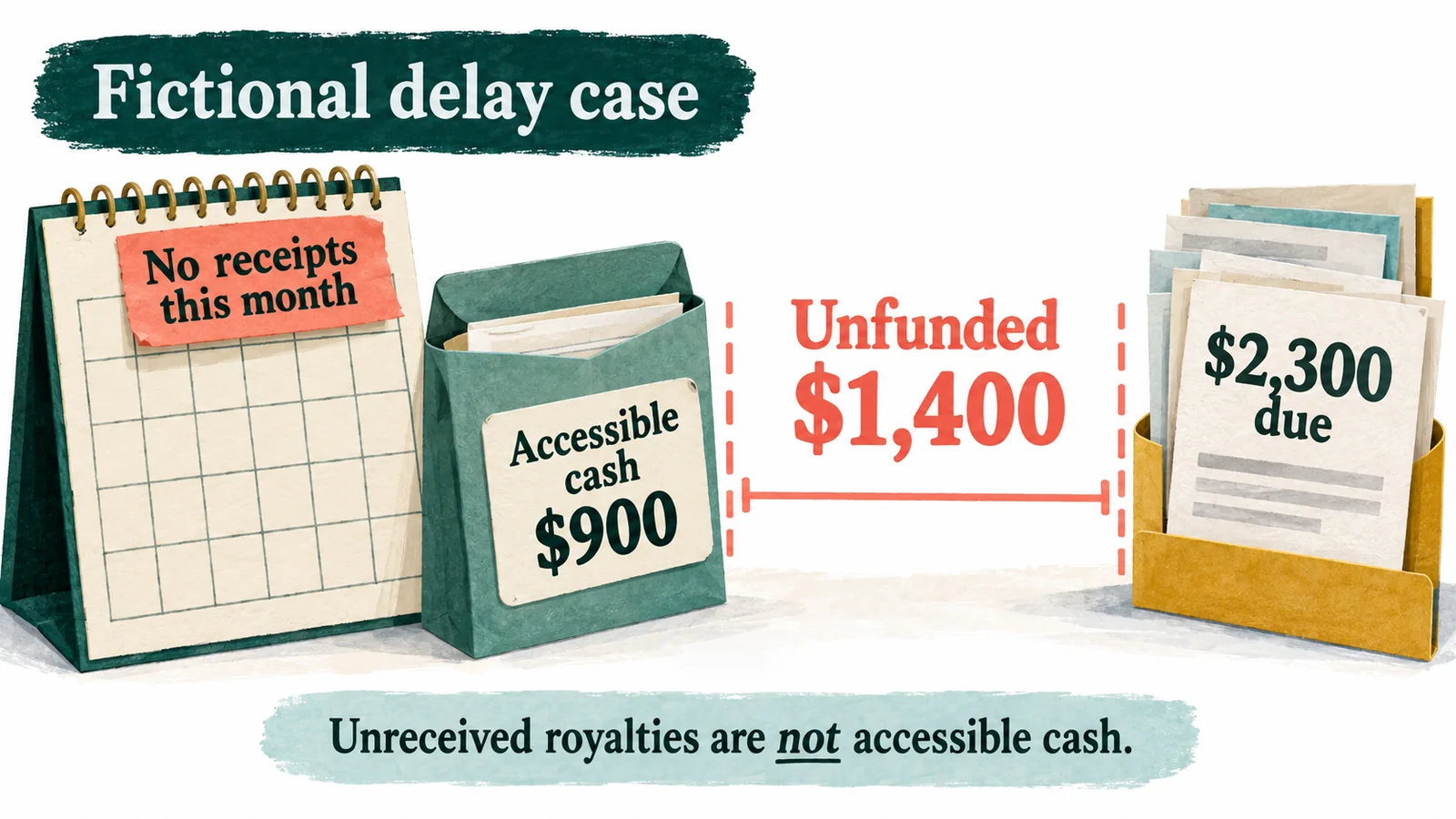
If a fictional month has no receipts while $500 of business costs and $1,800 of household commitments still fall due, the cash requirement is $2,300 before other obligations. Royalties may still be accruing. That distinction is why earning-period profitability cannot replace a liquidity check.
In a separate version of that delay case, suppose only $900 of uncommitted opening cash is accessible. With no receipts and the same $2,300 due, the unfunded gap is $1,400. An unreceived royalty estimate does not fill it. Identify an actual funding source, reduce a genuinely optional commitment or revisit the timing; do not count the same reserve against two obligations. The income calculator models an earning-period remainder, not this cash calendar.
Test concentration, promotion costs and weak periods
Use the fictional average royalties of $2,300 and business costs of $500 as a starting point, not as a forecast. The following independent stress cases show how different dependencies can affect that model. They should not be added mechanically into one scenario without checking which assumptions overlap.
| Stress case | Explicit hypothetical change | Result before personal taxes |
|---|---|---|
| Broad earning decline | Royalties fall 30%; business costs stay $500 | $1,610 - $500 = $1,110, a $690 gap to the target. |
| Concentrated title slowdown | One title supplies 65% of royalties and loses half that contribution | $1,552.50 - $500 = $1,052.50, a $747.50 gap. |
| Higher period spending | Business costs rise by $200 with unchanged royalties | $2,300 - $700 = $1,600, a $200 gap. |
| Delayed cash receipts | No receipts this month; $500 business and $1,800 household commitments remain | A $2,300 cash requirement; this is not the earning-period result. |
Count dependencies, not just titles
Ten titles can still depend on one reader segment, one promotion channel or one high-performing book. Record the share of royalties and contribution from each important dependency. Publishing another title does not automatically diversify those risks or establish repeat readership. Evaluate the new book's reader purpose and production economics separately.
Check whether the working pattern is sustainable
Record writing, editing coordination, illustration, production checks, reader communication, marketing and reporting time. Include necessary revisions and breaks. A month that required unusually long hours may not be a repeatable baseline, even if its cash result looks attractive.
Ask what happens if a release is delayed, an author cannot work for a period or an essential freelancer is unavailable. Do not presume a fixed amount of additional output from every newly available hour. More working time is capacity, not evidence of demand or a guarantee of higher per-hour income.
- Record actual hours and external service commitments.
- Identify work needed to maintain existing books, not only new releases.
- Check dependence on the next launch or a time-limited promotion.
- Keep quality checks and reader fit intact when reducing costs.
- Include a reduced-capacity case in the planning record.
Keep emergency savings separate from a launch budget
The CFPB's emergency-fund guidance explains that the amount needed depends on personal circumstances and distinguishes reserves for unexpected expenses from routine spending. It does not establish a universal savings amount that makes a KDP career transition safe.
Separate household reserves, publishing working cash, tax provisions and committed production spending in the review. The same funds cannot simultaneously cover an unexpected household expense and a contracted cover invoice. Choose any reserve goal from the actual obligations and relevant advice, not a generic number attached to a publishing success story.
Do not use an unreceived estimate as a reserve
A forecast of next month's royalties is not accessible savings. Nor is an assumed KU rate a fixed future payment. Use royalty reconciliation to understand what is estimated, reported, paid and actually received before assigning money to a purpose.
Document a reversible next step and a review trigger
Possible next steps include continuing alongside another income source, testing a smaller production commitment, obtaining a missing cost estimate or postponing a larger transition. The correct choice depends on the person's circumstances; this guide does not make it for them. Record what evidence would change the decision and when the review will happen.
Define triggers in advance: cash below a personally chosen reserve boundary, rising acquisition costs, a materially weaker title or an unsustainable workload. Pair each trigger with a practical response, such as reducing discretionary spend or reviewing the release plan, rather than assuming the next book will repair every shortfall.
Use the marketing hub for a bounded campaign decision and profitability planning for a new project. The goal is a supported household and business decision, not accumulating enough optimistic spreadsheet rows to justify a predetermined answer.
For another earnings task, return to the KDP earnings guide hub and choose the relevant royalty, measurement, planning or catalog workflow.
Sources and scope
Primary KDP and CFPB references were checked on 17 October 2026. The monthly history and stress cases are explicitly fictional educational calculations. No author career, household budget, account or tax position was audited. Obtain qualified local advice for consequential financial decisions; no observation period, title count or savings figure here certifies readiness.
Frequently asked questions
Does this page recommend leaving a job for KDP?
No. It offers an educational readiness review, not a personal career or financial recommendation. Actual obligations, records, uncertainty and qualified local advice matter.
Is an average monthly surplus enough to establish readiness?
No. An average can hide months below the target and does not establish cash availability, tax obligations, new production costs or a sustainable workload.
Does a larger catalog guarantee stable income?
No. Several titles can still depend on one high-performing book, reader segment or promotion channel. Review actual earning and contribution concentration.
How much emergency savings makes a transition safe?
There is no universal amount in this guide. The CFPB explains that emergency savings needs depend on personal circumstances. Do not count funds already committed to other obligations twice.
Why does payment timing matter if the books are profitable?
Business and household bills may be due before royalties arrive. Keep earning-period records and the cash calendar separate, using actual payment details when available.
Do six months of results certify that I can live from KDP?
No. Six months is the length of a fictional example here, not a minimum observation rule or a career-readiness certificate. Review the periods and risks relevant to the actual decision.