

KDP Income Examples: Four Worked Publishing Cases
An income example is useful when its quantities, costs, period and exclusions are clear.
Compare explicitly fictional projects, then replace the assumptions with matching records before using a result for a decision.
KDP income examples need explicit assumptions
The useful question is not whether an example looks impressive. It is whether you can identify the paid units, reading units, royalty assumptions, expenses and period behind the result. Without those inputs, a revenue screenshot offers little help with a publishing decision.
Every case below is fictional. These are worked arithmetic examples, not observed author accounts, average earnings or evidence of how common an outcome is. They do not show a progression from beginner to successful publisher. Use the author income model for the broader framework and current royalty rules before substituting real book inputs.
Use a consistent comparison basis
All cases use USD planning amounts, net paid copies after refunds, royalties already net of applicable platform deductions, and explicitly listed period operating costs. They exclude personal taxes and author labor. One-off production spending is separate. Do not subtract manufacturing or digital delivery again from these assumed royalty figures.
| Case | Assumed earning inputs | Royalties | Period operating costs | Operating remainder |
|---|---|---|---|---|
| A: Small launch | 25 paid copies at $3.20; no KU | $80 | $40 promotion + $20 tools = $60 | $20 |
| B: Mixed formats | 120 eBooks at $2.70; 45 paperbacks at $4; 15,000 KENP at assumed $0.004 | $564 | $220 promotion + $30 tools = $250 | $314 |
| C: Higher campaign cost | The same earning inputs as B, as an independent assumption | $564 | $520 promotion + $30 tools = $550 | $14 |
| D: Quiet month | No net paid copies or eligible reading | $0 | $20 tools | -$20 |
The last column is royalties minus the stated operating costs. It is neither cash received nor a complete lifetime profit figure. A larger number of titles is not an input that automatically changes any row. Each additional earning stream needs its own volume and cost evidence.
Case A: A positive operating month can still leave production unrecovered
Twenty-five paid copies at an assumed $3.20 royalty produce $80. Subtract $60 of promotion and tools and the period has a $20 operating remainder. That is a narrow answer to a defined question: did these royalties exceed these ongoing costs?
Add the original project budget separately
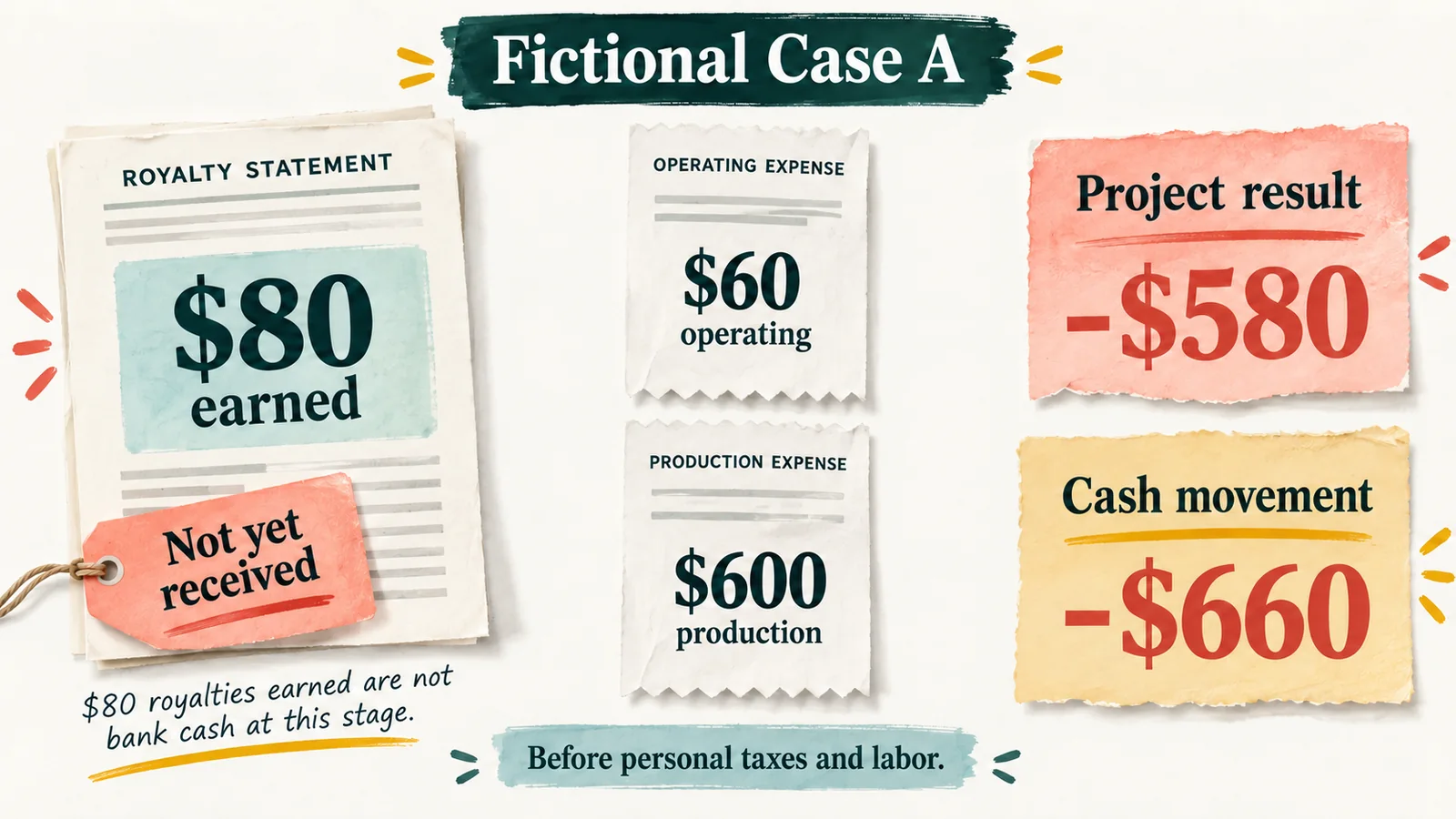
Suppose the launch also required $600 of cover, editing and formatting spending. After including that amount in this simple project view, the result is $80 - $60 - $600 = -$580, before personal taxes and labor. A positive operating remainder does not establish that the project has recovered its initial investment.
If the $600 was paid in a previous month, the earning-period calculation and cash calendar must reflect different dates. Do not pretend that moving the payment date removes the production cost. Conversely, do not charge the entire original budget again in every subsequent month. Track cumulative recovery and current expenditure separately.
Case B: Keep paid copies and KU reading distinct
The assumed eBook stream gives 120 x $2.70 = $324. The paperback stream gives 45 x $4 = $180. The hypothetical KU stream adds 15,000 x $0.004 = $60. Total royalties are $564, leaving $314 after the stated $250 operating costs.
This is 165 paid copies plus a separate reading stream, not 15,165 book sales. The $0.004 figure is an arbitrary teaching assumption, not a current or permanent KU rate. KDP's KU guidance describes eligible normalized reading and the fund-based mechanism; paperback page count is not the denominator for that calculation.
A stronger monthly remainder does not prove project profitability
If the book previously cost $1,200 to produce, that historical amount remains relevant to cumulative recovery even though it is not a new cash outlay in this month. If an author spent many unpaid hours creating the book, those hours also matter when evaluating whether the work was worthwhile. The table intentionally does not turn the remainder into an hourly wage.
Case C: Higher expenditure can consume the same royalties
Case C holds the earning inputs constant and raises promotion spending by $300. The operating remainder falls from $314 to $14. This isolates one arithmetic effect. It does not demonstrate that a real campaign caused the stated sales, that the additional spend was wasted or that the lower-spend case would have produced the same sales in practice.
Separate attribution from incrementality
For an actual campaign, inspect total project contribution, the campaign's stated attribution scope and a suitable comparison period. A sale assigned to an ad is not automatically a sale that would otherwise never have happened. Keep other changes, such as price, cover or a release, visible when interpreting the result.
The ACOS guide helps distinguish attributed retail sales from royalties available to pay for advertising. Set a spending boundary before a test. Do not finance an expanding campaign from a royalty estimate without checking when the corresponding cash could arrive.
Case D: A no-sales month belongs in the model
With no paid copies and no eligible reading, $20 of tools creates a negative operating remainder. This is a stress case, not a statement about how frequently authors experience zero-sales months. It tests whether the plan still has unavoidable expenditure when the earning stream stops.
The -$20 case is not a loss ceiling. It assumes there are no other period costs; a nonrefundable placement or continued ad spend would make the result more negative even with no sales. Use the committed-cost stress case to test that different assumption explicitly.
Identify which subscriptions are necessary, which costs can be paused and which contractual or production commitments remain. Do not remove a real cost from the model just because it makes the downside uncomfortable. If you are considering publishing as a primary income source, use the livelihood-readiness guide to examine the household consequences of a weak period.
Bridge the earning result to the month's cash movement
Return to Case A and assume the $600 production bill and $60 operating costs are paid this month, while none of the newly earned royalties has arrived. There are no receipts from earlier earning periods in this simplified example. The cash movement is therefore different from the project result.
| Item | Project calculation | Cash movement this month | Why they differ |
|---|---|---|---|
| New royalties | +$80 | $0 | Earned in the model but not yet received. |
| Operating costs | -$60 | -$60 | Assumed paid in the same month. |
| Launch production | -$600 | -$600 | Assumed incurred and paid in this period. |
| Net result | -$580 | -$660 | The $80 royalty receivable is not bank cash. |
KDP's payment guidance describes approximately 60 days after the earning month's end, or 90 for Expanded Distribution, subject to applicable requirements and payment-method timing. Use royalty reconciliation to match the actual earning period, statement and payment instead of treating this illustrative calendar as a guaranteed date.
If the same modeled $80 is later received in full, with no withholding, conversion difference or other adjustment in this separate assumption, that receipt settles the existing receivable. It is not a second $80 of royalties. Record the later cash movement without duplicating the earning-period result.
Replace assumptions with records of matching scope
For your own case, retain the actual edition, marketplace, source currency, date range and relevant expenses. Replace assumed royalties with the matching statement lines when available. Save the earlier estimate rather than overwriting it, so the difference remains inspectable.
KDP's estimator documentation explains why estimated amounts can differ from actual earnings and points to the statements for official records. Do not combine an all-marketplaces estimate with one marketplace's costs and call the result a reconciled account.
- Label every number actual, quoted or hypothetical.
- Keep paid units, refunds and normalized reading separate.
- Document whether platform deductions are already included.
- Separate recurring costs, one-off production and author time.
- Preserve both earning-period and payment-date views.
- State missing inputs instead of inventing an average.
Use a case to answer one publishing decision
For launch planning, ask whether the upfront commitment is affordable under a low-volume case. For promotion, ask how much contribution remains after period spending. For a monthly goal, use the required-sales calculation rather than copying another case's quantity.
For a real income decision, inspect several relevant periods, not a selected best month. The examples show how definitions and assumptions change the calculation. They do not establish market demand, the probability of reaching a target or permission to ignore the quality and reader fit of the book itself.
First reconcile your paid-copy volume. If you also use a published benchmark, check its cohort, year and income definition; neither a survey median nor one of these cases supplies your book's demand.
For another earnings task, return to the KDP earnings guide hub and choose the relevant royalty, measurement, planning or catalog workflow.
Sources and scope
The linked primary KDP references were checked on 16 October 2026. All projects and financial amounts are original fictional teaching cases, not author surveys, audited accounts or personalized financial advice. Use actual records and qualified local accounting or tax advice when making consequential decisions.
Frequently asked questions
Are these real author earnings examples?
No. All four projects and financial amounts are explicitly fictional teaching cases. They are not audited accounts, testimonials, average earnings or evidence of how common an outcome is.
What does the operating remainder include?
It is the stated royalties minus the stated period operating costs. The examples keep one-off production, personal taxes and author labor separate, and the remainder is not cash received.
Why can a launch show a positive operating result but lose money overall?
The month's royalties can exceed ongoing costs while still failing to recover upfront production spending. The timing of invoices and royalty receipts creates a separate cash-flow question.
Can KENP read be added to paid copies?
No. Normalized reading is a different unit. Model its assumed royalty separately from net paid-copy counts, and do not treat a hypothetical KU rate as a permanent rate.
Does the campaign comparison prove that extra ads caused no extra sales?
No. Holding earnings constant is an independent arithmetic assumption. A real causal claim needs evidence beyond a comparison of assumed budgets.
How should I adapt a case to my own book?
Use the actual edition, period, marketplace, currency, royalties and expenses. Label unknowns, retain original records and keep estimates separate from statements and bank receipts.