

How Many Books Do You Need to Sell to Make Money?
Start with a defined goal and positive contribution per copy, not retail price or a competitor's rank.
Work through monthly targets, upfront recovery and mixed-format examples, then check whether the demand and cash assumptions are supported.
The number of books depends on the goal and contribution per copy
There is no universal number of copies that makes a KDP project profitable. Recovering an editing bill, covering monthly tools and generating an ongoing surplus are different targets. Write down the target, period and included costs before dividing anything by a royalty figure.
This page explains required-volume arithmetic, not how many copies a market will buy. Use the worked income cases to see the cost categories and the livelihood-readiness guide for the separate question of relying on publishing income. Every dollar amount below is a fictional planning input.
State the target in usable terms
For example: generate a $500 monthly operating surplus before personal taxes, after $80 of fixed monthly business costs. That wording excludes one-off production recovery unless you add it explicitly. It is much clearer than make $500, which could mean customer spending, royalties or money available in the bank.
Use contribution per net paid copy, not retail price
Start with the royalty for the actual edition and transaction conditions. Subtract any modeled variable cost per copy that is not already included. The remaining contribution pays fixed costs and the defined surplus target. If promotion is instead modeled as a fixed period budget, include it with fixed costs rather than deducting it again per copy.
Do not repeat platform deductions
Print manufacturing and digital delivery may already be reflected in the royalty you start from. Repeating those deductions understates contribution. Check the current royalty rules and preserve the source of the per-copy estimate. Higher retail price does not necessarily mean higher contribution or stable demand.
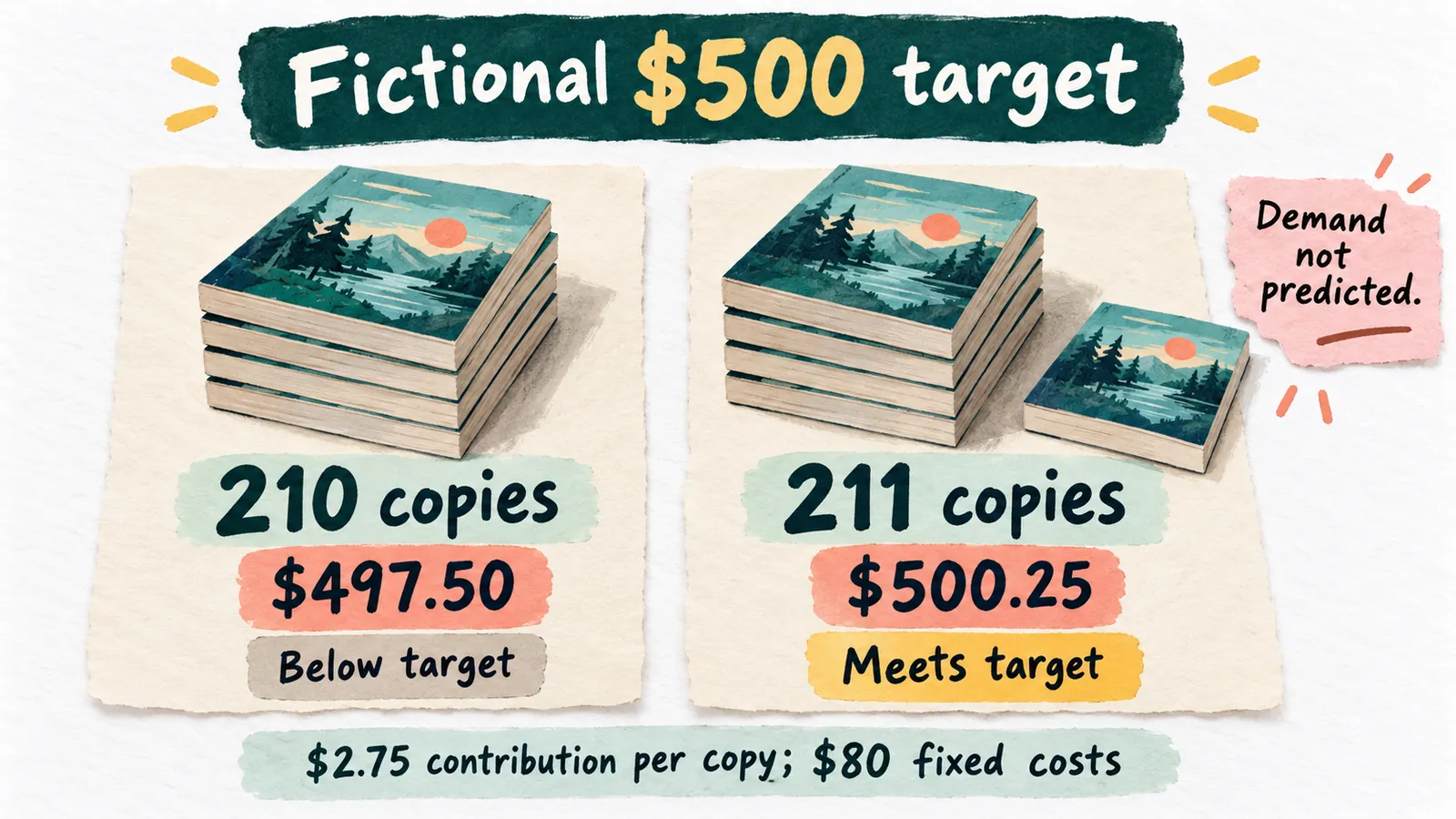
For the first model, assume a $3.25 royalty and $0.50 of additional variable cost per net paid copy. Contribution is $2.75. This is an assumed average for one defined scenario, not a published KDP rate, acquisition-cost quote or claim that each additional customer can be reached at the same cost.
Calculate the monthly target and round up
With positive contribution per copy, the basic formula is required net paid copies = round up((surplus target + fixed period costs) / contribution per copy). Use the same period and currency throughout. Round up to a whole copy, because a fraction of a sale cannot meet the target.
| Monthly surplus target | Contribution required | Minimum net paid copies | Check at that quantity |
|---|---|---|---|
| $250 | $330 | 120 | 120 x $2.75 - $80 = $250 |
| $500 | $580 | 211 | 211 x $2.75 - $80 = $500.25 |
| $1,500 | $1,580 | 575 | 575 x $2.75 - $80 = $1,501.25 |
| $3,000 | $3,080 | 1,120 | 1,120 x $2.75 - $80 = $3,000 |
Check both sides of the rounding boundary
For the $500 target, 210 copies contribute $577.50 and leave $497.50 after fixed costs. They miss the target. At 211 copies, the model leaves $500.25. This verification catches a common spreadsheet error: rounding a fractional requirement to the nearest integer instead of rounding upward.
Dividing 211 copies by a 30-day planning month gives about seven copies per day, but that is an average planning pace, not a requirement for identical daily sales or a forecast. Check the actual month's length and uneven selling patterns before using a daily monitoring number.
Exactly seven copies on each of thirty days would total 210 and still miss this target. Retain the whole-period requirement of 211 instead of rounding the monitoring pace down. To inspect the income implied by a chosen format volume, use the period income calculator; it evaluates entered quantities, not the minimum-copy formula.
Separate upfront recovery from recurring earnings
Suppose the project has $1,200 of upfront production spending and the same $2.75 contribution. Recovering that amount alone requires round up($1,200 / $2.75) = 437 net paid copies. At 436 copies, contribution is only $1,199. The calculation excludes recurring costs, personal taxes and labor.
A recovery allowance is not another payment
If you decide to recover $100 of that budget each month, add the allowance to the defined monthly target once. For the earlier $500 surplus goal and $80 fixed costs, the requirement becomes round up($680 / $2.75) = 248 copies. Do not also deduct the full $1,200 from every month's operating result.
Keep a separate cash record of when the production invoice was actually paid. A recovery allowance spreads a planning goal; it is not a new cash bill or an accounting depreciation rule. The royalty reconciliation guide explains why the earning model and bank movement need different views.
A format mix can change the required number
There is no rule that paperbacks always need more sales than eBooks to meet the same goal. Compare the actual contribution, price and cost inputs. A weighted contribution can help with planning, but the assumed mix must be supported and the final counts must be whole copies.
| Planning mix | Assumed average contribution | Initial copy requirement | Whole-copy check |
|---|---|---|---|
| All eBook | $2.50 | 232 | 232 eBooks contribute $580. |
| 60% eBook, 40% print | $2.90 | 200 | 120 eBooks and 80 print copies contribute $580. |
| 90% eBook, 10% print | $2.60 | 224 | 202 eBooks and 22 print copies contribute $582 after rounding the mix. |
| All print | $3.50 | 166 | 166 print copies contribute $581. |
These assumed margins do not describe an actual book configuration. If real purchases shift toward the lower-contribution format, the original weighted estimate becomes less useful. For a precise plan, model each stream separately and check the combined contribution rather than relying on one average indefinitely.
Subtract other contributions only when their scope matches
A more general formula, for positive copy contribution, is round up(max(0, target + fixed costs + recovery allowance - other net contribution) / copy contribution). Other contribution must be in the same period and currency and net of any additional costs you have not already included.
For a fictional $60 KU contribution, the $500 target, $80 fixed costs and $100 recovery allowance leave $620 for paid copies to cover. At $2.75 each, that is 226 net paid copies. Without the assumed KU contribution, it was 248. The difference depends on an unproven reading assumption, so keep a zero-KU downside case too.
Do not convert pages into paid-copy counts
KU royalties use eligible normalized reading and the fund mechanism. A borrow is not necessarily a completed read, and the book's print page count is not a universal conversion factor. Report the paid-copy requirement and the separate reading assumption, not one combined sales count.
Handle zero contribution, refunds and incomplete inputs
If contribution is zero or negative, no finite number of those copies covers a positive remaining target under the model. More volume cannot repair negative per-copy economics by itself. Revisit the price, actual costs or acquisition assumptions before using a copy target. Do not hide a division-by-zero error behind an arbitrary large number.
Net paid copies are after refunds. If a fictional 5% refund assumption is used for planning, 211 net copies require at least round up(211 / 0.95) = 223 gross paid orders in that simplified expectation model. The assumption is not a measured refund rate or a guarantee that 223 real orders will produce the desired net result.
- Use positive, supported per-copy contribution before dividing.
- Keep fixed costs, variable costs and recovery goals distinct.
- Use net copies or model refunds explicitly, not both.
- Round copy requirements upward and verify the resulting total.
- Mark unknown acquisition costs or format mixes as unresolved.
A required volume is not evidence that demand exists
Compare the target with your own records, reader fit, relevant alternatives and a bounded promotion test. KDP sales rank does not provide the exact units or contribution available to a new title. Do not convert a competitor's rank into a guarantee that your required volume is reachable.
Cash timing is another constraint: KDP payments follow an earning-period schedule rather than arriving with each order. Before increasing expenditure, check whether available cash covers the interval. Return to profitability planning if the model only works under unsupported sales or cost assumptions.
For another earnings task, return to the KDP earnings guide hub and choose the relevant royalty, measurement, planning or catalog workflow.
Sources and scope
Primary KDP references were checked on 17 October 2026. Formulas and financial examples are original educational calculations with explicitly hypothetical inputs, not sales forecasts, actual royalty quotes or personalized financial advice. Verify the actual edition and record the assumptions before acting on a target.
Frequently asked questions
What is the basic required-sales formula?
With positive contribution per net paid copy, round up the sum of the operating surplus target and fixed period costs divided by that contribution. Keep the period, currency and included costs consistent.
Why must copy targets be rounded upward?
A fraction of a copy cannot cover the target. Check that the rounded quantity meets the requirement and that one fewer copy would miss it.
How many copies recover a hypothetical $1,200 budget at $2.75 contribution?
437 net paid copies. At 436 copies, contribution is only $1,199. This calculation excludes recurring costs, personal taxes and labor and is not a sales forecast.
Do paperbacks always require more sales than eBooks?
No. Compare actual contribution by format. The price, royalty conditions, production costs and additional variable costs determine the answer.
What if contribution per copy is zero or negative?
No finite number of those copies covers a positive remaining target under that model. Revisit the economics instead of reporting an arbitrary large sales requirement.
Does a calculated copy target prove the market can support it?
No. It states what would be required under the assumptions. Demand, acquisition cost, refunds, format mix and cash timing still need evidence.