

Start with purchases per click, not a guess about the page
To improve Amazon Ads conversion for a book, first check whether suitable readers are reaching the correct edition. Then remove a specific mismatch between what the ad suggests and what the reader finds. Rewriting every section at once makes the next result difficult to interpret. Paying for more clicks before inspecting the destination simply makes that uncertainty more expensive.
For your own worksheet, define purchase conversion as attributed purchases divided by ad clicks, multiplied by 100. Keep the campaign type, marketplace, advertised ASIN, reporting dates and attribution scope consistent. Purchases and units are not interchangeable: one purchase can contain more than one unit. This worksheet definition is not a claim that every report's purchase-rate column uses the same denominator or lookback.
A small baseline is an observation, not a benchmark
In a fictional cohort, 100 clicks and five attributed purchases give an observed purchase rate of 5%. That number does not establish the normal conversion rate for your genre, or prove that the remaining readers disliked the description. Price, targeting, shopping context and reporting maturity can all affect the result. Record the count of purchases beside the percentage so a small sample does not look conclusive.
Amazon currently documents a 14-day click-attribution window for Sponsored Products authors. Recent clicks can therefore acquire purchases later; reporting can also be adjusted. Use a consistently matured comparison rather than treating today's clicks as a finished experiment. You may pause spending at your loss limit while waiting for existing data to mature. See Amazon's attribution documentation and the ROAS and reporting guide.
Check whether the ad attracts the intended reader
A product page cannot reliably convert an audience looking for a different book. Read the available search terms and inspect product targets before editing the offer. For a beginner's balcony-herb guide, a term about growing basil in small pots is plausible. A term about commercial greenhouse engineering is not fixed by adding more persuasive language to the same beginner book.
| Reader expectation | What to inspect | Useful response |
|---|---|---|
| A particular genre experience | Cover, opening scene, tone and category context | Remove unrelated targets; make the real genre unmistakable |
| A practical solution | Level, constraints, examples and contents | Show the problem actually covered, not a broader promise |
| A specific format | Advertised edition, availability and sample | Correct the edition path before buying more traffic |
| A comparison with another book | Audience overlap, subject depth and use case | Retain a product target only when the comparison makes sense |
Separate traffic cleanup from page testing
Mark plainly irrelevant traffic for a scoped targeting change. Keep relevant but unproven traffic separate. If you remove half the audience while changing the description, a higher purchase rate might reflect the new audience rather than the copy. Maintain a change log and explain the competing interpretation. The keyword strategy guide covers discovery and exclusions in more detail.
Follow the actual advertised edition on desktop and mobile
Open the destination for the ASIN used by the campaign, in the intended marketplace. Check that the title, cover, format, language, price and purchase availability agree with the offer you planned. Then repeat the journey on a phone. Do not assume that inspecting one linked edition verifies all other formats, or that a familiar desktop view represents what mobile readers see.
- Confirm the advertised ASIN and format against the campaign record.
- Read the title and cover at a normal small-screen size.
- Check whether the description communicates the subject without requiring every hidden section to be opened.
- Inspect the available sample and optional publisher content in that store.
- Record unavailable or inconsistent elements before considering a bid increase.
Distinguish a real destination problem from a personal preference. A broken format path deserves immediate attention. A cover you have simply grown tired of needs evidence about reader expectations, not an expensive redesign based on one slow afternoon.
Replace vague praise with a precise reading promise
The description should help a suitable reader decide whether this is the right book. For fiction, establish the central situation, conflict and tone without summarizing the entire plot. For nonfiction, identify the audience, starting level, problem and scope. State real contents or constraints rather than promising a guaranteed result.
Original nonfiction copy example
Before: A must-have gardening book packed with amazing secrets for everyone who wants incredible plants.
After: Grow a small herb garden on a sunny balcony. This beginner guide covers choosing containers, watering basil and mint, and recognizing common signs of stress, with illustrated planting examples for limited space.
The second version is useful only if those topics and illustrations are genuinely in the book. It may discourage an advanced grower, which is appropriate. A description that promises less but matches the interior is preferable to a broad claim that attracts the wrong clicks.
KDP restricts what belongs in this field. Do not add customer reviews, testimonials, review requests, external URLs, contact details, pricing or time-sensitive promotions to the description. Follow the allowed formatting rather than pasting arbitrary website markup. Verify changes against KDP's description guidance. These restrictions apply even when a conversion tactic sounds commercially attractive.
Make the sample representative of the book
Inspect Read Sample where it is available for the actual format and device. A nonfiction sample should let a reader assess clarity, organization and the kind of instruction offered. A fiction sample should provide an honest experience of the opening and narrative voice. Correct broken formatting, unreadable illustrations or a contents list that does not describe the interior.
Improve the book, not an artificial preview trick
Retain necessary front matter and a sensible reading order. Do not pad the opening with promotional claims or remove essential material simply to force a particular page into the preview. If the useful content starts late because the manuscript is poorly organized, improve that structure for paying readers as well.
Sample availability and processing differ by format and device; an updated manuscript may not appear immediately. Check the live result after processing instead of assuming the upload completed the task. KDP's Read Sample documentation explains the feature. The advertising report does not tell you which individual reader opened a particular sample page, so do not present that imagined behavior as a measured cause.
Use A+ Content to answer a specific remaining question
A+ Content is optional. A clear interior spread, a truthful explanation of reading level or a comparison between your own genuinely distinct books may help a reader understand the offer. Decorative panels that repeat the title add little diagnostic value. Choose one unanswered question and show the relevant evidence with images and text you have the right to use.
KDP authors can use the A+ workflow in the Marketing section, select the marketplace and associate eligible ASINs. Do not send an author through a seller Brand Registry workflow as a universal prerequisite. Check the selected editions and stores rather than assuming publication everywhere. See Create A+ Content.
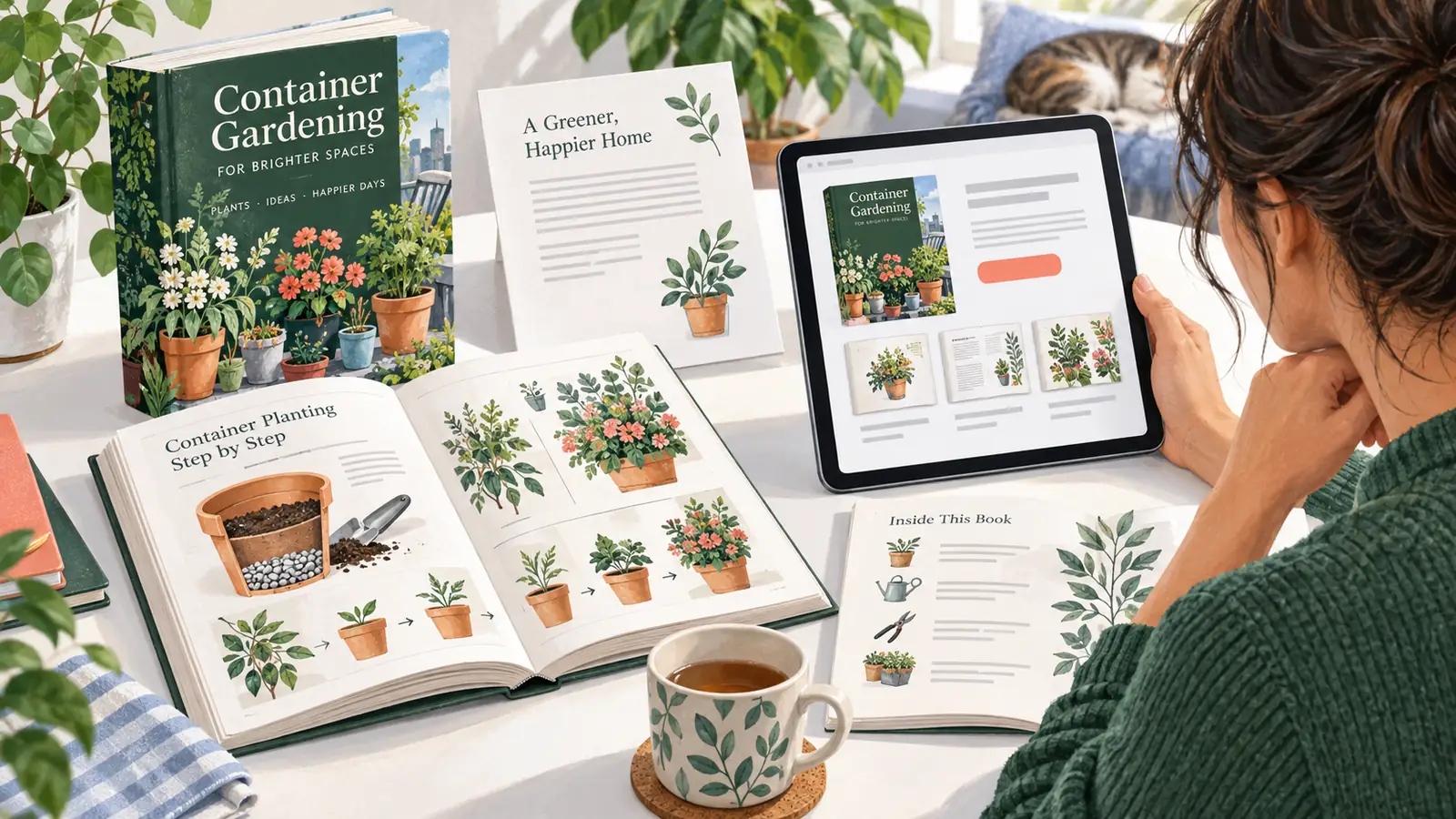
Keep mobile images legible. Exclude customer reviews, price or discount claims, purchase commands, external contact links and unsupported comparisons. Follow KDP's A+ guidelines and its current asset specifications. The WebP illustration on this article is a conceptual website asset, not an A+ upload template. Neither adding a module nor passing moderation guarantees a conversion increase.
A higher purchase rate can still leave less money
Evaluate retained contribution alongside conversion. Here, contribution means the amount retained from a purchase after applicable production or delivery costs and other relevant variable costs, but before advertising. It is not the retail price. KDP payouts depend on the option, territory and applicable deductions; consult KDP's royalty guidance rather than assigning every sale a universal royalty percentage.
| Scenario | Clicks / purchases | Contribution per purchase | Spend / contribution after ads |
|---|---|---|---|
| Original offer | 100 / 5: 5% conversion | $3.00 | $20 / -$5 |
| Lower-priced offer | 100 / 8: 8% conversion | $1.50 | $20 / -$8 |
The calculation is five times $3 minus $20, compared with eight times $1.50 minus $20. These invented observations do not prove a discount caused extra purchases. They show why a conversion percentage alone cannot justify a price change. Keep account-wide Kindle Unlimited earnings separate from campaign-attributed estimates, and do not assign unrelated organic sales to the ad.
Run one bounded improvement cycle
Choose a hypothesis that can fail: suitable beginner traffic is arriving, but the description does not state the starting level. Save the baseline export and current copy. Change that explanation, wait until the live destination shows it, and record the date. Keep bids and targeting stable where affordable; document any unavoidable changes.
Compare non-overlapping, similarly matured periods using clicks, purchases, spend and contribution. Annotate price changes, promotions, seasonality and traffic mix. A before-and-after comparison is not a randomized experiment, so describe a promising association rather than claiming proof. If purchases remain too sparse, report uncertainty and stop at the agreed loss limit instead of manufacturing a winner.
Choose the next task from the observed bottleneck
When the destination is coherent but clicks cost too much, use the controlled ACOS reduction plan. When several explanations remain plausible, work through the high-ACOS diagnosis. For the wider sequence of setup, measurement and optimization, return to Amazon Ads for books. The next change should answer the remaining question, not repeat the previous edit with stronger adjectives.
Sources and scope
Official Amazon Ads and KDP sources checked: 14 October 2026. Examples and calculations are fictional teaching scenarios, not results from a live campaign. Features, eligibility and reporting fields depend on the account, marketplace and ad product; verify the current console before acting. This guide concerns improving the purchase journey, not purchasing reviews or guaranteeing sales.