

Amazon Ads Launch Strategy: A Staged Book Release Plan
Give each release phase a job, a cash allowance and a decision gate.
Coordinate publication, advertising and reader communication without crediting every launch sale to Ads.
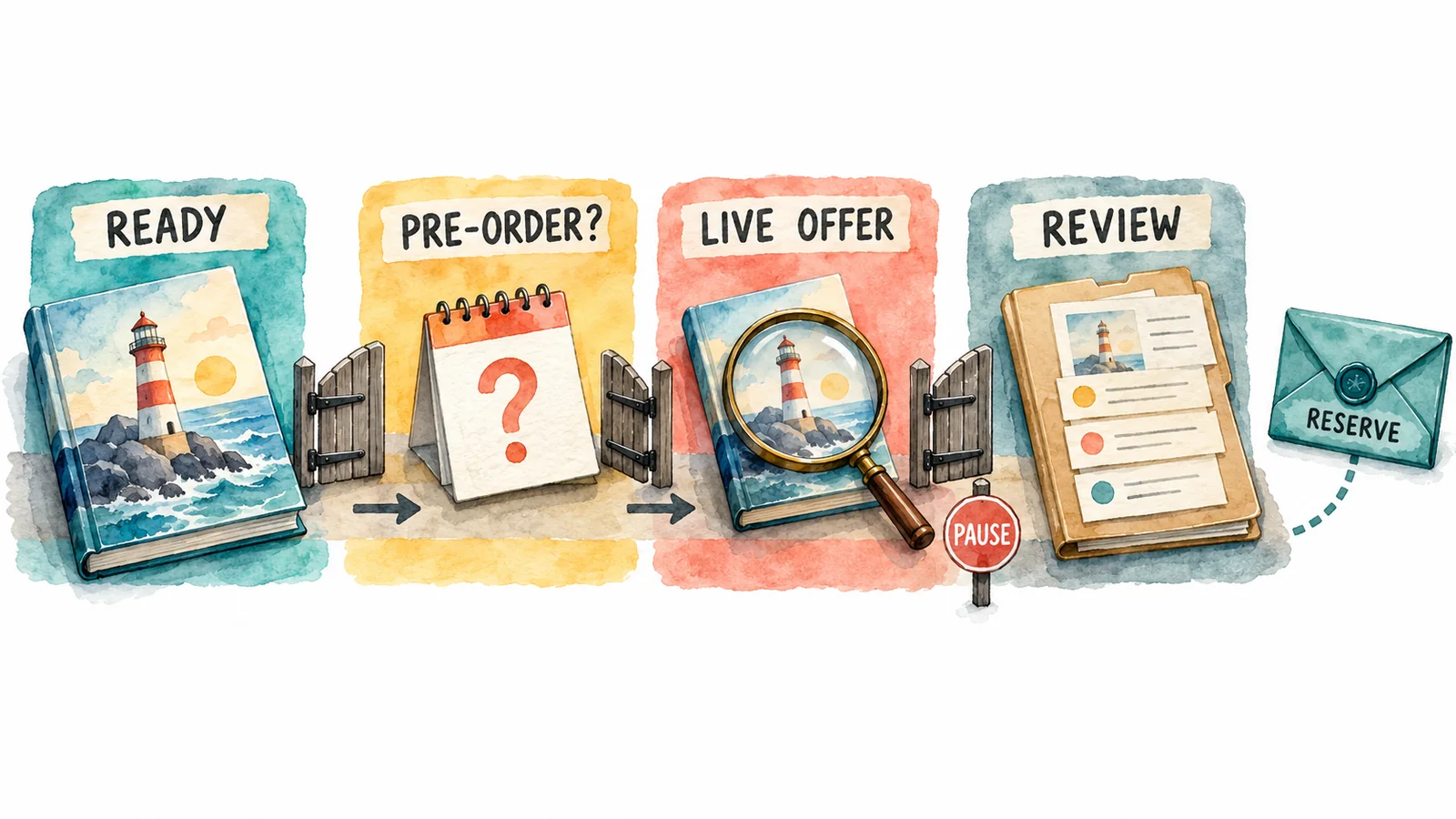
Plan an advertising sequence, not a release-day spending spike
An Amazon Ads launch strategy should specify when exposure starts, what each phase is meant to learn and which conditions release the next portion of cash. Publication day is a milestone, not evidence that every campaign should run at maximum budget. A useful plan can delay or stop advertising when the offer, eligibility or economics are not ready.
Start with one written objective: test whether suitable shopping contexts produce affordable purchases for the new edition, or run a finite visibility test with a declared learning loss. Do not combine rank, sales, reviews and profit into one unmeasurable promise. Advertising does not buy an entitlement to reviews or guarantee a ranking outcome.
Keep setup separate from the release calendar
Use the first-campaign readiness guide for account, ASIN, destination and submission checks. This page focuses on sequencing: preparation, conditional pre-release exposure, release monitoring and the transition into ongoing management. The broader book launch checklist covers publishing work that the advertising schedule cannot replace.
Use a staged calendar with conditional gates
The following timeline is an original planning example, not an Amazon requirement or a universal best launch window. Adapt it to the real publication date, market, moderation status, cash availability and data volume. When a gate fails, revise the sequence; do not preserve the calendar by buying traffic for an unavailable offer.
| Example phase | Main task | Gate before further exposure |
|---|---|---|
| Days -14 to -8: prepare | Verify edition, destination, contribution and account | Offer is coherent and the test is affordable |
| Days -7 to -1: conditional pre-release | Submit ads; test only an eligible pre-order offer if appropriate | Approval, availability and publishing obligations are checked |
| Day 0: release verification | Inspect live purchase paths and scheduled campaigns | No broken destination or unexpected exposure |
| Days 1 to 7: observe safely | Monitor spend and delivery; log other promotions | Cash limits hold; urgent defects are repaired |
| Days 8 to 21: review older cohorts | Assess appropriately matured evidence and one repair | Comparisons use the same definitions and maturity |
| Days 22 to 35: handoff | Continue a bounded test, adopt ongoing management or stop | The next phase has a separate objective and allowance |
A calendar date alone does not mature every click in a reporting period. Under the currently documented 14-day Sponsored Products author click window, clicks near the end of a week remain newer than those at its start. At a review, specify the cohort actually being evaluated rather than labeling all launch traffic finished.
Amazon's frontlist guide discusses advertising beyond the release day. Treat that as context for a staged plan, not proof that indefinite advertising will pay for itself. Its general launch recommendations do not replace your contribution model or a cash stop rule.
Choose an eligible pre-order branch or wait for release
A pre-release advertising plan is conditional. Verify that the intended book is available for pre-order and that the selected ad product, ASIN and marketplace allow the campaign. A publishing pre-order and advertising approval are different checks. If the offer is not eligible or the manuscript schedule is uncertain, prepare the research and settings without paying for exposure.
Protect publishing obligations first
Read KDP's Kindle eBook pre-order requirements for the actual submission deadline and release obligations. Do not copy that workflow to every print format. An advertising start date does not change a KDP deadline, and campaign approval does not confirm the final manuscript is ready.
Allow time for moderation and possible correction. Amazon's book-ad moderation guide describes usual review around 24 hours, potentially up to three business days. That is guidance, not a guaranteed completion time. A missed advertising slot is preferable to an inaccurate or unavailable purchase promise.
KDP currently requires the final eBook manuscript to be uploaded and submitted at least 72 hours before release. Put the deadline displayed for your title into the publishing calendar, with your own earlier delivery buffer. This is not the advertising moderation deadline: an approved ad does not confirm manuscript submission, and a scheduled print release is not a Kindle pre-order.
Do not invent launch urgency
Keep the advertised offer accurate at the time the reader sees it. Do not leave pre-order wording running after release, or claim a limited discount before verifying its availability. When price or format changes, inspect the live destination and update the economic assumptions before releasing further cash.
Allocate cash by decision gate, with reserve uncommitted
Budget the whole test, including the possibility that it produces no purchases. A fictional $180 envelope could allocate $40 to an eligible pre-release test, $70 to release-period exposure, $30 to a specific repair test and $40 held in reserve. These amounts sum to $180. They are not recommended minimums, platform hard caps or permission to spend every portion automatically.
| Portion | Allowance | Release condition |
|---|---|---|
| Conditional pre-release | $40 | Eligible, approved offer with a useful question |
| Release observation | $70 | Live destination and monitoring are verified |
| One repair test | $30 | Evidence identifies a controllable bottleneck |
| Unallocated reserve | $40 | A separate decision justifies further exposure |
If there is no eligible pre-order campaign, retain its allowance rather than automatically doubling release-day exposure. If a gate fails, unused money remains unspent. A smaller envelope may support one test rather than several simultaneous streams. Do not fragment the budget to imitate a larger author's campaign structure.
Planning limits need active monitoring
Amazon's daily settings use monthly averaging and may spend additional unused budget on a given day. See the daily budgeting policy. A daily setting or scheduled end is not an exact lifetime loss cap. Assign a monitoring owner and pause at the affordable limit, allowing for reporting delay and current exposure.
The linked budget announcement was published on 9 May 2023; checking it on 17 October 2026 does not make it a new policy. Inspect current account options and any active rules before setting the phase allowance. A reserve is an editorial planning decision, not an Amazon switch that automatically protects the remaining cash.
Coordinate email and other promotion without claiming all sales
Keep one event log for subscriber emails, social posts, third-party promotions, price changes and advertising interventions. Record the destination and time zone where relevant. This does not produce perfect attribution, but it prevents an obvious error: crediting the day's entire sales increase to Ads when a newsletter went out that morning.
For owned audience preparation, use the author email-list guide. Send readers to the correct live offer and avoid promising a promotion that has not appeared. Do not ask subscribers or ARC readers to click advertisements, simulate purchases or coordinate positive reviews to make the launch data look stronger.
Coordinate the calendar without changing everything at once
Some launch events must happen together. Record those overlaps honestly. When possible, reserve a later test period for one advertising change while the offer remains stable. If a price change and bid increase coincide, describe the resulting evidence as confounded rather than assigning the improvement to one control.
Amazon's KDP promotion overview lists publishing and promotional tools. Each has its own conditions; access to one does not make every other launch tactic available. Do not insert an expired promotional credit into the cash plan as if it were guaranteed funding.
Use the right decision for each phase
Before release, evaluate readiness and eligibility. On release day, check safety and the actual destination. In the first observation period, inspect delivery and material irrelevant spending without overinterpreting sparse purchases. Later, assess contribution using matched mature cohorts and choose one controlled repair.
| Situation | Useful response | Avoid |
|---|---|---|
| Ad is still under review | Inspect status and correction needs; adjust the calendar | Raising bids to fix moderation |
| Wrong format appears at release | Pause affected exposure and correct the destination | Buying more traffic before the path is repaired |
| Recent clicks have no purchases | Check relevance, maturity and loss allowance | Declaring the book unsellable from a tiny cohort |
| Sales exist but contribution is weak | Diagnose costs and target mix | Counting retail sales as author profit |
Use the ongoing optimization workflow to handle an identified bottleneck. The launch label does not justify paying for clearly irrelevant intent. Equally, a small unresolved group should not become a permanent negative solely because it has not produced an immediate purchase.
Write a launch readout that keeps uncertainty visible
Report dates, market, ad product, ASINs, spend, clicks, purchases and attributed sales. State the applicable earnings inputs and which click cohorts are sufficiently matured. Refer to Amazon's attribution methodology for the author window. Keep total book sales separate from ad-attributed sales; neither total-sales trends nor rank changes establish causal advertising impact.
Original contribution example
Suppose a fictional matured cohort has eight purchases retaining $2.50 each before ads, with $28 spend. Modeled contribution after ads is 8 x $2.50 - $28 = -$8. A concurrent email send might also generate organic sales, but those cannot simply be added to the campaign to erase its loss. Check payout assumptions against KDP's royalty documentation.
For a planned learning test, record what the $8 loss actually taught and whether another affordable test can resolve the remaining question. Do not rename the loss "momentum" without measurable evidence. Before-and-after results are not randomized experiments, and a new review is not proof that an ad caused it.
Transition deliberately after the launch period
Choose one outcome: stop, continue a finite test, repair a specific defect or adopt ongoing management. Remove obsolete launch rules and inspect any automatic budget or bid changes before leaving the campaign unattended. A release allowance should not quietly become a recurring monthly commitment.
If later data supports additional exposure, use the scaling guide to assess the next increment rather than doubling spend from enthusiasm. Recheck economics when a temporary price or subscriber-driven spike ends. A book that cannot support paid acquisition at present can still be promoted through other appropriate channels.
Return to Amazon Ads for books for setup, measurement and troubleshooting. The durable result of a launch plan is a clear record of the offer, exposure, decisions and evidence, not an obligation to keep advertising indefinitely.
Make the next action concrete: choose a reader hypothesis with the keyword strategy worksheet, check edition-level inputs with the royalty calculator, and model the wider project with publishing ROI. Use the promotion-test record to retain interventions, report dates and the next decision.
Sources and scope
Source access checked on 17 October 2026: public Amazon Ads and KDP pages were reviewed; help for match types, search-term reporting and attribution was available as substantive official indexed text after direct opens returned application shells. These are documentation checks, not inspection of your account or confirmation of feature access.
Official Amazon Ads and KDP sources checked: 17 October 2026. Timelines, allowances and calculations are fictional planning examples, not platform requirements or campaign forecasts. Verify current eligibility, publishing deadlines, account controls and marketplace conditions. Advertising does not guarantee reviews, rankings or incremental profit.
Frequently asked questions
How is a launch strategy different from first-campaign setup?
Setup verifies account, ASIN, destination and campaign configuration. A launch strategy sequences preparation, conditional pre-release exposure, release monitoring and later review, including phase allowances and coordination with other promotion.
Do I need to spend heavily on release day?
No. Publication day is a milestone, not evidence that maximum advertising is appropriate. Verify the destination and safety controls, then release only the exposure justified by the plan. Preserve unused allowance when a gate fails.
How far before release should I prepare ads?
Allow time for eligibility checks, moderation and corrections rather than relying on same-day approval. Use a timeline suited to the actual book and market. The example calendar is not a platform requirement or a guaranteed approval schedule.
What happens to the pre-release allowance if the offer is ineligible?
Keep it unspent unless a separate decision justifies another use. Do not automatically move it into a release-day spike. Publishing pre-order obligations and advertising approval are separate gates.
Can I attribute a newsletter-day sales increase to Amazon Ads?
Not automatically. Log subscriber emails, promotions, price changes and ad interventions, and keep total sales separate from ad-attributed sales. Overlapping activity makes before-and-after results confounded; rank or review changes do not prove ad causation.
Should launch campaigns run permanently afterward?
Only after a new decision. Stop, continue a finite test, repair a specific problem or adopt ongoing management with a fresh objective and allowance. Remove obsolete launch rules and recheck economics after temporary promotions end.