

Amazon Ads Optimization Strategy for Books
Build a repeatable process for choosing useful changes, not a routine of editing every bid.
Match the reporting scope, identify the weak stage and evaluate one bounded intervention against contribution.
Optimize for an outcome you can afford and measure
An Amazon Ads optimization strategy for books is a repeatable decision process, not a schedule of bid reductions. Decide what the campaign must accomplish, identify the weak stage, choose a controllable change and review the outcome with comparable data. Editing every setting each morning creates activity without a reliable explanation of what worked.
Choose between a direct-contribution objective and a finite learning objective. Direct contribution asks whether the relevant attributed earnings, after applicable variable costs, exceed advertising spend. A learning test asks a narrower question, such as whether a specific group of reader-intent targets produces affordable purchases. Both need a cash limit. Calling a campaign a launch or awareness test does not remove its cost.
Retail sales are not author income
A fictional book can show $100 in attributed sales yet retain only $40 before ads. At $45 ad spend, its modeled contribution after ads is -$5. Do not describe the $100 sales column as a $55 author profit. Actual royalties and deductions depend on the edition and marketplace; use KDP's royalty documentation for your inputs. Keep unmeasured future read-through and unrelated account-wide KU earnings outside that calculation.
Freeze the reporting scope before comparing results
Save an export with the report name, export date, campaign IDs, marketplace, currency, date range and advertised ASINs. Record the attribution definition and whether a metric counts purchases or units. Use the same definitions in the comparison. A campaign's spend divided by all KDP sales for the month is not that campaign's ACOS.
- Use the same ad product, marketplace and reporting scope.
- Separate recent click cohorts from sufficiently matured cohorts.
- Keep purchase counts beside conversion percentages.
- Annotate price, format, promotion and availability changes.
- Save the original settings before any intervention.
Amazon's attribution documentation currently gives Sponsored Products authors a 14-day click window, rather than the seller window seen in some examples. Reporting can still be adjusted. Check the applicable methodology; a window is not a promise that missing purchases will arrive. Stop new spending at the loss limit while existing clicks mature.
Do not confuse a missing row with zero demand
Search-term reporting covers clicked contexts, including some inferred or product contexts. It does not expose every unclicked query. Use the search term report documentation to understand the coverage before adding exclusions or declaring an audience absent. Sparse data should remain labeled uncertain.
Find the weak stage before choosing the control
Work from delivery toward retained contribution. If the campaign barely serves, a detailed conversion diagnosis is premature. If relevant clicks already arrive but the intended edition cannot be purchased, a bid change is the wrong first repair. One symptom can have several explanations; inspect the actual status, destination and report rather than relying on a colored dashboard cell.
| Observation | Inspect first | Relevant next task |
|---|---|---|
| Little or no delivery | Dates, status, exact-edition eligibility and funding | Delivery diagnosis |
| Impressions without useful clicks | Reader fit, thumbnail promise and sample size | No-click diagnosis |
| Relevant clicks without purchases | Edition path, description, sample and reporting maturity | Conversion review |
| Purchases with weak economics | Contribution, CPC and target mix | High-ACOS diagnosis |
| Supported results with constrained volume | Actual budget constraint and next-increment economics | Measured scaling |
For targeting controls, consult Amazon's targeting guide. Distinguish a selected keyword from the actual clicked context. Negative scope and match behavior matter; excluding a broad phrase can remove useful neighboring traffic as well as the unwanted row.
Prioritize expected decision value, not dashboard drama
Review material avoidable spend before tiny rows with spectacular ratios. A target spending $40 on clearly unrelated reader intent deserves more attention than one spending $0.30 without a purchase. Relevant but expensive traffic needs a different investigation from obviously irrelevant traffic. Do not use a universal number of clicks as an automatic negative rule.
Original prioritization example
A beginner herb guide receives costly greenhouse-engineering clicks, affordable balcony-herb purchases and a small amount of unresolved gardening traffic. Exclude the engineering context narrowly, preserve the supported herb traffic and keep the unresolved group within its separate test allowance.
This fictional case is a decision framework, not proof that a particular keyword will work. Record what could disprove the interpretation. If the supposedly irrelevant context actually describes a chapter and a suitable reader, the exclusion may be wrong. Inspect the book's real scope rather than judging a phrase in isolation.
At campaign level, compare sums of spend and sales, not unweighted averages of target ratios. Then inspect the child rows that explain the total. A losing segment can erase the contribution of a useful segment without making every target equally bad.
For two non-overlapping, consistently scoped rows, suppose spend / attributed retail sales are $10 / $20 and $90 / $300. Their ACOS values are 50% and 30%, but the combined value is ($10 + $90) / ($20 + $300) = 31.25%, not the unweighted 40% average. These fictional ratios describe retail-sales efficiency, not author contribution or incremental profit. Use matched totals before deciding which child row to inspect.
Make one bounded change with a defined comparison
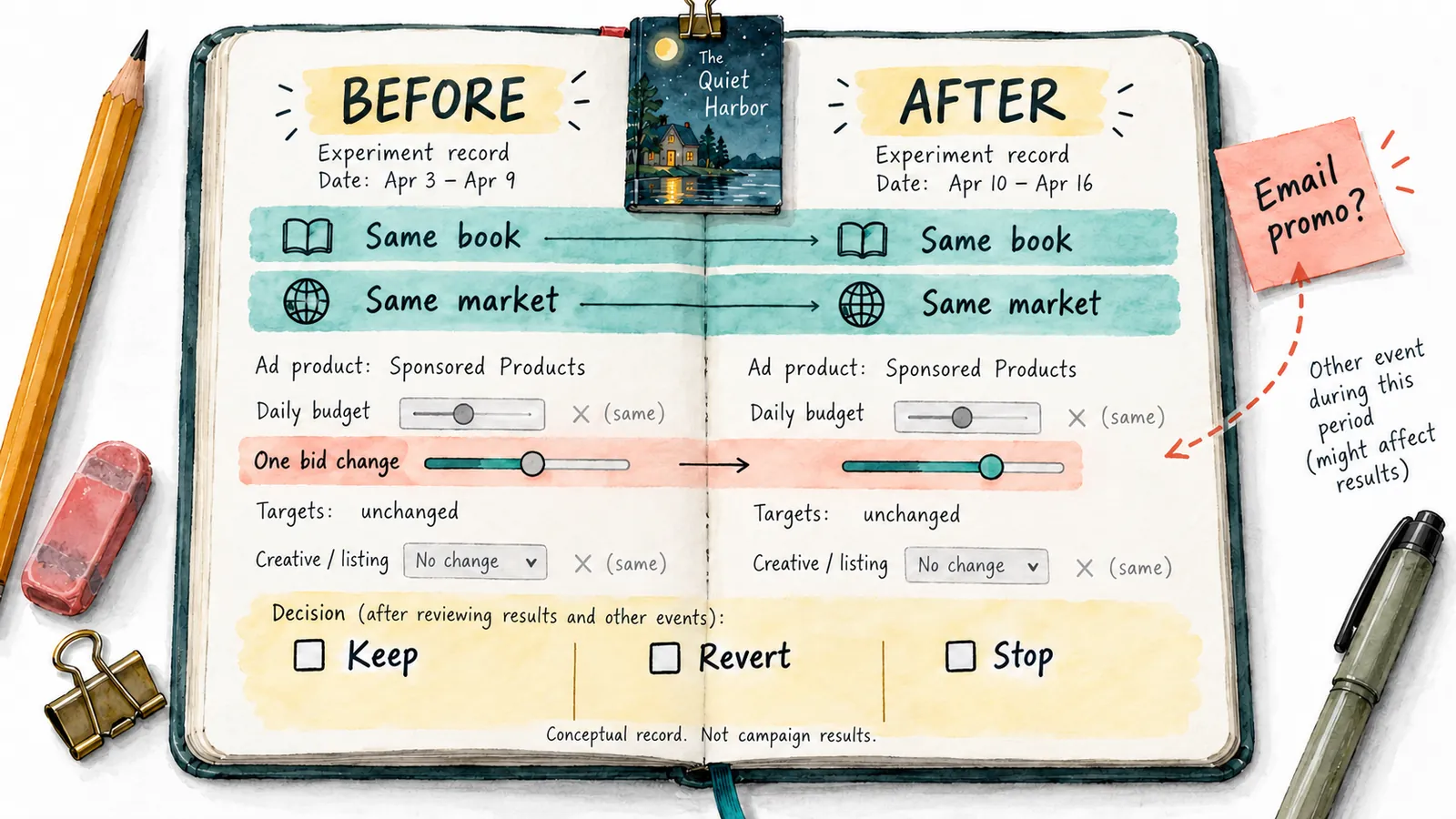
Write the hypothesis before editing. For example: a relevant target converts but its effective click cost exceeds the allowance, so reduce one bidding control while leaving the destination unchanged. Save the old setting, specify the affected scope, choose an affordable exposure limit and set the next review date. A clear test can fail without consuming the entire monthly budget.
| Field | What to record | Why it matters |
|---|---|---|
| Hypothesis | Specific weak stage and suspected cause | Prevents choosing a flattering explanation afterward |
| Intervention | One setting or destination change, with old and new values | Supports a meaningful revert |
| Exposure rule | Cash allowance and conditions for pausing | Limits the cost of uncertainty |
| Evaluation | Comparable dates, maturity, counts and contribution | Avoids judging a fresh period against a mature one |
Do not promise proportional effects
Base bids, dynamic strategy and applicable adjustments influence exposure together. A 20% lower bid does not guarantee 20% lower CPC or ACOS. Check current author-account controls in Amazon's bidding strategy guidance. Preserve a record of other changes and compare actual outcomes, not the setting alone.
Review allocation without creating unnecessary fragmentation
Separate campaigns when the distinction changes a decision: different cash limits, discovery versus controlled targeting, or materially different edition economics. Creating dozens of campaigns for a tiny book budget can leave every result too sparse to interpret. Use the simplest structure that makes spending and responsibility clear.
When moving a supported opportunity out of discovery, verify that its destination campaign actually delivers before adding exclusions to the original. Overlapping eligibility and match variants mean this is not guaranteed exclusive routing. Do not add both campaign totals to a third summary that already contains them; one click's cost should not be counted twice.
Inspect automation before enabling more of it
Budget rules and bidding rules change different controls. Amazon describes schedule and performance options in its rules guide, but availability depends on the account and product. A retail-sales ROAS trigger is not automatically a profitable author-income trigger. Record active rules, their scope and the condition for disabling them.
Separate frequent safety checks from slower performance decisions
Check urgent risks as often as exposure warrants: broken destinations, unexpected spend, rejected ads or a changed release date. Performance analysis can wait for a usable comparison. These are different jobs. Avoid rewriting the description and changing every bid because yesterday's ratio moved after one purchase.
Use a recurring review appointment that fits your budget and data volume, not a claim that every book needs the same optimization interval. At the appointment, revisit the oldest unresolved test, inspect material waste and choose the next single intervention. Retain a pause decision when the next useful observation would cost more than you can afford.
Daily budgets follow a monthly averaging policy and can use unused budget for extra daily spending. They are not exact hard daily loss caps. Verify the budgeting policy and current settings. A review calendar does not replace cash monitoring.
Keep, revise, revert or stop using the same criteria
Compare matured spend, clicks, purchases, attributed sales and modeled contribution. Add counts and competing explanations such as a price promotion, email send or seasonal demand. A before-and-after improvement is not a randomized experiment and does not establish incremental profit. If the evidence remains thin, record that rather than manufacturing a winning tactic.
Keep a change when it supports the objective within the cash limit. Revert an unsupported intervention when the prior configuration is still appropriate; stop when neither configuration is affordable. Only move into scaling after a separate readiness review. For a new title, use the first-campaign readiness guide and the staged release plan before applying an ongoing optimization routine.
Return to Amazon Ads for books for the wider cluster. Optimization should leave a usable decision history: what you believed, what you changed, what it cost and what the evidence now supports.
Keep three controls separate in the decision record: which reader intent to target, how the auction bid is adjusted, and how much cash is authorized. Check assumptions with edition royalties or publishing ROI, then save the comparison in a promotion-test record. Virtalibry does not run this optimization automatically in your advertising account.
Sources and scope
Source access checked on 17 October 2026: six public Amazon Ads/KDP pages were read directly and six help articles were checked as substantive official indexed text after direct responses returned application shells. These checks do not establish account access, live settings, spend or campaign performance.
Official Amazon Ads and KDP sources checked: 17 October 2026. Cases and arithmetic are fictional teaching examples. Features and reporting definitions depend on the account, marketplace and ad product. This is a controlled decision workflow, not a promise of sales, rankings or guaranteed profitability.
Frequently asked questions
What is an Amazon Ads optimization strategy for books?
It is a repeatable process for defining an objective, diagnosing the weak stage, testing one controllable change and reviewing comparable evidence. It includes a spending limit and stop decision, not just bid adjustments.
How often should I optimize book campaigns?
Check urgent risks as often as exposure requires, but make performance decisions from usable, consistently matured data. There is no universal interval for every budget and purchase volume. A broken destination needs an immediate response; sparse recent results need cautious interpretation.
Which report should I inspect first?
Start with campaign scope and the observed bottleneck, then inspect relevant child rows. Search-term reports cover clicked contexts rather than all impressions. Match dates, marketplace, attribution and metric definitions before comparing periods.
Should I change targeting, bids and the description together?
Usually choose one meaningful intervention so the outcome remains interpretable. Repair urgent defects immediately and document unavoidable concurrent changes. Before-and-after results are not randomized evidence, especially when price or promotions also change.
Does lower ACOS mean optimization succeeded?
Not necessarily. ACOS uses attributed retail sales rather than retained author contribution. Evaluate purchases, cash exposure and contribution after ads against the stated objective; a lower ratio can accompany less absolute contribution.
When should I stop optimizing a campaign?
Stop or pause when the affordable loss limit is reached, the destination is broken or the next useful test cannot be answered affordably. A documented inconclusive result is better than continuing uncontrolled spending.