

Amazon Ads for a Book Launch: Prepare the First Campaign
Verify the real offer before paying for a new book's first clicks.
Use a small, interpretable test with checked eligibility, a coherent edition path and an affordable loss allowance.
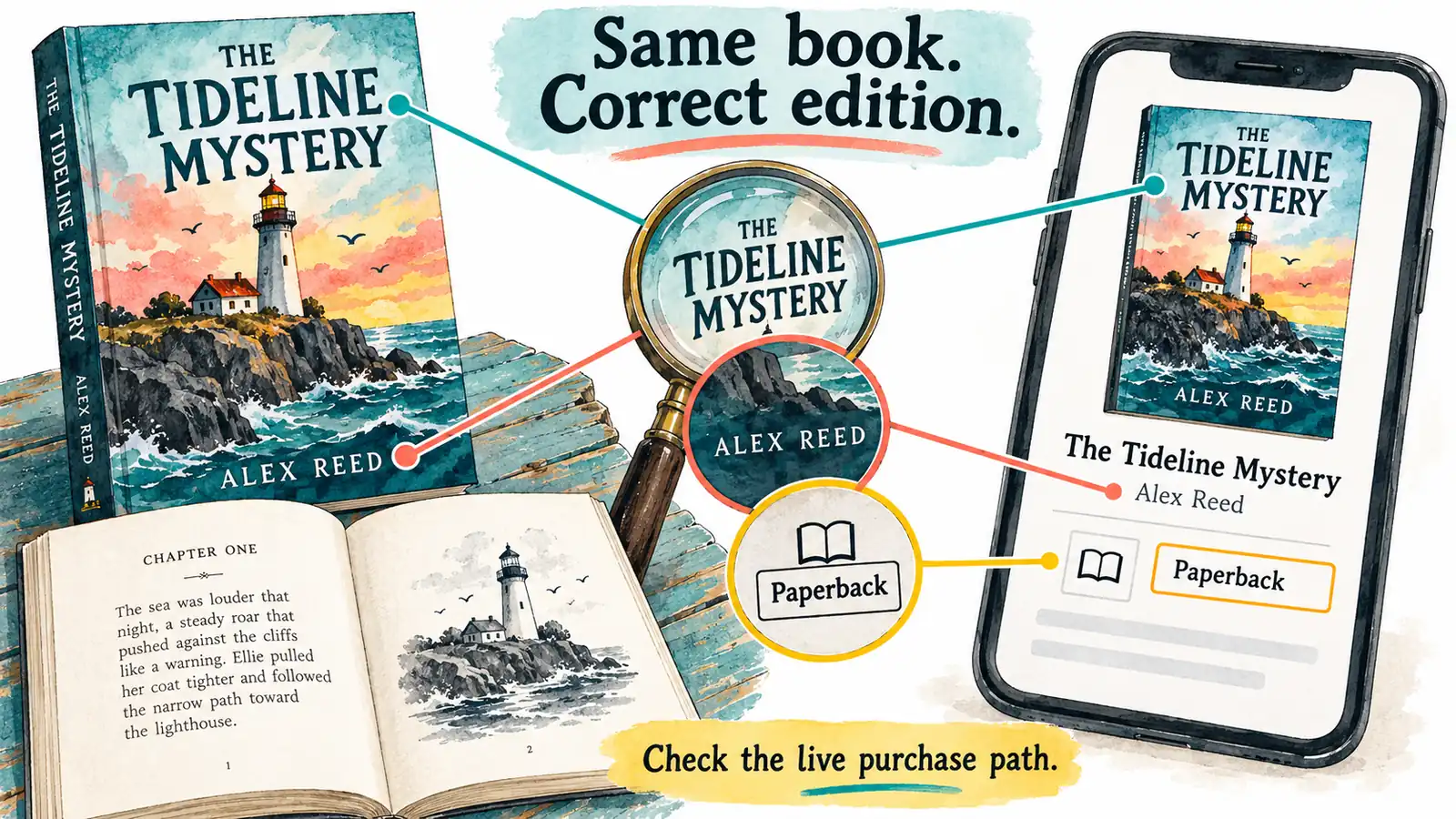
Use the first book-launch campaign to test a specific offer
Amazon Ads can put a new book in relevant shopping contexts, but publication does not automatically create demand. For a first launch campaign, choose one title, one marketplace and a clear reader hypothesis. The immediate task is to learn whether the intended edition can attract suitable readers within an affordable test, not to guarantee a bestseller rank.
This guide covers readiness and the first campaign decision. Use the staged launch strategy for the release calendar, phase budgets and coordination with email or other promotions. Keeping those tasks separate makes it easier to identify whether a problem is incomplete setup or an unsuitable launch plan.
Write a reader hypothesis you can inspect
This beginner balcony-herb guide is for readers who want to grow a few edible plants in small containers. The first test will focus on that use case, not commercial growing or advanced landscape design.
The example is fictional. Substitute the actual book's audience, reading level, genre experience or practical problem. If you cannot explain why a reader would choose this edition over a different type of book, finish that positioning work before paying for traffic.
Check the account, marketplace and exact edition
Amazon's author Sponsored Products guide describes selecting the advertising country, registering as an author and choosing an eligible book by title or ASIN. Follow the current author workflow and check the book's presence in Author Central. Interface labels and feature availability can vary; do not substitute a seller-account tutorial without checking the author requirements.
Verify that the intended edition is eligible in the chosen market, the account is in good standing and billing is ready. A book being sold on Amazon is not by itself proof that the ad will be approved. Inspect both the advertised book and campaign status. Do not try to work around an eligibility rejection by selecting an unrelated edition or making an inaccurate creative claim.
Pre-order availability is not automatic ad approval
Amazon's book-ad moderation guidance allows eligible books available for pre-order or sale, subject to its requirements. Confirm the particular ad product, ASIN and marketplace in the console. Separately, KDP's Kindle eBook pre-order rules govern the publishing schedule and submission obligations. Do not infer that a print edition has the same pre-order workflow, or that an advertising start date changes a manuscript deadline.
Ad review usually takes about 24 hours and can take up to three business days, according to Amazon's moderation guide. That is guidance, not a guaranteed completion time. Leave room for a correction rather than planning an essential release activity around same-day approval.
For a Kindle eBook pre-order, KDP currently requires final manuscript submission at least 72 hours before release. Record the actual deadline shown for the title and leave an earlier working buffer. If publication is delayed or the pre-order is canceled, recheck scheduled advertising and pause affected exposure; do not leave a campaign pointing to an unavailable promise.
Inspect the purchase destination before buying traffic
Open the actual advertised ASIN in the intended store. Check cover, title, author, language, format, availability and price. Repeat on a phone. Read the description as an unfamiliar reader, then inspect the sample where it is available for that format and device. A correct desktop eBook page does not verify every linked print edition.
| Check | Ready means | Delay exposure when |
|---|---|---|
| Edition path | The advertised ASIN matches the intended offer | A wrong format or unavailable purchase path appears |
| Reader promise | Cover and description describe the actual book | The audience or genre is misleading |
| Reading experience | Available sample is representative and readable | Formatting or interior images are broken |
| Economics | Current contribution and test loss are recorded | The plan treats retail sales as retained earnings |
| Operations | Billing, status and a monitoring owner are checked | No one can inspect unexpected spending |
Do not turn review count into an invented eligibility quota
A new title may have little reader history. Assess the page honestly; do not invent a universal minimum number of reviews needed to run a campaign or purchase reviews to satisfy it. Advertising is not a mechanism for requiring positive reviews. If the offer is unclear, repair it using the purchase-journey checklist rather than substituting fabricated social proof.
Choose a test you can afford to lose
Estimate retained contribution per eligible purchase using the actual format and marketplace. The retail price is not your payout. Royalty options and applicable deductions matter; consult KDP's royalty guidance. State which costs the model includes and keep fixed overhead separate. An intentional learning loss should be explicit, not hidden in an optimistic sales forecast.
For a fictional $60 test envelope, you might allocate $30 to a narrow intent test, $15 to limited discovery and hold $15 unallocated. The total is $60. This is a planning example, not a recommended starter budget or three guaranteed platform caps. If two test streams would each receive too little useful exposure, begin with one stream instead.
Use assumptions, not a universal opening bid
If the example offer can afford $1.50 advertising cost per purchase and the planning purchase rate is 4%, the conditional average CPC allowance is $1.50 x 0.04 = $0.06. That assumed conversion rate is not a benchmark, and the calculation is not a guarantee of auction delivery. If plausible costs do not fit the economics, change the test or delay advertising rather than selecting a bid simply because it is suggested.
Daily budgets use a monthly averaging policy and can draw on unused budget for extra daily spending. Check Amazon's current budgeting policy. Monitor cumulative exposure; a daily setting or end date is not a strict lifetime loss cap.
The $0.06 figure is an arithmetic allowance, not an instruction to enter a bid below an account or marketplace minimum. If the permitted controls, plausible click costs and expected contribution cannot fit the test, do not launch it merely to complete the checklist. Check edition inputs with the royalty calculator; use publishing ROI for project costs outside this small campaign model.
Use a small structure with distinct questions
Automatic targeting can explore contexts based on the book, while manual targeting lets you select keywords or products. Neither is automatically superior for every launch. Choose a structure that makes the first question interpretable and affordable. Consult Amazon's targeting guide for current matching and exclusion controls.
| Approach | Question it can test | Watch for |
|---|---|---|
| Narrow manual reader intent | Does a known use case fit this edition? | Overconfidence from too few purchases |
| Selected comparable products | Does the audience overlap make sense? | Matching only surface-level cover similarity |
| Bounded automatic discovery | Which clicked contexts deserve further inspection? | Unrelated traffic and uncontrolled discovery spend |
For the herb-guide example, beginner container growing is a coherent hypothesis; advanced hydroponic engineering is not automatically a useful comparison. Select a manageable group with a written reason for each target. A long keyword list does not create more budget or more interpretable evidence. Use the keyword strategy guide for the research process.
Save the configuration before submitting the campaign
Record campaign name, market, advertised ASIN, objective, dates, targets, bids, dynamic strategy, applicable adjustments and budget settings. Name the test so you can distinguish it from a later edition or promotion. Keep the original export or settings record outside the memory of whoever pressed the launch button.
- Check the actual start date and the account's displayed time zone.
- Confirm which controls can raise effective bids or budgets.
- Record the cash stop rule and person responsible for monitoring.
- Submit accurate creative and inspect the review result.
- Do not increase spend to compensate for a rejected or unavailable ad.
Keep unsupported products out of the plan. Author ad formats and eligibility change over time; a generic seller feature is not automatically available to a book advertiser. You do not need to launch every format at once. A simple Sponsored Products test can be easier to interpret than several unfamiliar products sharing a small envelope.
Verify delivery before making performance judgments
After approval and the scheduled start, check campaign and child-level status, billing and actual delivery. Being eligible to serve does not guarantee impressions. If little happens, inspect constraints before raising bids or budget. Use the no-impressions diagnosis and preserve the message shown in the console.
Do not click your own ads to create a test conversion path. Inspect the destination directly and use legitimate reports for delivery evidence. If you need support, provide campaign IDs, market, ASIN, dates and the relevant error, without passwords, payment details or unrelated personal information.
Fix urgent defects immediately; defer speculative optimization
A wrong destination, unexpected spending or a changed release date can justify an immediate pause. A few clicks without a purchase do not establish that the cover is bad. These are different kinds of decisions. Keep the technical safety check separate from the later assessment of reader fit.
Read the first evidence without promising launch momentum
Save matched report scopes and allow for attribution maturity. Amazon currently documents a 14-day click window for Sponsored Products authors; consult the attribution methodology. Purchase counts, spend and contribution matter more than a release-day ratio with one sale. You can pause new exposure while existing clicks mature.
Annotate emails, promotions and price changes so total launch sales are not all credited to advertising. Sales rank and review count do not prove incremental ad impact. At the agreed checkpoint, continue only with a useful question and an affordable allowance. Use the optimization workflow for repairs, and the scaling guide only after a separate readiness review.
Return to Amazon Ads for books for the wider cluster. A successful first test can end in a documented stop decision; it need not become a permanent campaign.
Save a dated preflight record: the direct destination URL, edition and market, observed availability, targeting rationale, effective spending controls, pause owner and next check. Re-open the live offer after a material change. Use the promotion-test record for the later readout; a readiness check is evidence of what you inspected, not a promise of approval or conversion.
Sources and scope
Source access checked on 17 October 2026: public Amazon Ads and KDP pages were reviewed; help for match types, search-term reporting and attribution was available as substantive official indexed text after direct opens returned application shells. These are documentation checks, not inspection of your account or confirmation of feature access.
Official Amazon Ads and KDP sources checked: 17 October 2026. Examples and budgets are fictional planning scenarios, not recommendations for every launch. Eligibility, pre-order handling, reports and controls must be checked in the relevant account and market. No review, sales-volume or ranking result is guaranteed.
Frequently asked questions
Can Amazon Ads guarantee a successful book launch?
No. Ads can create opportunities for discovery, but they do not guarantee purchases, reviews, ranking gains or profit. Start with a specific reader hypothesis and an affordable test rather than a promise of launch momentum.
Can I advertise a book before release?
Eligible pre-order offers may be advertised subject to the ad product, ASIN, marketplace and moderation requirements. Verify the current console and publishing obligations separately. Do not infer that every format uses the Kindle eBook pre-order workflow.
Do I need a minimum number of reviews to start?
Do not invent a universal review-count quota from general launch advice. Check actual account and title eligibility, and assess the destination honestly. Do not buy or coordinate positive reviews to make a new title appear ready.
Should the first campaign use automatic or manual targeting?
Choose the structure that answers the first question affordably. Narrow manual intent can test a known use case; bounded automatic discovery can reveal clicked contexts to inspect. Neither approach is universally best, and a small budget may support only one stream.
What is a sensible launch advertising budget?
Use an amount you can afford to lose learning, with a defined monitoring owner and stop rule. There is no universal starter amount. Distinguish the total planning envelope from the platform's averaged daily budget setting.
How soon should I judge the first campaign?
Fix urgent destination, billing or spend problems immediately. For performance, use consistent reporting scopes and sufficiently matured click cohorts, with purchase counts beside percentages. You may pause new spending while existing attribution matures.