

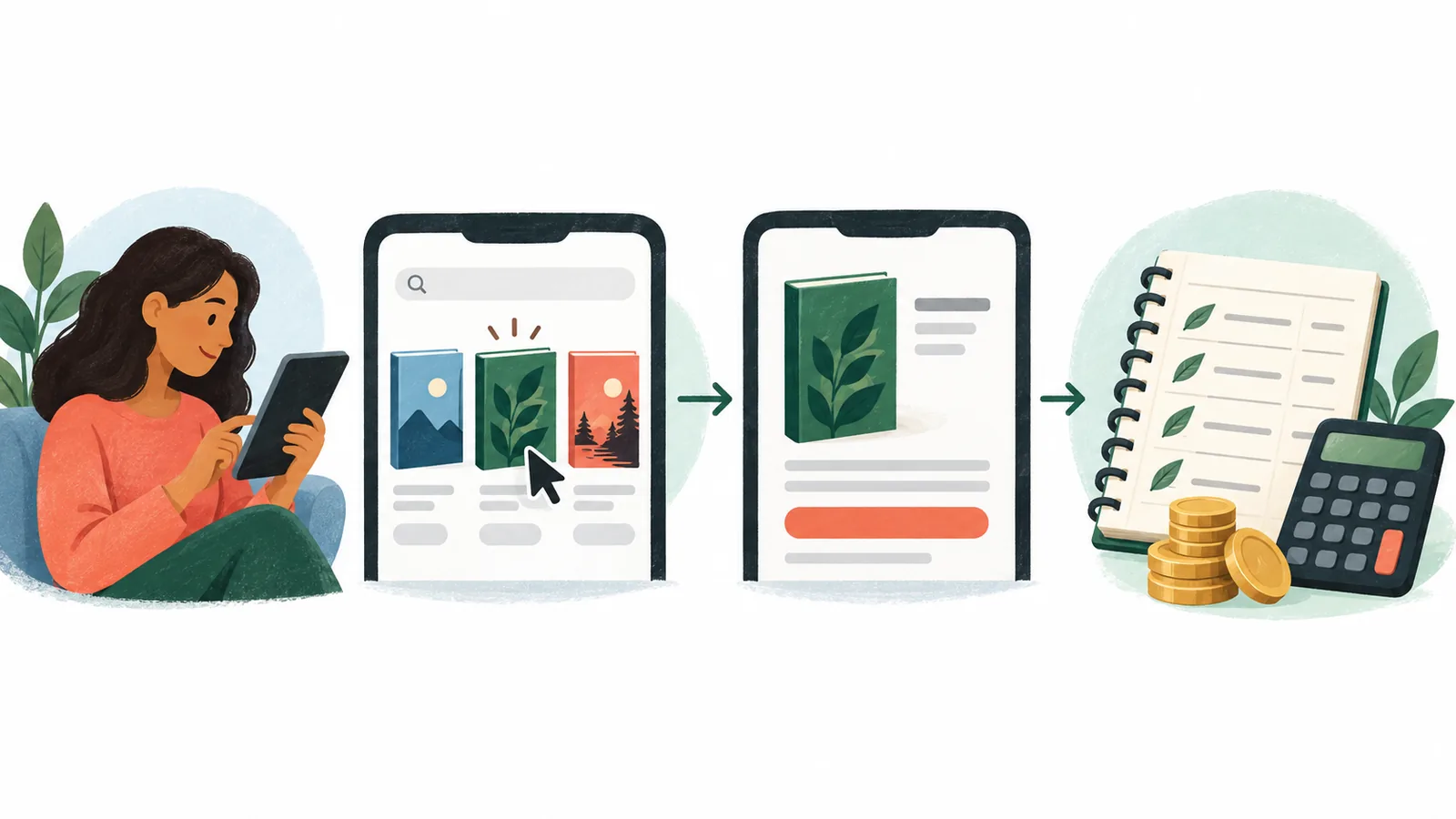
How Amazon Ads for books work: buying opportunities, not guaranteed readers
For a Sponsored Products book campaign, you select an eligible edition, define targeting and set bids and a budget. An eligible ad can compete for placement; an impression may become a paid click to the book's detail page. A purchase may later qualify for attribution in the advertising report. None of those steps guarantees the next one.
This guide explains the mechanism and how to interpret the numbers. Use the beginner walkthrough for actual setup, and the format comparison for Sponsored Products versus Sponsored Brands. The examples here focus on click-based Sponsored Products; do not apply their assumptions to every Amazon advertising product.
Five separate stages
- Eligibility: the book and campaign must qualify to serve.
- Delivery: the ad appears in a relevant advertising opportunity.
- Click: a reader follows the ad; CPC spending is incurred.
- Attributed conversion: a qualifying purchase is assigned under the report's rules.
- Economics: you compare author contribution with advertising and other costs.
Amazon describes Sponsored Products as CPC ads taking shoppers to an individual product page. Its general product page also describes placements beyond Amazon and newer capabilities. That does not establish availability for every author account; inspect the actual book campaign and placement reports.
1. Why an eligible campaign may still receive no impressions
A target makes your ad eligible for a context; it does not reserve a position. Relevance, bidding, competition, availability, campaign status and budget all affect delivery. The highest number typed into a bid field is not a universal guarantee of winning every opportunity.
Base bid, adjusted bid and CPC are not the same number
Your base bid is an input. The selected strategy and enabled adjustments can change auction exposure. CPC is the observed cost of clicks, normally summarized as spend divided by clicks. Compare actual CPC with your economics rather than assuming every click costs the base bid.
Amazon's bidding help distinguishes fixed, dynamic and other strategies. Down-only bidding can reduce bids; up-and-down bidding can raise them. Placement and other enabled boosts require their own review. Do not stack adjustments without calculating their effect.
A delivery check before a bid increase
Check dates, approval, payment problems, edition availability, targeting relevance and budget status first. Then consider whether the bid is competitive within what you can afford. An unaffordable auction remains unaffordable even when Amazon recommends a higher bid. Spending more is not the only possible response to low delivery.
2. A keyword is not the customer's actual search
A target is what you select; a shopping query is what the customer types. The search-term report helps you inspect the traffic that your targeting actually matched. Product targeting instead relates to selected products or categories, so not every report row should be read as a typed phrase.
| Control | What it does | Book example |
|---|---|---|
| Manual keyword | You choose a phrase and match type | A relevant container-gardening phrase |
| Broad match | Can reach related meanings and variations | Traffic beyond the literal words you entered |
| Phrase match | More constrained phrase matching | A longer query containing the phrase |
| Exact match | Most constrained, still with allowed variants | The chosen phrase or a permitted close form |
| Product targeting | You choose product or category contexts | A comparable book serving the same reader |
| Negative targeting | Excludes specified matches or contexts | An unrelated subject consuming the allowance |
Automatic targeting is a discovery mechanism, not a fourth keyword match type. Close match, loose match, substitutes and complements are automatic targeting groups; broad, phrase and exact belong to manual keyword matching. See Amazon's Sponsored Products targeting guide for current behavior. A single reported purchase is a clue to investigate, not proof of stable conversion.
3. Read the funnel before reading ACOS
| Metric | Calculation or meaning | What it does not establish |
|---|---|---|
| Impressions | Recorded ad displays | Unique people, attention or purchases |
| CTR | Clicks / impressions x 100 | Profit or reader satisfaction |
| Average CPC | Spend / clicks | A sustainable bid without conversion evidence |
| Purchase conversion rate | Attributed purchases / clicks x 100, using matching report definitions | All retailer sales or guaranteed future conversion |
| ACOS | Spend / attributed sales x 100 | The percentage of royalties spent |
| ROAS | Attributed sales / spend | Author profit or causal sales lift |
Use the same currency, dates, campaign scope and conversion definitions for numerator and denominator. Purchases, units and sales value are different measures. When attributed sales are zero, ACOS is undefined, not a meaningful 0% result. When clicks are zero, a conversion rate cannot be estimated from that row.
4. Calculate the difference between sales and earnings
A fictional report with enough detail to audit
Assume 10,000 impressions, 100 clicks, $30 spend, 5 one-unit purchases and $25 attributed sales. All purchases in this simplified example are the same $5 edition. Assume each sale contributes $3 after the edition's applicable production or delivery costs, but before advertising and other overhead.
- CTR: 100 / 10,000 x 100 = 1%.
- Average CPC: $30 / 100 = $0.30.
- Purchase conversion rate: 5 / 100 x 100 = 5%.
- ACOS: $30 / $25 x 100 = 120%.
- ROAS: $25 / $30 = 0.83, rounded.
- Attributed author contribution: 5 x $3 = $15.
- Contribution after ads: $15 - $30 = -$15, before other expenses.
The ad report's $25 sales figure is not $25 available to the author. KDP's eBook royalty guidance explains why payout depends on the applicable option, territory and costs. Use the actual edition's numbers when replacing these fictional inputs.
Break-even is book-specific
In this simplified example, break-even CPC is $3 x 5% = $0.15. Break-even ACOS is $3 / $5 x 100 = 60%, before other expenses and assuming the report's sales basis matches the $5 price. That is not a universal target. A different edition, refund rate, royalty or conversion rate changes the answer.
If you require $1 contribution per sale after advertising, only $2 is available for ads; at the assumed 5% conversion rate, the corresponding CPC allowance is $0.10. This is scenario arithmetic, not a recommendation that such a bid will win traffic.
5. Attributed does not mean incremental
Attribution assigns qualifying conversions to ad interactions under defined rules. It does not prove the customer would never have purchased without the ad. A branded search campaign can capture existing interest, and simultaneous emails, discounts or launches can influence the same period.
Amazon's attribution help lists a 14-day click lookback for Sponsored Products authors and vendors; seller accounts and other campaign types have different rules. Check your report's exact definition instead of hard-coding one rule for every format. Recent clicks may gain conversions later, so compare similarly matured periods and re-export reports after the relevant window and processing time. The same documentation says book products do not have brand-halo attribution; do not assume every later sale of another title belongs to this ad.
Ads and KDP reports serve different purposes. Date conventions, attribution, editions, territories, cancellations and later adjustments can prevent totals from matching. Keep report downloads and note their extraction date. Do not label all sales outside the ad report as proven organic sales caused by ranking improvements.
6. Keep Kindle Unlimited reading separate
Amazon's metrics documentation describes KENP Read and estimated KENP royalties for author advertising. Where available, use the attributed reading metrics and identify them as estimates. A borrow is not a paid purchase, and a download does not mean the entire book was read.
Reconcile estimated reading income with finalized publishing reports before making a long-term budget. Do not add all account-wide KU royalties to a single campaign's return, or count the same income twice. If read-through matters, model it separately with an explicit observation period and uncertainty.
7. Diagnose the stage that is actually weak
Few impressions
Investigate delivery and eligible demand. Confirm status and availability before testing targeting or bids. A large budget cannot create relevant searches.
Impressions but few clicks
Check the context, cover, title and price against comparable books. Do not chase a universal CTR benchmark across different placements and genres.
Clicks but poor economics
Read actual traffic, inspect the product page, allow for reporting delay and compare CPC with contribution. More impressions will not repair an unprofitable cost per purchase by themselves.
Use the first-campaign review routine to make one recorded change at a time. Return to the Ads hub for specialist topics. If the real problem is format selection, use the author-focused comparison.
Sources and scope
Official documentation checked: 14 October 2026. Equations and fictional examples are shown in full so assumptions can be replaced. They are not industry averages, earnings claims or measured results. Amazon's definitions and available reporting can change; the current account's report help takes precedence.