

Puzzle Books for KDP
Build a puzzle production workflow that checks correctness, answer matching and the reader's printed experience.
This page is a guide, not a puzzle builder. Use separate generation and validation software before preparing the final interior.
Choose the reader before generating pages
This is a production guide, not an embedded puzzle generator. You will need separate puzzle software, a way to validate its output and a layout tool. Confirm that their licences cover your intended print or download use before committing to a workflow.
Write a brief with the reader, puzzle type, difficulty, page size and answer format. A large-print word search needs readable letters and spacious word lists; a children's Sudoku book needs clear instructions and a tested progression. Neither requirement is solved by increasing the puzzle count.
Start with the puzzle book planning guide. Then choose a focused approach: Sudoku, large-print Sudoku, children's Sudoku or the word search production checks below.
Match the validation to the puzzle
| Puzzle | Check | Keep with the production file |
|---|---|---|
| Sudoku | Consistent givens, a valid solution and exactly one solution for a standard Sudoku. Test difficulty with the intended solving method, not just the number of clues. | Puzzle ID, solution, uniqueness result and difficulty method |
| Word search | Every listed word has a valid path. Check spelling, allowed directions, repeated words and unintended vocabulary. | Final word list and start/end coordinates for each answer |
| Crossword or cryptogram | Clues and answers agree, crossings work and instructions explain the convention. Check factual clues and rights separately. | Clue-to-answer mapping and reviewed solution |
| Maze | Entrance and exit are connected, the drawn solution follows open paths and printed walls remain legible. | Verified route and the final exported maze |
Use a proven solver or validator for structural checks. A separate solving pass can catch defects the generator repeats. Human review is still needed for language, instructions and difficulty. Do not use an AI response as proof that a grid is valid.
Validate the final file, not just the generator output
- Build a small sample. Include instructions, an easy and a harder activity, and their answers. Ask a reader from the intended audience to complete it.
- Keep stable puzzle IDs. Match every activity to the correct answer after reordering pages. Recheck numbering whenever you change the layout.
- Check at actual size. Review type, line weight, writing space and the inside gutter. A readable screen zoom does not establish a readable printed page.
- Export and inspect again. Confirm that grids, fonts and answer paths survived the export. Check every page for clipping and missing elements.
- Review the physical proof. Use the current paperback formatting requirements and print options. Test readability and writing comfort in the actual binding before release.
Describe the product accurately
Show the real interior and explain puzzle types, difficulty approach, print size and answer location. Avoid untested health benefits or income promises. Do not assume every activity book is low-content: KDP's definition generally treats puzzle books differently from repetitive notebooks, while noting exceptions.
If you add a companion download, use the QR planning guide to test access from the printed edition. For drafting listing text, see AI Tools for KDP; for a modeled sales scenario, see the BSR calculator. Neither validates puzzle correctness.
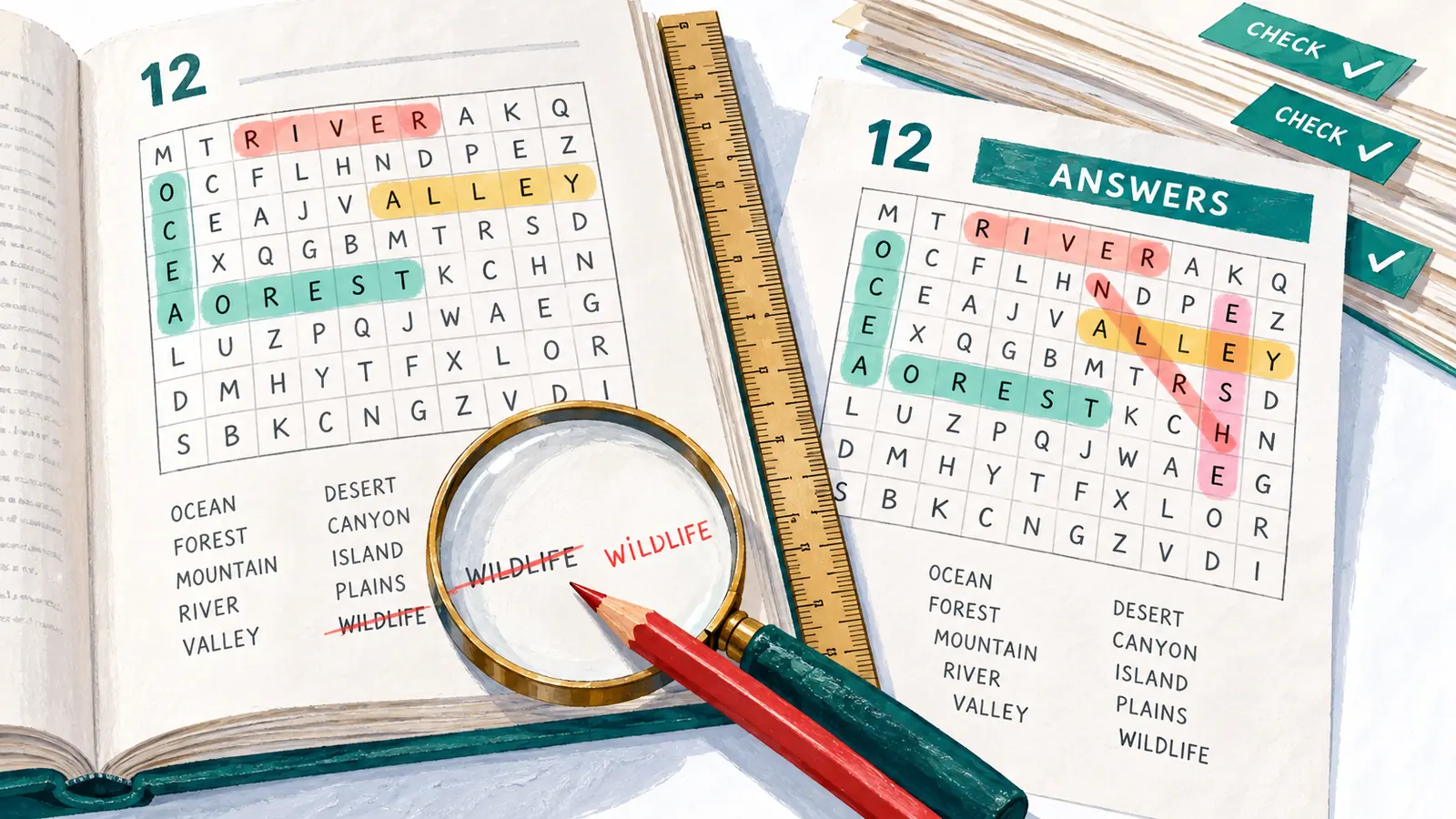
Return to Free Tools for Authors or KDP Tools for the resource directory. Official KDP references checked on 16 October 2026. The header illustration is conceptual, not a tested puzzle or downloadable interior.
Frequently asked questions
Can I generate or download puzzles on this page?
No. This guide explains production checks. You need separate generation, validation and layout software, with usage rights suitable for your project.
Is a generated Sudoku automatically ready to publish?
No. Verify consistent givens, a valid solution and uniqueness for standard Sudoku. Assess difficulty using the intended solving method and review the final exported page.
How do I prevent mismatched answer pages?
Keep stable puzzle IDs through generation, layout and export. Recheck every activity-to-answer mapping after reordering pages or changing numbering.
Are all puzzle books low-content on KDP?
No. KDP generally distinguishes puzzle books from repetitive low-content notebooks, while noting exceptions. Apply the current definition to the actual interior rather than selecting a label by habit.
What needs checking in a printed proof?
Review letter and digit size, line weight, contrast, writing space, gutter comfort, instructions and answer readability. Solving correctness must be validated separately.