

Start with the edit the feedback could change
“Tell me what you think of my book” gives a reader too many jobs. They might comment on the cover, opening chapter, genre, spelling or price. The answers can all be sincere while helping with none of the decisions in front of you. A useful book-feedback brief identifies the material, the question and the next action before inviting anyone.
Write the decision privately first: “Do I need to revise the cover's genre cues before approving the design?” That is an author decision, not the wording to give readers. The reader's first task should describe what they notice, without being told which answer will please you. A preference question can follow, but it cannot replace the observation.
Keep presentation feedback separate from manuscript feedback. A reader can identify a confusing subtitle from a cover image; they cannot judge the pacing of an entire novel from that image. If the real question concerns the opening chapter, supply the chapter and ask about a specific reading experience instead.
A worked brief for a fictional cozy mystery
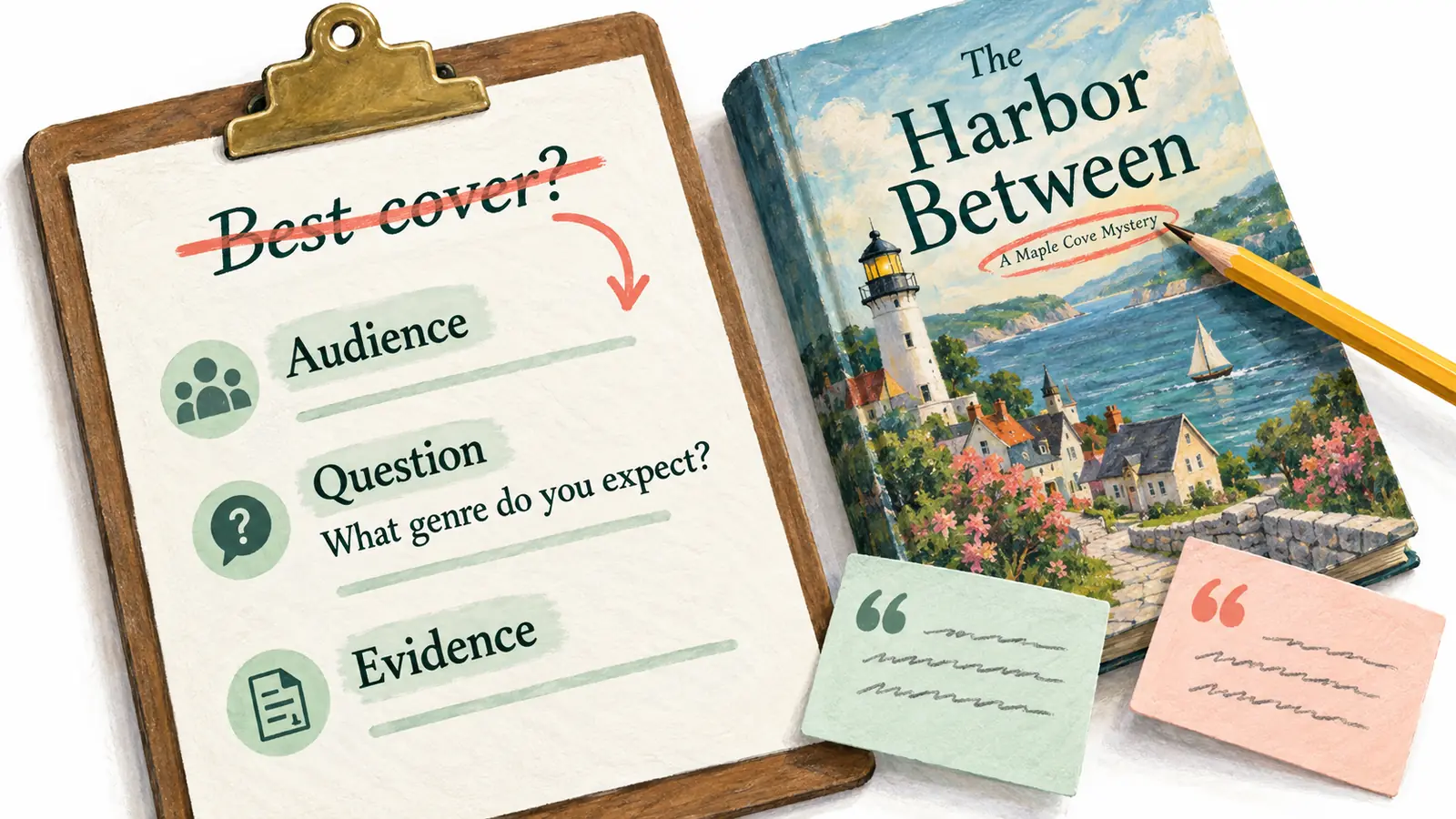
Imagine you are preparing The Harbor Between, a fictional small-town mystery. Two cover drafts are ready. One emphasizes a quiet seaside village; the other emphasizes a dark lighthouse. You want to learn what story each cover appears to promise, not collect praise for the artwork. The example below is a planning document, not a customer case or a platform survey form.
| Field | Author's planning note | Reader-facing instruction |
|---|---|---|
| Decision | Check whether the covers communicate the intended mystery tone. | Do not reveal a preferred cover or the desired genre answer. |
| Audience | Seek people who read English-language mysteries; record how they were recruited. | Ask about reading interests separately from the first visual impression. |
| Material | Save A-v1 and B-v1 with the same title and author name. | Inspect both images at the same presentation size. |
| First question | Identify the story expectation before explaining the premise. | What kind of story would you expect from each cover? Name the visual detail that led you there. |
| Follow-up | Investigate readability as a separate question. | Which words, if any, are difficult to read at this size? |
| Next action | Review repeated tone mismatches and check any reported unreadable text. | No request for a purchase, public review or favorable answer. |
The brief does not tell respondents that the dark version is “too scary”. That would supply the diagnosis you are trying to investigate. Nor does it promise that the preferred version will sell more. For interpreting the eventual counts, use the cover-poll results example.
Replace questions that contain their own answer
AAPOR's questionnaire guidance recommends specific, understandable questions that address one concept and avoid pushing respondents toward an answer. Apply that principle to your brief; an informal voluntary feedback group is still not a representative sample of book buyers.
| Weak question | Better question | Why it helps |
|---|---|---|
| Isn't this cover more professional? | What detail most affected your impression of this cover? | Does not hand the reader a favorable comparison. |
| Is the title clear and exciting? | What do you think this title suggests the book is about? | Tests interpretation without combining two judgments. |
| Would everyone love this opening? | Where, if anywhere, did you become unsure what was happening? | Asks about a passage the reader actually encountered. |
| Which cover will sell the most? | Which cover would you inspect first, and what drew your attention? | Collects a stated preference, not an unsupported sales forecast. |
Ask one main question per comparison. If you need a second diagnostic question, keep it visibly separate. Allow “neither”, uncertainty or a specific limitation where your chosen method supports them. If a tool requires a winner, do not reinterpret that forced choice as evidence that the respondent liked either option.
Freeze the material before the first response
Save the exact images or text versions you send. Use consistent dimensions, crop, title treatment and reading instructions where those are not the variables under examination. If both artwork and title change, describe the exercise as a package comparison; it does not isolate the effect of the artwork alone.
For a first-impression task, show the material before explaining your intention. Later, you can reveal the actual premise and ask where the promise matches or conflicts. Keep those stages separate in your notes. A person who has already read the synopsis cannot give a fresh cover-only reaction in the same session.
Test the brief with one person before distributing it. Ask them to explain the task back to you. If they think you want proofreading while you want a genre impression, fix the instruction. Do not quietly edit a live comparison halfway through; save the revision and keep its responses distinguishable.
Use the platform for the task it actually records
Virtalibry's poll workflow supports cover, title, description and mixed comparisons. Participants choose a winner and provide option ratings and comments. A focused question can guide those comments, but these outputs are not a general-purpose multi-stage research interview or an Amazon purchase report. Check the current poll form before planning a question sequence it may not support.
The worked brief can also guide a separate conversation with a reader. Do not imply that Virtalibry automatically screens a statistically representative audience, randomizes your study or evaluates a whole manuscript. See How It Works for the service workflow and its boundaries.
Translate a comment into an observable check
Retain the reader's actual wording, the version they saw and the relevant question. Separate an observation such as “I cannot read the subtitle” from a suggestion such as “make everything yellow”. The first can be checked at the displayed size; the second is one proposed repair, not a requirement.
Group comments by issue, not by whether they flatter the book. Several independent readability observations justify inspecting the subtitle. Several different genre expectations justify checking the visual promise against the manuscript. A single preference may be worth noting without justifying a redesign. Record disagreement rather than removing it to make the conclusion tidy.
Write a bounded decision: “We will increase subtitle contrast and inspect the revised thumbnail. We are not claiming a sales improvement.” If the issue is a promise in the description, use the claim-by-claim description audit before asking readers to judge a misleading draft.
The brief is ready when these checks pass
- One concrete author decision is written down.
- The reader question does not reveal the desired answer.
- Each task asks about material the person will actually see or read.
- Versions, presentation size and recruitment context are recorded.
- Preference, option ratings and comments will remain separate.
- Uncertainty and criticism will be retained, with no public-review obligation.
- A follow-up action and a stopping point are defined.
Keep the resulting decision in your marketing task board. If you later test a promotion, use the promotion measurement worksheet to distinguish feedback from observed traffic and attributed orders. Return to the blog for the editorial collection. Source checked on 16 October 2026; all book examples are fictional.