

Verified Purchase Amazon Book Reviews: Evidence, Not Approval
Verified Purchase describes a purchase check. It does not certify an opinion or guarantee that a customer can publish a review.
Separate acquisition, eligibility, submission and display. Check the actual symptom without inventing reading quotas or collecting private account data.
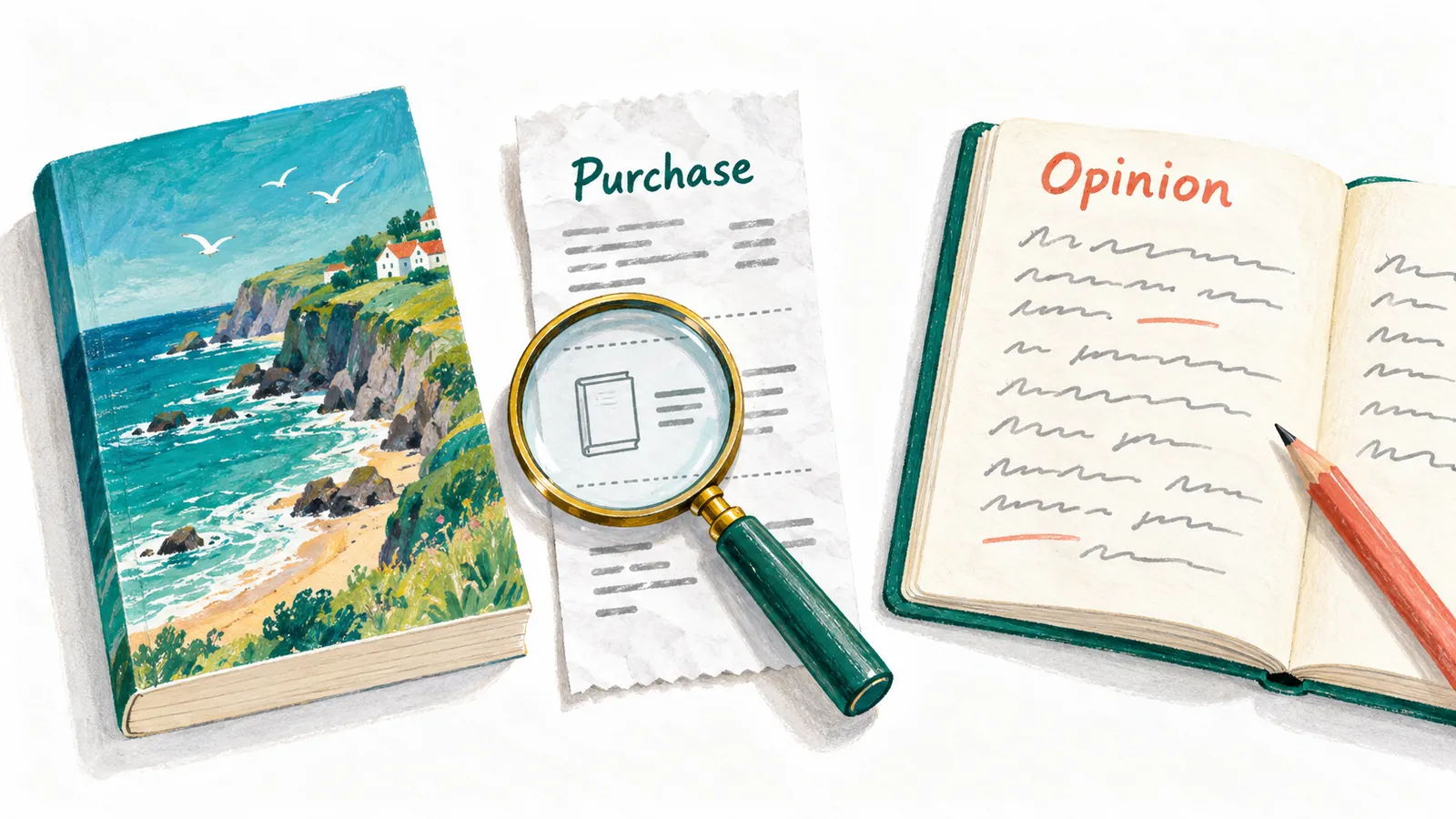
Verified Purchase describes a purchase check, not an approval certificate
Amazon's public review explanation says it checks whether the item was bought on Amazon at a price available to most shoppers before assigning Verified Purchase. The label is therefore about a transaction connection. It is not a certification of literary judgment, a required positive opinion or permission to ignore review rules.
Read the badge as one piece of context, not a complete biography of the reviewer. Without it, you cannot conclude that someone never read the book. With it, you cannot conclude that every condition surrounding the review was appropriate. Neither inference follows from the visible label alone.
Keep the question narrow
If your concern is "I bought this book but cannot submit a review," that is a submission restriction question. If it is "my published review has no badge," that is a label question. If the contribution vanished, it is a display-change question. Use different records and support wording for these symptoms.
Separate acquisition, eligibility, submission and display
A reader's legitimate access to a book does not tell you the outcome of every later step. Treat these as separate questions so that a receipt is not used to demand a guaranteed public result. The table below is an original classification aid, not a list of every account rule.
| Question | Relevant evidence | Do not infer |
|---|---|---|
| How was the book obtained? | Purchase, loan or copy-delivery record | A guaranteed badge or publication |
| Can this customer submit? | Current account-facing requirements and messages | Eligibility from the author's dashboard |
| Was something submitted? | The customer's actual submission result | Public acceptance from intent alone |
| What is displayed? | Specific review, store, format and observed label | A private decision reason from the label alone |
Eligibility is not one worldwide receipt threshold
Amazon's public explanation notes that customer purchase requirements vary by region. Check the applicable current account-facing guidance rather than copying one country's number into instructions for everyone. Buying the particular book does not answer every eligibility or content question.
Different access routes create different evidence
A retail order, a library loan, a gifted copy and an author-supplied file are not the same transaction. Record the route accurately rather than describing every reader as a verified buyer. Do not ask someone to make an unnecessary purchase simply to change how you can advertise the contribution.
For a library or outside-store copy, the reader may have genuine first-hand experience without a matching Amazon purchase. That is a reason to avoid treating absence of the label as proof of dishonesty. It does not grant every reader automatic eligibility to post on every destination.
Describe your campaign honestly
If you supplied reading copies, say so when describing that activity. Do not market the resulting group as guaranteed Verified Purchase reviews. If you commission a private report, do not relabel its author as a customer buyer. Use the deliverables comparison to keep public opinions, editorial coverage and private feedback distinct.
Do not turn Kindle Unlimited reading into a badge formula
The official public sources inspected for this guide do not establish a reading-percentage rule for earning Verified Purchase through Kindle Unlimited. Do not tell readers to open a particular number of pages, finish a specified percentage or wait a prescribed number of days to obtain the label. Those instructions would present an unverified mechanism as fact.
Likewise, do not claim that an ordinary purchased Kindle book loses its badge because the customer has not read enough pages. A purchase check and reading activity are not interchangeable evidence. If a particular customer sees a result they do not understand, retain the exact product and message instead of inventing a universal explanation.
Borrowing and buying should not be merged in reporting
Describe Kindle Unlimited access as borrowing or subscription access when that is what happened. Keep any subsequent retail purchase as a separate event. Do not claim a guaranteed badge outcome for either from this article. The point is accurate reporting, not a technique for converting one route into another.
Check a missing badge without collecting private account data
Begin with the individual review and correct edition. Record the marketplace, format and observed label. Compare that with what the customer says they acquired. An author usually cannot see the customer's full transaction context and should not present a private assumption as a diagnosis.
A bounded record is enough
Keep a product identifier, retained review link, date of observation and a short description of the question. If the customer contacts support, they can provide relevant order information through the official channel. Do not collect passwords, session cookies, full payment details or unrelated order histories in a review campaign.
If the problem is actually that the contribution is not yet visible, follow the timeline guide. If it was previously observed and is now absent, follow the missing-review workflow. Switching to the right case avoids spending time on a badge that is not the actual issue.
Classify examples without making undocumented promises
These fictional situations show the limits of visible evidence. They are not determinations about a real account. Even when a transaction seems straightforward, only the relevant platform can clarify its particular label or restriction.
| Fictional situation | Supported observation | Unsupported conclusion |
|---|---|---|
| Reader used a library copy | Reading access without this recorded Amazon order | The reader is fake or never read |
| Customer has an order and sees a restriction | A transaction and a separate submission problem | The receipt guarantees permission to post |
| Review displays Verified Purchase | The displayed label is present | The opinion is accurate or permanently protected |
| KU reader asks about page percentage | A question about subscription access | A verified reading quota establishes the badge |
Write the unresolved question explicitly
Fictional case note: "The review is visible for the retained edition and store, but no purchase label is displayed. The customer reports buying the book. The reason for the label outcome is unknown; any account-specific clarification belongs with the customer and official support."
This wording records a mismatch without accusing someone or promising a repair. Keep the customer's account question separate from a publisher's retail metadata issue, even when the two conversations happen during the same launch.
The same visible label can require different case notes
Fictional comparison: one reader used a library copy; another reports a retail purchase. Both contributions are visible without the purchase label. The first record describes the reported loan, while the second retains an unresolved purchase-label question. The identical display does not justify calling either person dishonest or assigning the same private cause.
The author can retain the product identifier, review link, marketplace and observation date. The customer keeps order-specific evidence for official support rather than uploading unrelated transactions to a campaign dashboard. Record whether the question was clarified or remains unknown. If the contribution itself later becomes unavailable, move to the display-change guide instead of continuing to investigate a badge that can no longer be observed.
Do not engineer a purchase trail to obtain the badge
Do not reimburse a book purchase, require a rating and call the result independent because a receipt exists. Do not ask readers to switch accounts, manipulate returns or fabricate an acquisition record. A badge is not a cure for a review-linked benefit or a required favorable opinion.
For the actual incentive boundary, read the review rules guide. For an existing process that links benefits to public posting, use the workflow replacement checklist. Audit the arrangement itself instead of optimizing its appearance.
Do not make reader support conditional on a label
If your offer was a usable reading copy, support that offer. Do not withdraw assistance because a public contribution lacks the badge you expected. Nor should a reviewer have to expose their purchasing account to prove that their experience was sincere. Keep any optional public response separate from the work you actually promised to provide.
Focus author effort on the book and accurate communication
Check that the edition identifiers, links and sample in your own materials are correct. Make it easy to identify the intended format without implying that a particular acquisition route guarantees a review outcome. These are publishing tasks you can verify directly.
If your broader problem is a small review count, use the reader-path diagnostic guide. That question needs evidence about relevant exposure and access, not an attempt to force a badge onto every contribution. Judge each observable issue separately.
End the case with an honest status: label observed, customer seeking clarification, issue reclassified or outcome unknown. Do not promise that support will apply a badge or that an unchanged review count proves the label request failed. A precise limitation is more useful than a confident invented explanation.
Use the Amazon book review guides to find the next step for reader recruitment, review rules or visibility problems.
Sources and scope
Amazon's public review explanation and KDP's review reference were checked on 16 October 2026. KDP's linked Community Guidelines and detailed ratings page returned 503 errors, so no claim is made to have inspected their complete current text. The tables and case note are original aids. No private order, KU reading rule, badge assignment or individual moderation outcome was verified.
Frequently asked questions
What does Verified Purchase mean on an Amazon book review?
Amazon's public explanation ties it to a checked Amazon purchase at a price available to most shoppers. It is not an opinion-quality certificate.
Does buying the book guarantee permission to leave a review?
No. Acquisition, account eligibility, content rules and public display are separate questions.
Does an unverified review prove the person never read the book?
No. Access may come from another store, a loan or a reading copy. The missing label alone does not establish dishonesty.
Does reading a certain percentage in Kindle Unlimited guarantee the badge?
The official sources inspected do not establish such a rule. Do not present a reading quota or waiting period as a verified mechanism.
Can an author force Amazon to add Verified Purchase?
No outcome is promised here. Keep the observed label separate from the customer's account-specific support question.
Should I reimburse purchases to produce verified customer reviews?
Do not engineer a purchase trail or review-linked benefit. A transaction label does not resolve the conditions surrounding the contribution.