

A Safer Alternative to Paid Book Reviews: Replace the Workflow
A new label does not fix a workflow that still rewards or requires public customer reviews.
Map the whole process, remove hidden posting conditions and test participant choice before restarting. No process guarantees review acceptance.
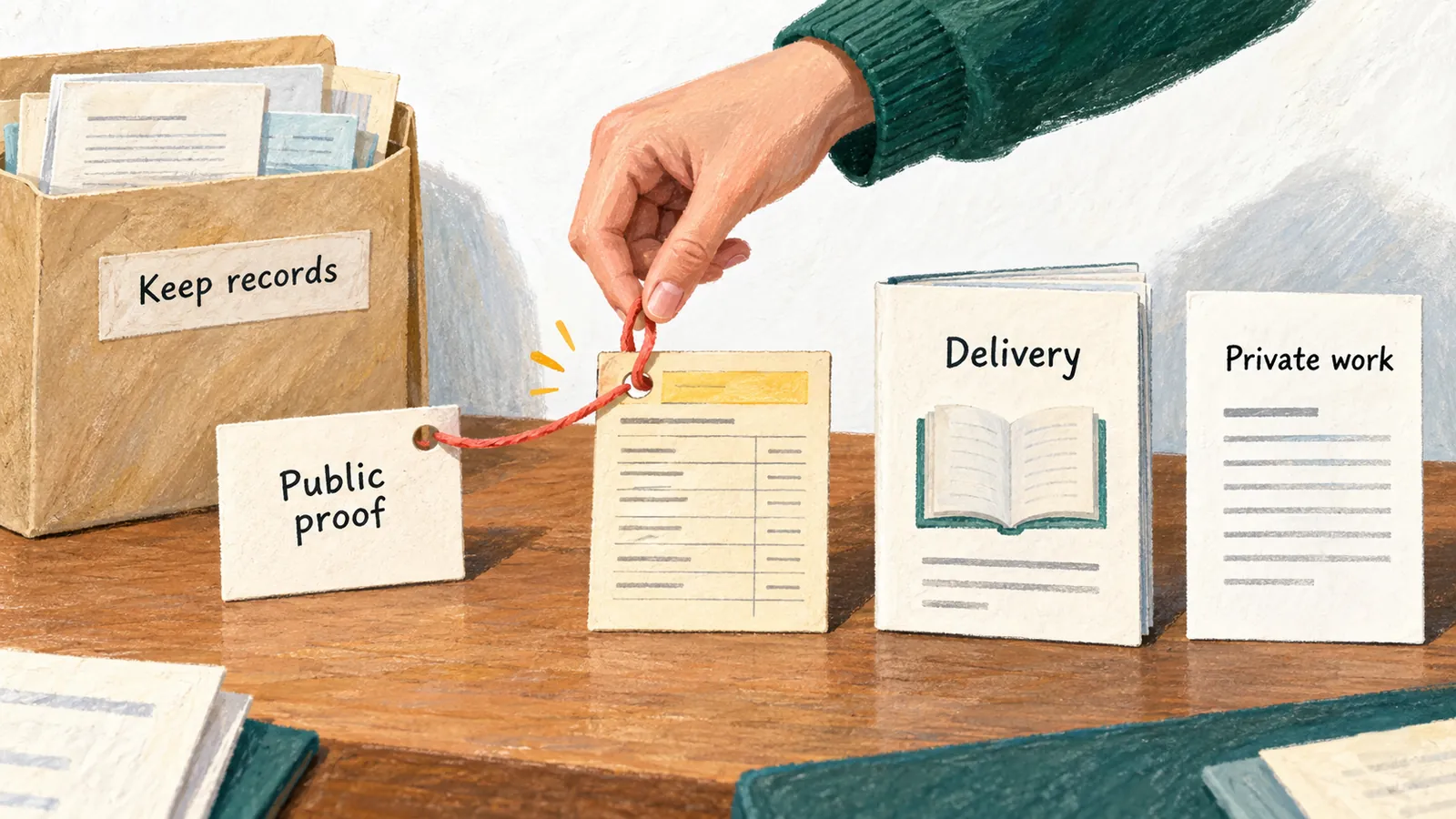
A safer alternative to paid book reviews starts with the workflow
If your current process treats an Amazon customer review as a purchased or rewarded completion event, changing the wording is not enough. Replace that dependency with a genuinely different task: optional reading access, separately scoped private feedback or defined promotion. This guide is an implementation checklist for organizers, not a promise that any future contribution will be accepted.
The target is specific: a participant can receive the offered reading copy and choose not to publish a public review without losing a benefit for that choice. Separately contracted private work must have its own scope and acceptance conditions. Do not use it as a delayed route to obtaining the same public contribution.
Choose the replacement before restarting
Use the alternatives comparison to identify the actual author need. For the policy boundary, consult KDP's review-copy guidance and Amazon's review explanation. Neither source certifies your implementation. Read the rules guide before choosing participant conditions.
Map every place where the old obligation appears
Pause new public-review commitments while documenting the current process. Follow one participant from the first invitation to the final account state. Include the public offer, signup form, terms, dashboard, support scripts, scheduled messages, completion checks, benefit ledger and cancellation handling. A requirement often survives in an automation after the visible page has changed.
| Surface | Condition to inspect | Replacement evidence |
|---|---|---|
| Invitation and terms | Promised review count, rating, deadline or reciprocal task | Versioned scope describes the real activity |
| Completion screen | Review URL or screenshot required to finish | Optional reading has no public-proof gate |
| Benefits and access | Points, refunds or future eligibility depend on posting | No review-contingent grant, clawback or access rule remains |
| Timers and support | Reminders or agents enforce the old obligation | Jobs and scripts match the new scope |
Give each finding an owner
For every dependency, record its location, responsible person, proposed change and verification step. Do not mark the whole migration complete because a headline was edited. Keep unresolved items visible and distinguish an agreed design from code or operations that have actually changed.
Create distinct paths for reading and private feedback
Optional reading needs a usable copy, access support and a contact-preference path. Its completion state should describe delivery, not publication. Private feedback needs agreed questions, manuscript version, output format and any deadline or compensation for that private work. Keep the two records distinct even if the same organizer administers them.
Do not quietly move the deliverable
A private report must not later become a required public post. If promotional reuse is proposed, resolve permissions and applicable requirements separately before any reuse. A participant declining that new proposal should not retroactively fail the original task. Likewise, an optional reader should not receive surprise editing assignments to justify an existing reward.
For a small optional-copy pilot, use the no-paid-budget plan. For a larger release, use the ARC workflow. The size of the group does not change the need to keep its actual conditions consistent.
Remove the obligation from benefits, not just from the form
Inspect every advantage a participant can gain or lose: points, tokens, priority, discounts, refunds, access and eligibility for later work. If any of them depends on a public-review URL, star rating or screenshot, the workflow still contains a review-linked condition. Renaming points as appreciation does not remove that dependency.
Trace early credits through cancellation
An early credit that is taken back when no review appears remains conditional. Test expiration, rejection, self-cancellation, staff cancellation and scheduled reconciliation. Removing the initial reward event while leaving a negative adjustment job active can also harm participants and make the new offer untrue.
Do not resolve historical balances casually. Preserve the original ledger, identify the relevant terms and have the responsible team decide how existing commitments should be handled. Record any authorized correction transparently. This guide does not change account balances or settle contractual rights; it identifies questions the migration must resolve.
For a deeper incentive audit, see the review-incentive guide. There is no hidden safe amount or posting delay supplied by this checklist.
Tell participants exactly what changed
Prepare separate messages for new participants and people already in the old workflow. New participants need the current scope. Existing participants need an accurate explanation of their own status, remaining actions and who can answer account-specific questions. Do not send a generic statement that claims every previous obligation has been resolved if that work is unfinished.
A fictional transition message
Fictional example: "We are ending public-review completion tasks. The new reading-copy offer does not require a public review. Your existing account record is being checked separately; contact support if its displayed status does not match the individual update we send you. We are not asking you to publish, edit or remove a review."
Use that structure only when it describes real actions. It is not a ready-made promise about balances. Stop incompatible automated reminders before sending the announcement, and give support staff the same versioned scope so their replies do not reintroduce the old requirement.
Test refusal, criticism and unavailable destinations
Use test accounts and fictional data in a non-production environment. Cover both normal completion and the paths most likely to expose hidden conditions. Check the screen, stored status, scheduled jobs, notification queue and benefit ledger after each case. A correct visual message does not prove that the later timeout job behaves correctly.
| Test case | Expected new behavior | Evidence to inspect |
|---|---|---|
| Reader declines public posting | No public-proof demand or review-linked penalty | Completion state, ledger and queued reminders |
| Reader reports an access problem | Delivery support without a posting obligation | Support reply and revised delivery record |
| Reader gives unfavorable private feedback | No forced edit, praise requirement or retaliation | Private-task acceptance and subsequent communications |
| Public destination is unavailable | No replacement review or alternate-account demand | Timeout handling and participant status |
| Reader stops contact | Optional outreach stops across active campaigns | Preferences, queues and support follow-up |
Inspect sentiment gating separately
Do not route dissatisfied readers only to private feedback while inviting satisfied readers to publish endorsements. Review the branching conditions themselves, not just the final text. A workflow should not require a favorable opinion to access the public invitation or to be treated fairly by the organizer.
Preserve the record without exposing participant data
Retain old terms, notices, invoices, relevant messages and authorized ledger changes in an access-controlled record. Document the date and reason for the migration. Do not coordinate deletion or editing of public contributions to make the previous arrangement disappear, and do not instruct participants to conceal their involvement.
Collect only the information needed for the actual new task. Avoid asking for Amazon passwords, session cookies or account access. KDP's account-security guidance explains how to recognize official channels and protect credentials. A service administrator does not need control of a reader's shopping account to deliver a book file.
Separate operational records from public examples
Use fictional names and redacted screenshots in training or marketing materials. Restrict historical financial and contact records to people who need them. Set a documented retention policy that accounts for applicable obligations; preserving evidence is not permission to expose personal information indefinitely.
Release only after the actual dependencies are removed
Require sign-off from the person responsible for participant terms, the technical owner and the support owner. Run a small controlled pilot and compare observed behavior with the acceptance cases. If a hidden penalty or incompatible reminder remains, pause new enrollment until it is fixed.
Keep a release receipt for old jobs and new terms
Fictional migration: offer version 2 removes public-review completion, but a reminder queued under version 1 still asks for a review link. The new page is accurate while the participant's next email is not. Record the affected cohort and job, pause the incompatible message and verify the corrected path before describing the migration as complete.
- Record the effective offer version, affected participants and technical and support owners.
- Inspect already queued messages and later scheduled reconciliation, not only jobs created after release.
- Replay a completed test case and confirm it creates no duplicate benefit adjustment or renewed public-proof demand.
- Retain evidence of authorized changes; preserve useful delivery support rather than deleting every queue item indiscriminately.
This is an implementation example, not a report that any live service was changed. Historical rights and balances still require their own authorized handling. Use the timing guide for internal observation dates; they must not quietly become replacement deadlines for public posting.
Monitor access failures, opt-out handling, unexpected benefit changes and complaints about obligations. These are process-health measures. A rise in visible reviews is not proof of compliance, and a lack of reviews is not evidence that participants have failed an optional activity.
Keep a dated change log and an owner for future policy checks. If an actual Amazon notice arrives, preserve it and use the review investigation guide or the risk guide map for the relevant response task. A better workflow does not retroactively erase earlier conduct or guarantee future moderation outcomes.
Use the Amazon book review guides to find the next step for reader recruitment, review rules or visibility problems.
Sources and scope
Official KDP and Amazon references checked on 16 October 2026. Direct Community Guidelines retrieval returned a 503 error; the complete current body was not read. The inventory, acceptance cases and fictional message are original implementation aids, not an audit of any specific service or legal advice. This article changes no product behavior, account record or historical balance and offers no compliance guarantee.
Frequently asked questions
Is changing a required review to an optional review enough?
Only if the actual process changes too. Inspect forms, reminders, completion checks, benefits and support handling for remaining posting conditions.
What if points are granted early and removed when no review appears?
The benefit remains conditional. Trace the full lifecycle, including expiration and cancellation, rather than inspecting only the initial grant.
Can private feedback be a separate paid task?
Define its own scope, output and acceptance criteria. Do not later turn it into an obligation to publish a customer review.
Should historical messages and ledgers be deleted during the change?
No. Preserve relevant evidence with controlled access and handle authorized corrections transparently. Set retention requirements deliberately.
What should an optional workflow test include?
Test refusal, access problems, unfavorable private feedback, unavailable destinations and stopping contact. Inspect statuses, queues and benefit records.
Does this workflow guarantee that Amazon will accept reviews?
No. It is an implementation aid, not platform approval, legal advice or a guarantee about moderation outcomes.