

Paid Book Review Service Alternatives: Choose the Right Output
Choose an alternative by the problem you need to solve, not by a promise of more social proof.
Compare manuscript feedback, optional reader access, promotion and editorial coverage with clear deliverables and resource limits.
Paid book review service alternatives: buy or organize a useful output
The best alternative depends on what you wanted the review package to accomplish. A manuscript problem needs diagnosis. A finished book may need relevant readers. A weak launch destination needs clearer positioning. Paying someone to deliver public customer reviews does not resolve all three, and renaming that output an author service does not change it.
Start by writing the missing result in plain language: readers misunderstand the opening, the intended audience has not seen the book, or the release needs a concrete communication plan. Avoid a brief that says only "more social proof." That phrase hides both the business problem and the conditions placed on contributors.
Compare methods, not unverified providers
This guide compares work categories. It does not rank companies, quote live prices or certify a service. Before purchasing a specific offer, use the paid-service procurement audit. Amazon's review explanation rejects monetary rewards and reciprocal positive reviews; a different invoice label is not an exemption.
Match the method to the decision you need to make
Choose an output you can inspect without requiring an independent shopper to publish a particular contribution. The comparison below is an original planning framework. None of these categories automatically complies with every destination's requirements; inspect the actual arrangement, especially when private work is later repurposed publicly.
| Author task | Potential method and output | What it does not promise |
|---|---|---|
| Find manuscript weaknesses | Private beta reading or editorial assessment: a scoped report | Public customer reviews or automatic sales improvement |
| Help suitable readers access a finished book | Optional ARC distribution: working copies and delivery support | A required public response or publication date |
| Reach an interested audience | Permissioned newsletter or relevant promotion: a defined communication | Guaranteed purchases or customer-review volume |
| Seek a professional perspective | Independent editorial coverage: an assessment under stated terms | Permission to present it as an ordinary shopper review |
| Clarify the offer | Reader-fit research: specific comprehension observations | A statistically representative market forecast |
Use private feedback when the book needs revision
Define the reading question before choosing a volunteer or professional. For a novel, you might need to know where a character's motivation becomes unclear. For a practical guide, ask whether a reader can complete a specific task using the instructions. "Tell me if you like it" produces less actionable material than a bounded question.
Specify the report, not the praise
A useful brief states manuscript version, approximate length, relevant reader experience, requested observations and deadline for the private report. Ask for examples tied to chapters or passages. Do not request a predetermined verdict. Decide whether the work covers structure, factual checking or proofreading; these are not interchangeable services.
Keep paid private critique private unless a separate, properly scoped arrangement permits a public use. A report's existence does not authorize publishing its author as an Amazon customer reviewer. Likewise, permission to quote one sentence does not mean you may turn the entire report into promotional copy. Resolve scope and rights before reuse.
Use optional reader access when the finished book needs readers
An advance-copy project is primarily a delivery and communication project. Choose readers by subject fit, format compatibility and willingness to receive the book, not by willingness to supply a high rating. For a detailed organizer workflow, follow the ARC team guide.
KDP's review-copy guidance distinguishes an unconditional book copy from an incentivized review. Make that distinction real in the participant experience. Separate any optional public response from delivery support, completion rules and access to future communications.
When you do not have a paid budget
Start with existing, appropriate channels and a small workload. The no-paid-budget reader plan supplies a four-week schedule and measurement definitions. Do not replace a monetary budget with an obligation to review other authors: that changes the arrangement rather than eliminating the relevant condition.
Keep promotion and editorial coverage distinct
Promotion pays for an agreed exposure opportunity, such as a newsletter placement or advertising distribution. Define the destination, audience, placement date and evidence that the placement ran. Sales remain a separate outcome. If a service bundles customer-review promises into promotion, evaluate those terms separately instead of accepting the bundle as one harmless category.
Editorial coverage has its own contract
A professional review or editorial assessment can involve a publication's selection process, fee and reuse terms. Inspect what the fee purchases, who controls the opinion, where it will appear and whether inclusion is guaranteed. Do not assume editorial coverage is equivalent to a customer review, or that every paid editorial service is prohibited.
Check the intended destination's requirements and applicable disclosure obligations before commissioning or reusing coverage. This guide does not resolve those legal questions. For channel-specific promotion planning, start with the promotion-platform comparison; verify current offer details again before making a booking.
Compare total resources rather than the sticker price
A volunteer group may require more coordination than a narrowly scoped professional report. A newsletter placement may require a ready cover, a working destination and a qualifying price. Record these prerequisites, because a cheap booking that cannot run is not a useful bargain.
| Method | Resources to estimate | Inspectable completion |
|---|---|---|
| Private reading report | Fee or volunteer coordination, manuscript preparation, revision time | Report addresses the agreed questions and version |
| Optional reading copies | Files, delivery support, permitted recruitment, possible postage | Requested copies work and contact preferences are respected |
| Newsletter promotion | Placement cost, creative assets, destination readiness | Agreed placement ran; outcomes reported separately |
| Editorial coverage | Submission preparation, stated fee, timing and reuse permissions | Contracted assessment or placement, without a fabricated verdict |
Put uncertainty into the decision
Record cancellation conditions, dependencies and the maximum loss you can accept. Include your own hours. Do not invent a cost per review by dividing a service fee by a provider's promised number. That metric rewards the wrong deliverable and treats an uncertain public decision as inventory.
Write a brief that makes the boundary testable
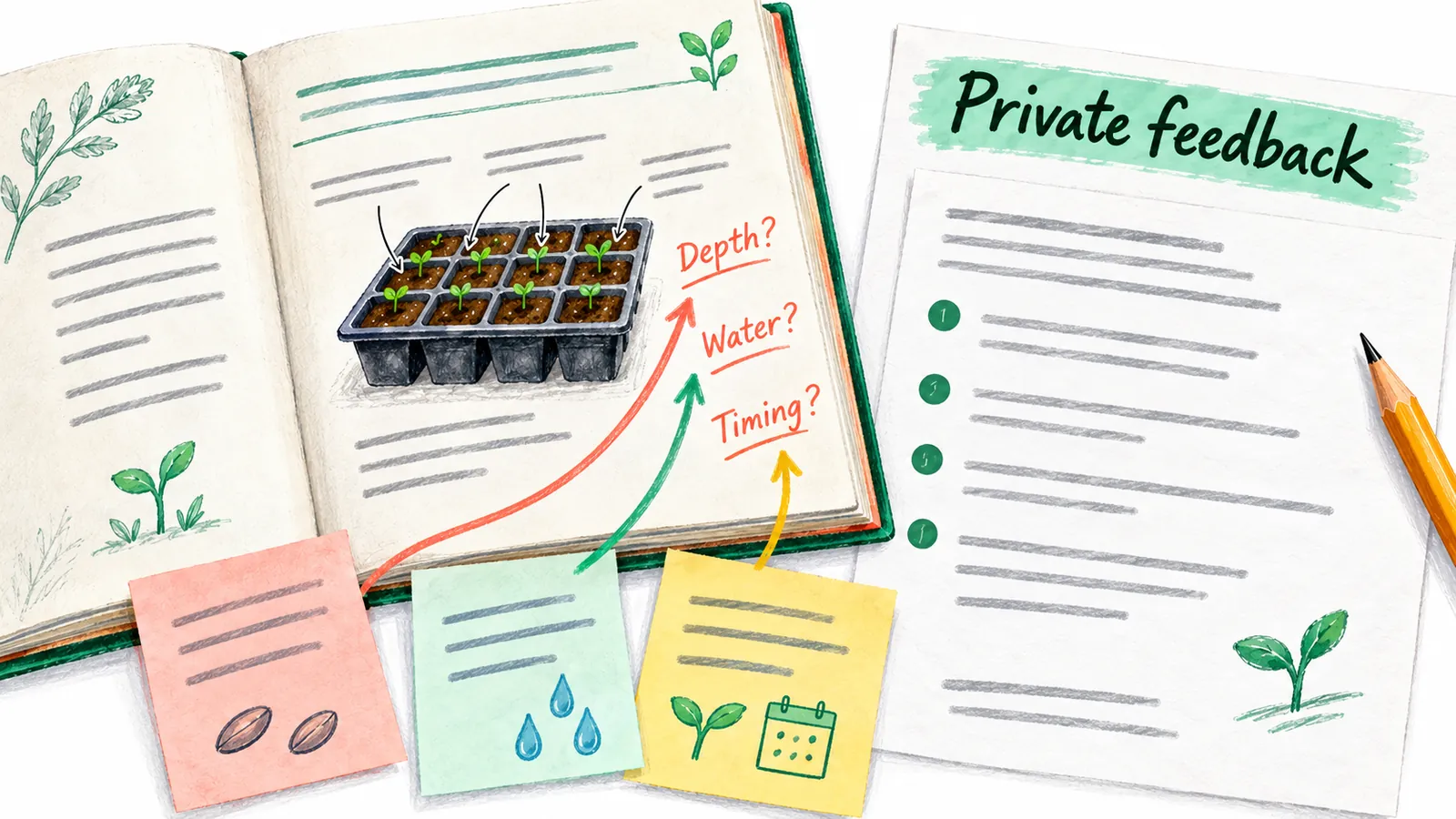
A fictional author of a gardening guide has received repeated questions about one planting diagram. Their next project is not a public-review campaign. They ask three suitable readers to attempt the explanation and describe where it becomes ambiguous. The output is a private comprehension note, not a customer endorsement.
Fictional brief: "Read the seed-starting chapter in version B and identify instructions you could not follow. Return a private note with page references by the agreed date. This project does not include publishing customer reviews or granting promotional quotation rights."
Define acceptance before beginning
For this example, acceptance means the report addresses the chapter and gives concrete observations. It does not depend on favorable findings. Record the terms with the manuscript version so that a later team member does not silently convert the work into public-review delivery. Agree on revisions to the brief before expanding the project.
Turn the notes into a bounded revision decision
Continue the fictional gardening project: two of the three readers cannot identify the planting depth, while the third asks how often to water. Retain their page references, revise the diagram and distinguish that revision from a general verdict about the whole book. Ask a different suitable reader to use the revised explanation without coaching, then record which instructions still need clarification.
This small, purposefully selected exercise can identify a specific usability problem; it cannot establish market demand or a representative approval rate. Its completion evidence is the requested notes and revision record, not published praise. If you instead select optional-copy distribution, keep your delivery milestones separate from the uncertain timeline of any public review. Choose the next task from the evidence, not from a need to show a rising review count.
Choose one method and review what actually happened
Pick the method that addresses the nearest bottleneck. A book with an unusable sample needs repair before more promotion. A finished, well-positioned book with little exposure may benefit from a relevant introduction. An author with an inherited review-credit workflow needs a process change, not merely a new recruitment channel.
Use the replacement workflow guide for that last case. It examines invitation, participant benefits, completion rules and reminders together. Removing an obligation from one sentence while retaining it in a dashboard is not a different method.
After completion, compare the actual output with the brief. Note what decision it enabled, what it cost and what remains unknown. Keep the result separate from subsequent sales or review changes unless you have evidence connecting them. Build the next project around that decision rather than repeatedly purchasing a vague promise of credibility.
Use the Amazon book review guides to find the next step for reader recruitment, review rules or visibility problems.
Sources and scope
Official Amazon and KDP references linked above were checked on 16 October 2026. Direct Community Guidelines retrieval returned a 503 error; the complete current body was not read. The method and resource tables, fictional brief and selection process are original decision aids. No vendor was tested or endorsed, no live price comparison was performed, and this guide does not certify legal or platform compliance.
Frequently asked questions
What is the best alternative to a paid book review package?
It depends on the task. Manuscript diagnosis, reader access and promotion need different outputs; choose the method that addresses the nearest bottleneck.
Is private beta feedback the same as an Amazon customer review?
No. A private reading report has a separate scope and destination. Do not silently convert it into a public endorsement requirement.
Are all paid editorial services prohibited?
No blanket conclusion follows from the word paid. Inspect the actual deliverable, destination, terms, reuse permissions and applicable requirements.
Does a paid promotion placement guarantee customer reviews?
No. Define the placement and verify it ran. Treat sales and public contributions as separate, uncertain outcomes.
Does this guide rank or endorse review companies?
No. It compares methods rather than providers. No vendor test, current pricing survey or compliance certification is included.
What should I put in a private feedback brief?
State the manuscript version, questions, report format, timing and acceptance criteria. Favorable findings should not be a condition of acceptance.